
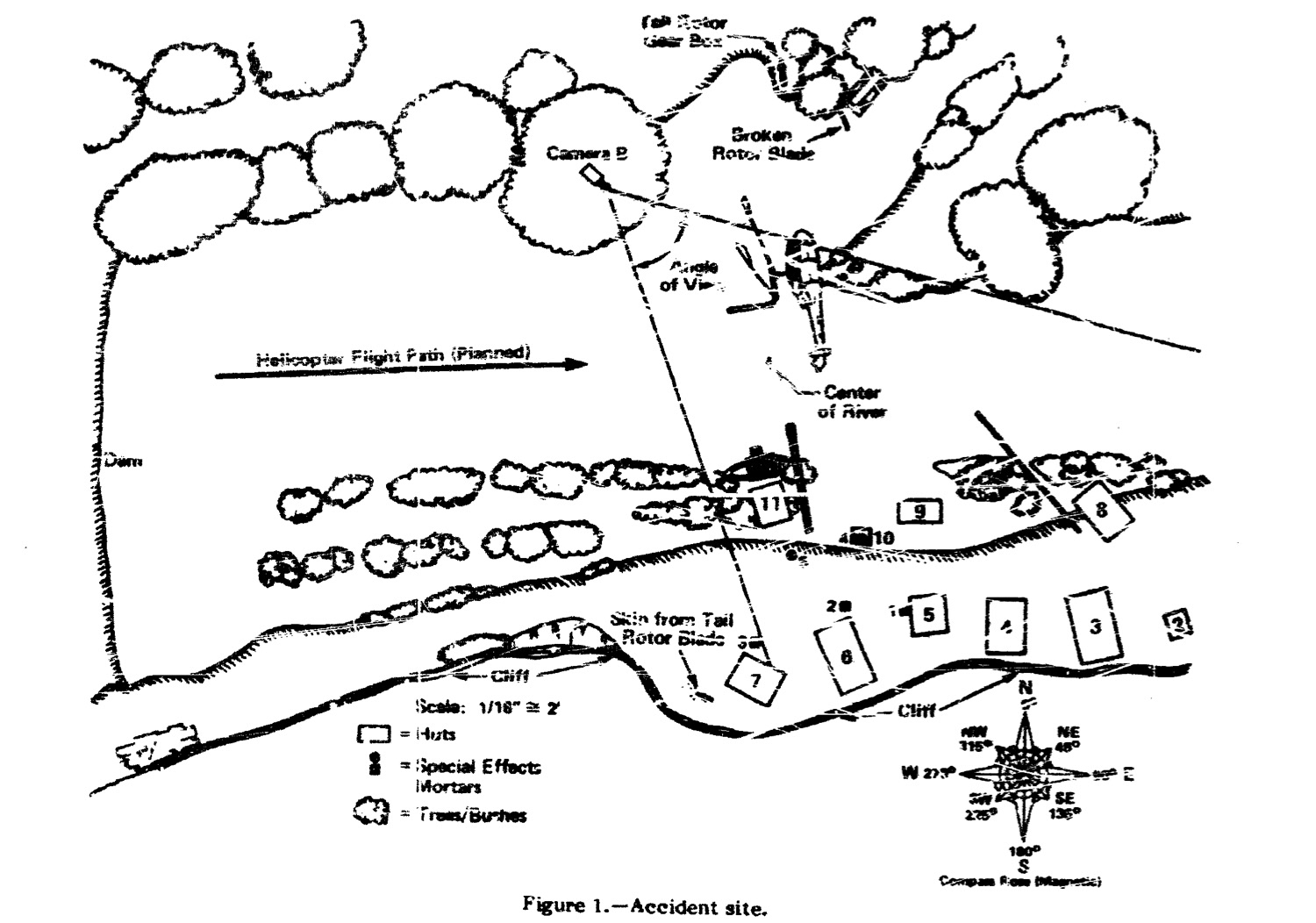
Index
| # | Title | Description |
|---|---|---|
| 01 | Hired illegally (June 13th – July 23rd, 1982) | Illegal hiring and accident. |
| 02 | Extreme negligence (June 11th – July 23rd, 1982) | Warnings to Landis et al. in the lead-up to the accident. |
| 03 | Five corporations and nine individuals (August 2nd, 1982) | Fourteen parties named in the Chen family lawsuit. |
| 04 | Serious threats of blacklisting (1982–1987) | Record of complaints. |
| 05 | A grand jury hearing, a preliminary hearing, and an appeal gone awry (May 1983–November 1984) | Pretrial happenings, especially concerning Counts 2 and 4 (the “office” counts). |
| 06 | Missing evidence (1982–1986) | Missing evidence: one of two audio recordings; the photographer’s negatives; the Executive Producer’s documentary; the fourth draft of the script; most graphical materials, including several “thumbnail sketches.” |
| 07 | “The spotting plan” | The sole graphical material turned over to the NTSB. |
| 08 | Twilight Zone crew list | Key players. |
| 09 | YNELITTA (1991) index locorum | Relevant passages, and commentary. |
| 10 | DISC Management Services Group, Inc. | Significance of Twilight Zone Productions’ payroll entity. |
| 11 | The stumble | Significance of Landis’s claimed last-minute tweak to the script. |
| 12 | Beer and liquor runs for the SFX team | Catalogue of drug and alcohol use reported on set. |
| 13 | No longer eligible for prosecution (1982–1987) | Record of law enforcement’s attempts to contact Marshall, including domestic (1983) and international (1986) subpoenas. |
| 14 | A short scene still to come | Scene 32/33 transition—the shed. |
| 15 | Chain claims (2021) | The Warner Bros. memos, and more. |
| 16 | Alternate versions (March – July 1982) | Story developments on Twilight Zone: The Movie, and analysis. |
| 17 | The four screenwriters of Jurassic Park (1990–1992) | Parallels between the accident and Jurassic Park drafts by Crichton, Carter, Marmo, and Koepp. |
| 18 | The Fabelmans (2022) is about the limits of honesty | Reflections on Spielberg’s cryptic late-career autobiography. |
| 19 | And, as a corollary, all artworks (1924) | An unresolved syllogism in Freud? |
| 20 | Musing on the problem for years (1974–1985) | Pauline Kael’s writing on Spielberg’s ambivalent role in New Hollywood. |
| 21 | Jaws, Close Encounters, Raiders, Poltergeist, E.T.: Stunts, danger, and negligence on Amblin movies (1974–1981) | Six cases: Susan Backlinie; Jeffrey Voorhees; Carl Rizzo; Karen Allen; JoBeth Williams; Rachel Brown. |
| 22 | Creation | Interpretations |
| 23 | Notes | Supplementary notes (#01n–#10n). |
#01. Hired illegally (without permits)
In the third draft of “Twilight Zone—Landis Episode,” dated June 13th, 1982, a new Vietnamese Village sequence was added (Scenes 28–32) in which the anti-hero protagonist redeems himself by rescuing two orphans from a marauding combat helicopter. Several of the filmmakers, in an effort to maximize realism despite labour laws, conspired to cast the parts illegally (without permits). The conspiracy would spiral to include several lower-ranked members of the production, forcing them to risk their careers by speaking out, or else be made complicit.
Folsey later told LaBrecque that drawing others into the illegal hiring is “one of the things I regret most. We put a lot of people on the crew in a very compromising position: Elie Cohn, people in wardrobe, and assistant directors, anybody who had knowledge that the kids were going to be used illegally and had to go along with us, in effect, in breaking the law. That made me very uncomfortable. We did a very bad thing there” (69).
- June 13th: Third draft; children added to rescue sequence.
June 16th: Casting session; casting agent raises legal and safety concerns.
Associate casting agent, Marci Liroff, of Fenton & Feinberg Casting, although just 24 years old, had already worked with Amblin
(Spielberg’s production companies: Amblin’ Productions, Inc., incorporated in California on December 17th, 1970, and Amblin’ Entertainment, Inc., incorporated April 1st, 1980) twice before, on Poltergeist (1982) and E.T.: The Extra-Terrestrial (1982).On July 7th, 1983, police investigators spoke with Liroff, who said:
... on 6/16/82 she had been one of four people at a “Casting Session” which took place in John Landis’ office at Universal Studios. Present at the casting session were herself, her boss (Mike Fenton), George Folsey, and John Landis. During this session, Mr. Landis explained to everyone present that the character (“Bill”) being portrayed by VICTOR MORROW in the Landis episode was coming across too harsh in the movie. Mr. Landis said that during the previous evening, he had come up with an idea, “softening Morrow’s character.” Mr. Landis explained that his idea included Vic Morrow running across a river at night being pursued by a helicopter which would be firing simulated machine gunfire. As Mr. Morrow was running across the river, he would be carrying two children. This scene was supposed to depict Vic Morrow rescuing these two Vietnamese children as a Vietnamese Village was under attack. Mr. Landis continued that, as Mr. Morrow crossed the river carrying the two children, numerous large explosions would be occurring to either side and to the front and back of the actors.
Mr. Landis told Ms. Liroff that they wanted her to obtain two children “Vietnamese, Korean or Thai, approximately 6 or 7 years of age” for use in the aforementioned scene. She stated that based on the children being in close proximity to explosions and close proximity to a helicopter, there was no way she would be involved in hiring the children.
She also explained that because of the danger, there was no way they could obtain necessary permits through the normal channels. She stated that she continued explaining to Mr. Landis and those present that additionally, the entire scene was to be shot in the late night and early morning hours and for that reason and in addition to the danger, there was no way proper permits could be obtained. Ms. Liroff continued by telling Mr. Landis that she would not be involved with the procurement of the children for this scene. She stated that her boss, Mike Fenton, concurred with her.
Ms. Liroff continued that John Landis, after receiving her refusal to obtain the children, immediately turned towards George Folsey and began to hold a conversation with him. During this time, Dan Allingham entered the office. Ms. Liroff stated that Landis, Folsey, and Allingham began having a conversation about hiring children in spite of the fact that they couldn’t get them through normal legal channels.
She stated that John Landis told Folsey and Allingham that they would “just have to get the kids off the street, we won’t put them on any records and we won’t tell anyone what we’re doing.”
She recalls that George Folsey commented something to the effect, “Okay fine, that’s how we’ll do it.”
(Police Report) Liroff also supplied the police with her casting notes for the day, where she’d written,
“Two Vietnamese kids, boy/girl (Chinese or Korean, Thai. Two nights.)”Besides substantiating that Landis had asked them to procure children at all (which Landis denied), Liroff’s testimony also established that the filmmakers believed that the shooting would or could take “two nights.”
This is significant because the parents were only given an abridged version of the sequence before committing to participate, and were told they would only be needed between 7:00pm–1:00am on a single night. But once they arrived on set, the filmmakers casually and repeatedly extended the families’ time commitment across two nights, past the point where all four parents were able to supervise their children as planned, and to the point of exhaustion. Along with the misrepresentation of the danger involved, then, the misrepresentation of the time commitment is a major issue in assessing the filmmakers’ culpability.
By 1984, Liroff supplemented her police statement, going on the record about the involvement of Executive Producer Frank Marshall (Raiders of the Lost Ark, Poltergeist, E.T.).
She testified that two days after the alarming casting session, during a scheduled production phone call with Marshall, whom she knew from her work on Poltergeist and E.T., she alerted him to Landis’s explicitly stated intentions to hire children “off the street.” He told her he would take care of it.
During cross-examination, the defence suggested that she couldn’t have been seriously alarmed by Landis’s statements, because she hadn’t followed up about the matter further at the time.
The young casting agent replied, “I told the director it was illegal. I told the producer, the production manager. I didn’t know it was my job to be a policeman. In hindsight I wish I had.”
(qtd. in LaBrecque 162) - June 26th: Fourth draft; budget increase approved.
-
July 6th: Discussions about hiring children illegally (without permits).
The issue of the children lay dormant for the rest of June as the Landis group geared up for production, starting with his prologue to the film, “Real Scary”.
Meanwhile, the new Vietnamese Village sequence was still awaiting official studio approval, which it received late in the month. Landis’s group would receive an additional $200,000 to make it, on top of the segment’s existing $1,000,000 budget
(Chain, ch. 18) . Landis turned in a fourth and final draft on June 26th, 1982, but it contained only a few minor adjustments.After the production got notice that the budget had been officially approved by the studio, the account of how the hiring proceeded varies: namely, between that of Co-Producer and Director John Landis and his “office” co-defendants, and that of Executive Producer Frank Marshall, known only by inference, in the absence of any public reference to the matter except for his 1990 LA Times interview.
The problem faced by the Landis group was that according to California state labour laws, well-known within the film industry, children under the age of 8 could only be worked until 6:30pm.
Marshall has never accounted for basic questions concerning his failure to prevent the illegal hiring of two children for a dangerous practical effects scene despite being alerted to Landis’s intention to do exactly that.
Defendants Landis, Folsey, and Allingham, for their part, have consistently maintained that after the budget was approved, Marshall twice visited their offices, an assemblage of trailers on the Universal Studios lot, to address the practical issue presented by the addition of the Vietnamese Village rescue sequence to the script: once early in the week of July 5th–9th, 1982, and once at the end of that same week
(see Braun’s letters to the DA; Landis’s trial attorney James Neal’s opening statement; Landis’s trial testimony; Folsey’s interviews with journalists). The discussion the first day, the defendants say, turned on whether it would be possible for the production to get waivers from the labour board that would allow the children to work at night legally.
According to the defendants, Marshall said he would have “the woman who works with me call the labor board and see about the viability of getting waivers.”
(LaBrecque 13) They assert that Marshall was referring to Associate Producer, Kathleen Kennedy. -
July 9th: Defendants conspire to hire children illegally.
On Friday the 9th, the defendants say, Marshall returned to the offices and informed them that the call had been made, and that unfortunately waivers could only be gotten until 8:00 or 8:30pm. However, this being July, it wouldn’t even be dark by 8:00 or 8:30pm.
So that the children could work despite the late hour, the co-defendants decided to go ahead with Landis’s plan to hire children which—they say—happened with Marshall’s explicit support.
Landis testified about the meeting as follows:
JL: Frank told us that they had called the labour board and the labour board said they would give a waiver but only until eight or eight-thirty, which to our purposes then, our state of mind then, wouldn’t accomplish what we needed because it was still light at eight-thirty.
James Neal (Landis’s trial attorney): Was any decision made at this time regarding the use of children?
JL: Yes.
Neal: What was that decision, John?
JL: We decided to break the law. We decided, wrongly, to violate the labor code.
Neal: John, what was your thinking at that time?
JL: I thought, and we discussed, that we would honor not the letter of the law but the spirit of the law. And I thought, and we discussed, that we would find children whose parents—we would explain to them that we were doing a technical violation, that we were working them without a teacher on the set—explain to them what we were going to do. And if we could find people who would fulfill that function as we thought, and I can only speak for my state of mind then, and I understand that was wrong—but we decided to go ahead and try to find parents who would fulfill that, what I thought would be the spirit of the law, and be the guardians, be there with them on the set.
Neal: John, that was wrong. You recognize that?
JL: Yes.
Neal: Out of this meeting or as a result of this meeting, John, was anybody given the task of obtaining the children?
JL: Frank [Marshall] and George [Folsey, Jr.] volunteered to try and find people.
In the end, they say, the task fell to Folsey.
Folsey later told LaBrecque:
We wouldn’t have hired the kids on a Spielberg picture unless either Spielberg or his people knew it. I mean, that would have been a terrible thing to do, put them in that position. The fact that Frank [Marshall] agreed to do it made me feel that it was okay, that it was really his responsibility, too.
(14) And legally speaking, Folsey was correct—a point confirmed by Allingham’s attorney in 1985. According to standards set by the Division of Labor Standards Enforcement (DLSE), the production company was deemed the sole employer of minors and crew members, with liability for their employment and supervision falling squarely on the company’s officers.
By July 9th, Folsey only had twelve days until the last scheduled day of shooting, July 21st, and scrambled for solutions.
After the third draft had been typed back in June, Landis ordered his studio-assigned typist
(Alpha Campbell) to keep it under lock and key. This created an operational bottleneck as various production personnel attempted to get a copy of the latest draft from the production coordinator(Donna Schuman) who herself was being denied by Campbell.Schuman asked Folsey (a family friend outside of work) about the reason for the secrecy, and he told her:
“Because John has written two children into the script. We’re going to have to work them without permits. And we don’t want that information getting out.”
(qtd. in Farber and Green [hereafter F&G] 70) The conspiracy soon expanded to include a production secretary
(Cynthia Nigh) ; the 1st AD(Elie Cohn) ; the 2nd AD(Anderson House) ; and a DGA intern (Hilary Leach, acting mostly as a PA).House had clocked the violation as soon as he was brought on board and read the script:
“I assumed that there was stage work and that we’d be working with the children on a stage so that the children would not be working after hours—later than 6:30. He [Unit Production Manager Dan Allingham] responded that, no, they were going to be working ‘night for night.’”
(Grand Jury) In Leach’s words, “as a member... of the DGA we know the rules, I know the rules, and I knew that we were not following the rules.”
(Grand Jury) However, comprehension of the seriousness of the action they were entering into varied, with many unaware of how Landis actually intended to shoot the scene. Perhaps he had devised a way to do so safely.
Schuman assumed that the children would obviously not be placed in any proximity to the conflagration Landis had been hyping up around the office for weeks.
It was always described as a big, huge explosion. John said he was going to blow that village off the face of the earth. You couldn’t put two little kids in the middle of that.
(qtd. in F&G 82) At Folsey’s request, Schuman even volunteered her husband
(Dr. Hal Schuman) as a pipeline to LA’s Asian community. Dr. Schuman had previously managed a community mental health center predominantly staffed by and serving Asian clientele, and remained friendly with several of the counsellors still working there. -
July 12th–14th: Children solicited.
Dr. Schuman called Dr. Peter Chen. He kept it brief, explaining that his wife worked for “Warner Brothers,” and that they were looking for two Asian children, a boy and a girl, ages 6 to 8, for a few face close-ups, and to be carried across a river by an actor
(Dr. Chen to the NTSB) . He was calling to ask if Dr. Chen knew of any suitable families that might be interested in participating.(Dr. Schuman may or may not have mentioned special effects and a lack of permitting—on this point Dr. Schuman and Dr. Chen disagreed.)
Dr. Chen thought about his own 6-year-old niece, Renee, and referred Dr. Schuman to his colleague, Dr. Daniel Le, a Vietnamese refugee-immigrant himself, who had two sons, 4-year-old Christopher, and 7-year-old Myca
(short for “America-Canada,” in recognition of the family’s asylum nations) .Dr. Chen relayed the opportunity to his brother and Dr. Le, respectively, who each presented it to their children, who were thrilled by the prospect. Each family confirmed their interest with Dr. Schuman. Subsequently, Dr. Schuman passed along an invitation to visit the set to meet the producers (Landis and Folsey), who would give them more details and answer their questions. The studio would send a van to take them there and back, northwest through Los Angeles, two days later on Friday, July 16th.
Meanwhile, Folsey’s search had taken him to Elysian Heights Elementary School in a then-predominantly Asian neighbourhood
(Echo Park) where he was put in touch with an educational support worker, Ms. Julie Hua, whose two children and her sister’s four were suitable for the roles. They were invited to the set the following night, Thursday, July 15th—the evening before the Chen and Le families were set to arrive. -
July 15th–16th: Casting sessions at Franklin Canyon.
Folsey picked up the Hua sisters and their six children in a limousine
(Chain, ch. 24) , and accompanied them across town to Franklin Canyon Park, near to Warner Bros. and Universal Studios. The bona fide Hollywood movie set was buzzing with about a hundred cast, crew, and guests passing through, filming the 1954 Alabama KKK timeline. Landis looked over the children, and selected the two youngest for the roles.On Friday, July 16th, the Chen and Le families were picked up by a driver in a white van and driven across the city to Franklin Canyon Reservoir for their meeting with Landis and Folsey. Only Dr. Le was absent among the four parents, as he was assured by Folsey that there was no need for him (or his wife for that matter) to miss their usual Friday night professional development workshop. It was the first of many times Folsey would casually suggest separating the children from their parents.
About 15–20 minutes after the families arrived, Folsey approached, along with John Landis’s mother
(Shirley Levine) . Introductions were made, and then, as they waited for Landis to become available, Folsey summarized the sequence:Hoa-Kim Le (HKL): He showed me who is Vic Morrow, I never met him before. And, “that man is Vic Morrow” and he said, “Vic Morrow walk up in village and he saw only two Vietnamese children, one boy and one girl, and they are the only two survivors in the village and then we pretend like the helicopter come over and shoot at the village. Shoot and bomb the village.” And in my mind, I thought the village was bombed. Oh, yes, he told me, “The village was bombed, was destroyed and there are only two children, two survivors from the village. So, and then after that, the helicopter was come out, and Vic Morrow just take the children and run across the river.”
Sheriff’s Department (SD): That was after the village was bombed?
HKL: Right. After the village was bombed. Because the children are the only two survivors in the village after the bomb.
SD: This was who telling you this again?
HKL: George Folsey, the producer, co-producer. That’s why he told me only two survivors in the village. And then, he said “Vic Morrow will walk across the river and we put a little,” ah, just like he said, “a little things on the river bed and something — Like a firecracker sound. ... it must be a little scary but it’s very safe.”
The Chens remembered Folsey’s summary in less detail.
NTSB: So as far as you knew, the children were only going [to be] carried across the river?
Mark Chen: Carried across the river. That’s all. That’s why he said the children didn’t have to speak anything. The actor just carries the two children across the river.
Only Hoa-Kim Le (interviewed again a few days after the above) recounted an ending in which, after Vic and the children reached the safety of a shed across the river, a helicopter was to “pick them up.”
George Folsey Jr. told Mr. & Mrs. Le that they needed Vietnamese children for the movie; that the two children would be the last two (2) survivors left alone with actor Vic Morrow. Morrow was to pick up the two (2) children, and run across a stream or river to a shed for safety. A helicopter was to pick them up. (DLSE summary, August 2nd, 1982)
Folsey maintains that he did tell the families about the explosives, which is consistent with the accounts of the production secretaries (Schuman and Nigh) who overheard Folsey mentioning the explosives in broken English over the phone as he described the scene to parents of prospective actors, although downplaying the pyrotechnical aspect of the sequence as “like watching fireworks.”
Schuman asked Folsey why he bothered to mention the explosives to parents if they would not affect the children. “It is the right thing to do,” she quoted him as saying. “When we are going to have explosions on the set, you ought to tell everybody up front. I mean, you know, God forbid anything goes wrong, and then if you tell everybody then you are covered.”
(qtd. in LaBrecque 21) Finally Landis arrived with Morrow in tow; more introductions were made, and then Landis told Folsey to hire them.
Folsey broke the news to Mrs. Hua the following day, that her sister’s two children were no longer being considered for the roles.
Mr. Folsey said in a very low and sorry voice that our children had not been chosen... He said Mr. Landis had found children younger and smaller. We were very disappointed.
(qtd. in F&G 116) He’d already promised the Huas some money for their trouble, however, and said he would drop it off that Wednesday evening (July 21st) along with an additional $300, if she and her family could stay on standby until 9:00pm in case the two smaller children couldn’t act.
-
July 19th: The production moves to Indian Dunes.
The production migrated to Indian Dunes on Monday, July 19th.
That evening, according to the 1st AD
(Elie Cohn) , he, Landis, Folsey, and Allingham held a clandestine meeting to discuss “what day to bring the children, and to make it as short as possible.” -
July 20th: First day of filming at Indian Dunes; live ammunition used on set.
On the morning of Tuesday, July 20th, a 75-year-old Warner Bros. accountant
(Jim Henderling) received a call from Bonne Radford.Radford is listed in the Twilight Zone production directory as an “accountant” from the “Warner Bros” faction of the production. Radford was later the longtime paymaster/accountant of Amblin Entertainment, and sister of Mary Radford, who is listed as the “Ass’t to Frank Marshall”.
Pursuant to the deal memo negotiated between Spielberg, Landis, Marshall, and Warner Bros., all production expenses above $500 needed to be co-signed by two gatekeepers. (1) Henderling, a 75-year-old payroll watchdog on the side of the studio, and (2) Marshall, on the side of the two Producer/Directors, and their and his various production companies.
Henderling told investigators that Radford asked him “how they could hire children without going through the Screen Extras Guild.”
(Police Report) He told her that he didn’t know, but would make some inquiries. He called the Screen Extras Guild but remained in the dark. He then mentioned the request to his boss, the Warner Bros. VP of Production assigned to the film, Ed Morey, who disapproved.
But before Henderling could get back to Radford, she called him, explaining that they would not be using children in the end after all, so the point was moot. Instead, she asked if Henderling could co-sign a $2,000 cheque payable to George Folsey, Jr., for a “personal cash advance,” that she would courier to Henderling immediately.
Henderling said he would ask Morey and call her back. He apprised Morey of the situation and that he suspected the production intended to use the money to hire children illegally. “The whole method seemed unorthodox,” Henderling testified; “I didn’t feel like signing it.”
(176) But Morey advised him that an Associate Producer had every right to request such an advance, and told Henderling to sign the cheque.
The cheque, with Henderling’s and Marshall’s signatures on it, became a key piece of evidence linking Twilight Zone Productions, Inc., as well as the production’s payroll entity, DISC Management Services Group, Inc., to the illegal hiring.
Meanwhile, at Indian Dunes, the production had begun shooting the story’s Vietnam sequence, in which Morrow’s character emerges from a tropical swamp before hearing a Viet Cong patrol, and hiding himself behind some reeds. But his rustling is noticed by a U.S. Army patrol, who halt, and wait for him to settle, before spraying the plants with machine gun fire.
During the production of this scene, Morrow (who’d agreed to do most of his own stunts) was waiting behind the plants for Landis’s signal, at which point he would leap out of the way, and then the special effects team would fire with semi-automatic marble guns. But the pressure was weak, and they weren’t punching through the leaves. The Special Effects Supervisor
(Paul Stewart) offered to replace them with squibs (small explosives) but when Landis found out that it would take fifteen minutes, Stewart suggested they use live ammunition instead. He happened to have three Remington shotguns and ammo in the back of the special effects truck.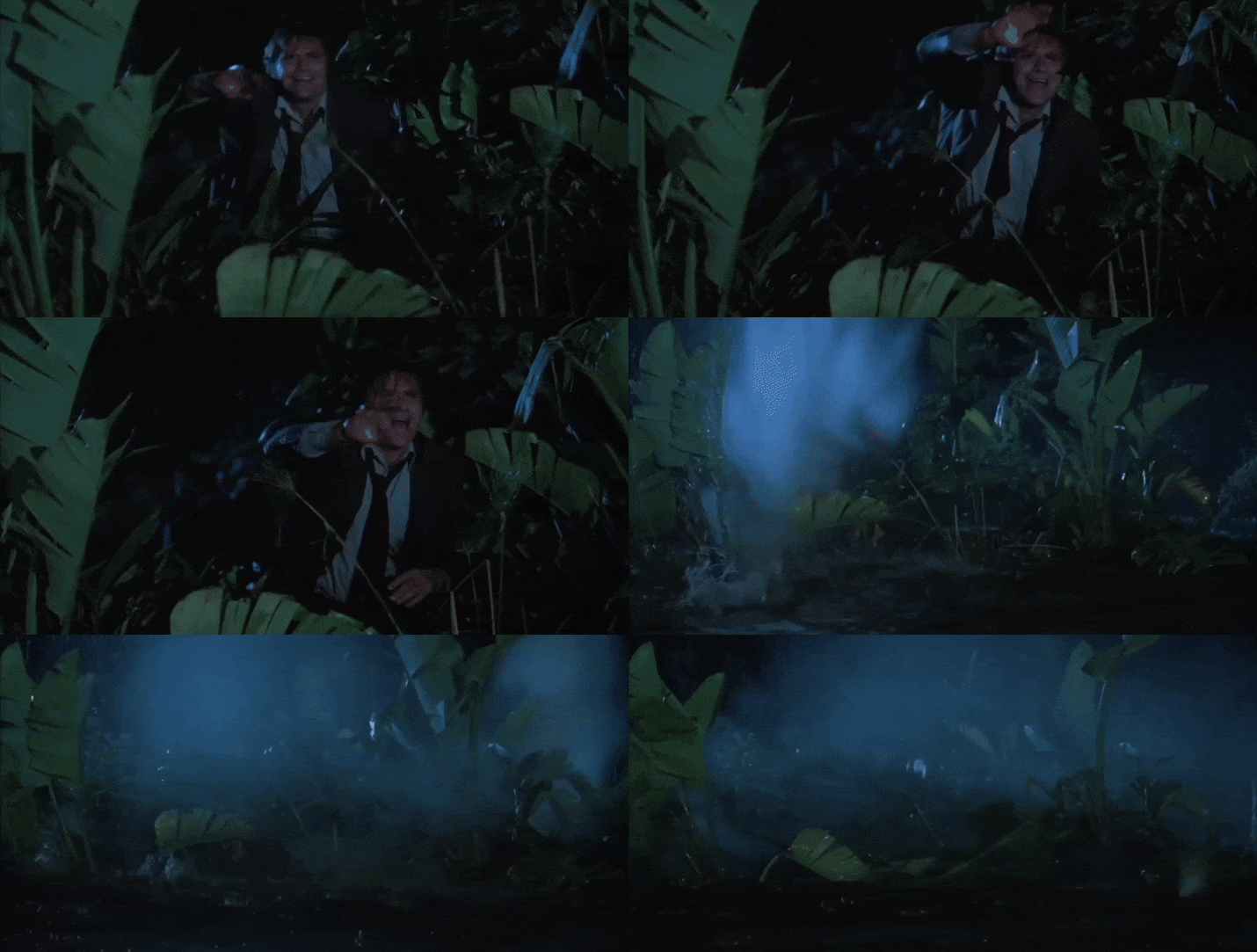
Several of the crew were alarmed by the use of live ammunition on set on Tuesday, July 20th, 1982, the day before the children arrived. Just seconds after Morrow dove out of the way, Landis called “fire!” and the special effects men fired the three shotguns at the banana plants.(Police Report; cf. Chain, ch. 21) Many of the crew were startled by the practice at the time, even in the context of a shoot already fraught with technical snags, safety violations, and near-misses, and among Landis’s notoriously rough, ramshackle—and loaded—production team.
Surely Marshall was aware of at least some of these red flags?
According to Chain, in August 1982, Marshall’s lawyers downplayed his involvement to Cal/OSHA, emphasizing the distinction between Spielberg’s group and Landis’s group, which kept separate offices on separate lots. Marshall was dismissed from consideration for indictment on the basis that he had only been on the set three or four times, when in fact it had been at least eight of the twelve days of production
(Chain, ch. 31) . -
July 21st–22nd: First night of filming with the children.
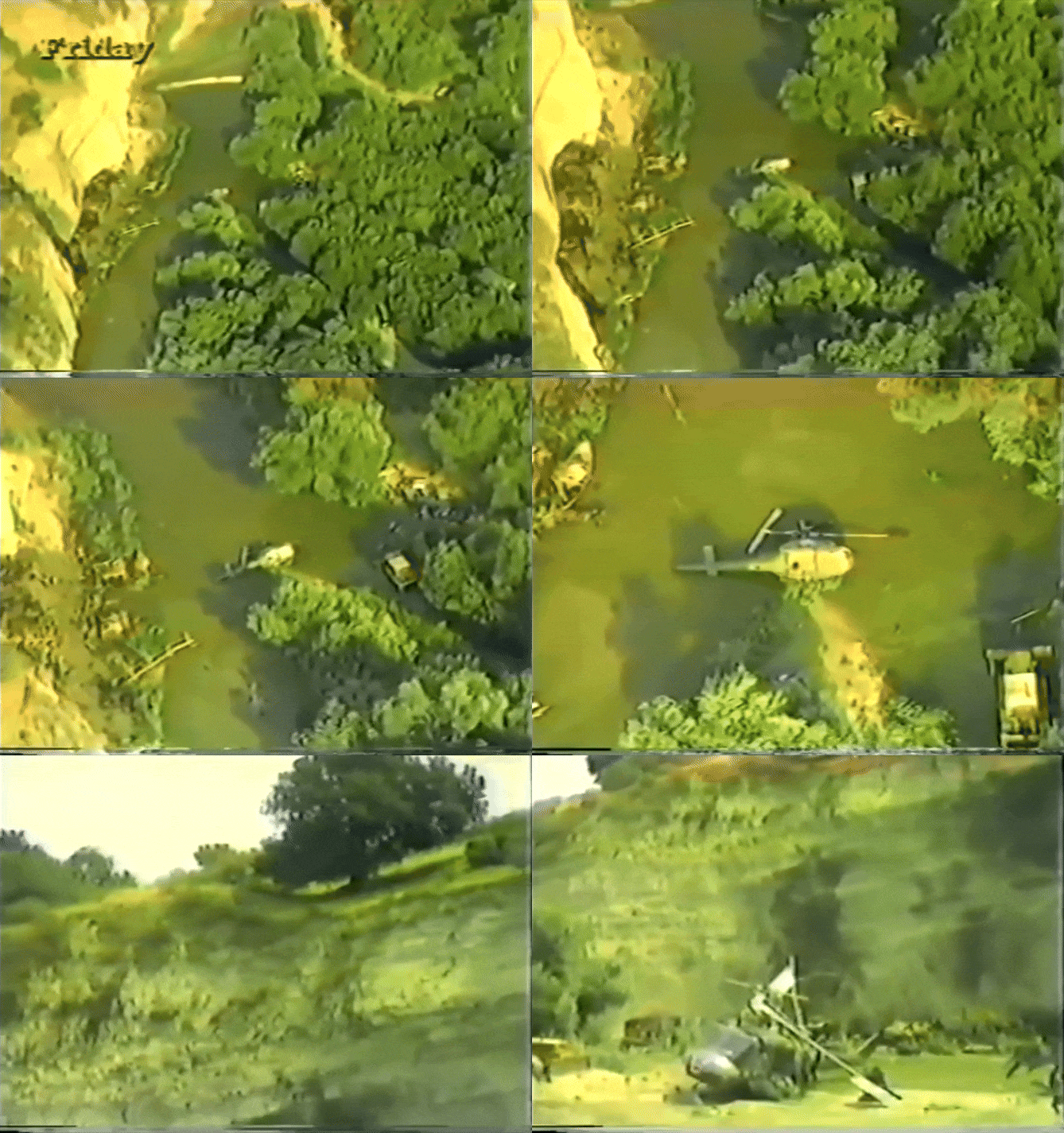
The production had used a backhoe to plant the mortars, and a bulldozer to dam the river. The viewing gallery was established between the bulldozer and the Chapman crane. According to Farber & Green, “As they entered the gates of the park, George Folsey turned to Dr. Le. He was relieved to be on private property... The county officials would not be able to get in.”
(118) As of Wednesday, July 21st, the Chen and Le families were still under the impression that their obligation to the filmmakers was only for six hours, 7:00pm–1:00am. Mrs. Chen had made clear at the July 16th meeting that she was mindful of her son’s sleep schedule.
But unbeknownst to them, the timeframe the filmmakers had given them was unrealistically ambitious: subsequent to their 7:00pm arrival on-set, the production—still bogged down shooting a tracking shot of Morrow walking into the village—required the children to shoot a dramatically significant scene inside the hut. After that, they still had the full rescue/river-crossing sequence—involving three distinct multi-camera helicopter-and-explosives setups—along with a short scene in a shed, and various pick-up shots.
The families, meanwhile, were being sequestered in a trailer a mile away from the set, bewildered by the long delay.
Mark Chen:
When we got there, we were waiting until midnight. What we had been told was the hours we would be there was only from 7 to 1 o’clock in the morning. It’s over midnight. We said, “How come, there’s nothing to do for our children?” So they say, “Well, just be patient, there will be.”
Hoa-Kim Le:
I keep asking him until now he said “We cannot do it. We have to do it after dinner.” I said, “what you mean by dinner? When is dinner? I never have dinner. A man there said twelve o’clock.” I said “Midnight? Dinner? This is strange to me and I expect he finish before midnight.” but then he said. “We worked day already.” We already got there and what can I say, “No I don’t want it? I go home?” I’m not that type woman. He said there’s no danger. So we stayed there, we stayed in the mobile home.
The Special Effects Supervisor
(Paul Stewart) told LaBrecque, “I knew by one o’clock that we would never finish... When you do a motion picture you know the Assistant Director is gonna say, ‘Oh, yeah, we’re gonna finish.’ But you walk away knowing he’s full of it. I know what I gotta do and it’s not humanly possible.”(30) Folsey was advised by 1st AD
(Elie Cohn) at 2:00am that it would be impossible to complete everything that had been planned for the night.Landis testified that, at 4:30am,
“Elie came to me and said the dolly shot had taken so long and we were behind, and he felt that once we finished the dialogue scene, he recommended that we send the actors home and not rush anything and just go a day over schedule.”
“Alright. What did you say about that?”
“I thought it sounded like a good idea and I went to Frank Marshall and George Folsey and we talked about it and agreed to do it.”
Once again, Spielberg’s right-hand man (allegedly) appears at the locus of decision-making concerning the 6- and 7-year-old children. Marshall, having just finished work on Poltergeist and E.T., involving myriad children working at night among special effects, would have been well-aware of the relevant labour laws. Indeed, he could fairly be described as a “highly placed... acknowledged expert,” as Landis’s first trial lawyer, Harland Braun, would later point out to the DA’s Office.
Folsey informed the parents on the set, provisionally asking them if they would consider returning the following day. He secured confirmation back at the trailer as he was paying them out for their children’s night’s work.
Shyan-Huei Chen testified that all four parents were taken back to the mobile home around 4:00am–5:00am. Folsey handed Dr. Le an envelope with the names “Daniel and Kim” written on it, and Mrs. Chen an envelope from the Mitsui Manufacturers Bank of Beverly Hills; each held five $100 bills. There were no receipts or stubs indicating dates or hours worked. Folsey told them not to tell anyone they got paid—just to say, if asked, that they were helping out some friends. (Chen family, NTSB; Chain, ch. 2) NTSB: You were saying that Mr. Folsey was talking to you about that the children just need to show up by themselves, and that the parents, you and your wife, didn’t need to come. Is that correct?
MC (Mark Chen): That’s correct.
NTSB: What was your response to that?
MC: To be a parent, we really want to be with the children.
NTSB: I understand.
MC: It was the first—the face shoot. It looked very simple. You know, they didn’t have to talk, they didn’t have to open their mouths. They just looked at the actor, Vic Morrow, that’s all. When he says it’s going to be very quick, they tried to finish earlier, so actually the parents don’t have to come, just have the children show up, that’s all.
NTSB: You mean they didn’t say anything about any other shot? They were going to re-take the shot, just taking a picture of the children that evening?
MC: We hadn’t seen the actor carry the children across the river. So we know that would be the next shot. After that, that will be completed. They take so long. He says, “Just come back tonight, and they will try to do it as soon as they can.”
NTSB: Have your child back home, is that what you’re saying?
MC: He said he’d try to make it before 3:30 a.m.
NTSB: 3:30 in the morning? That would be Friday morning?
MC: Friday morning. Since I was very tired, so I say, “okay.” I told my wife I’d have her come with Renee. The same thing with Le’s family. The father was the one to take My-Ca on Thursday.
The Chen family knew they were committing to another late night, but had no idea that the roll-over day would be of an entirely different tenor, reserved for the segment’s pyrotechnical and helicopter shots.
The Le family, however, were under the impression they were going to be finished within an hour or two.
“The first thing,” Dr. Le reminded her of the exact words Folsey used.
“The first thing tomorrow when you come back,” Mrs. Le said. They would be paid the same rate, $500, even if they finished early.
Mrs. Le begged out of it, explaining that although their children had enjoyed the experience, they, the parents, were very tired. Folsey had advised them to nap while they waited, but it hadn’t been so easy—and the next day (today) being Thursday—she and her husband had to go to work, as did Mr. Chen.
HKL: And well we look at each other and said, “I have to work, my husband has to work, and Mark had to return back to work. We cannot bring the children here.”
And George said, “Well, if you cannot bring the children here, I will pick up the children and bring them here and after the movie I will bring them back, and will treat them like my children. I promise with you.” And after he left there, his children were there too. I met his wife and his boy. He is playing the same as my boy so, well, I thought there was no danger, nothing, just like that. The children happy, giggle, laughing. One more day, maybe. I ask my husband, come back with the boy. ‘...we will pick you up at six o’clock and we finish early, by hour and a half hour, we finish.’
(Le family, NTSB) In any case, Dr. Le conceded that he had mostly just taken the filmmakers at their word.
I don’t know the law. We are the new immigrants into this country. I trust Dr. Schuman and Mr. [Peter] Chen, what they are doing. I do not question them... Folsey appeared to be very honest, nice person and I trust him. And I thought in my mind, because I am ignorant about the movie industry in this country, I thought this may be the way the movie industry working at dealings in this country.
(qtd. in LaBrecque 32) In the end, the families decided they could accommodate the beggarly filmmakers.
Meanwhile, the 2nd AD (House), as he was wrapping up, was recognized by one of the six Fire Safety Officers on set, Jack Tice. Tice recognized House from a commercial they had worked on together. House couldn’t place him, so Tice reminded him that he had been working on that project not as an FSO, but in his capacity as a studio teacher/children’s welfare worker.
This was a fateful opportunity, as House had already petitioned Allingham three times and Landis once on the illegality and seriousness of the hiring.
Tragically, however, when the critical moment arrived, House didn’t tip Tice to the illegal hiring. Instead, he sent a note back to the production office, warning Allingham about a possible fly in the ointment, hoping that he would be the one to call off the risky plan.
-
July 22nd–23rd: Second night (unscheduled roll-over); fatal accident occurs.
About six hours later, the crew began arriving back on set.
Mr. Pittman stated in substance that he is a Teamster truck driver and was performing his duties as driver of the special effects 10-ton truck during the filming of the Landis episode of the “Twilight Zone”. Mr. Pittman stated that the afternoon preceding the accident, he arrived on the set at approximately 12:00 o’clock in the afternoon and that prior to arriving at the location, Indian Dunes Park, he had purchased a case of Budweiser beer and soda pop for the special effects crew. He stated that he kept these beverages in a cooler on the back of the 10-ton powder truck. He stated that the 10-ton powder truck was positioned in the area of the Chapman crane and for most of the evening, this is where he spent his time.
(Police Report) Meanwhile, back at the office, a production assistant, Carolyn Lee-Epstein, testified that she was instructed by Folsey to go over to the Burbank Studios and contact Bonne Radford to pick up petty cash which was going to be paid to the Asian children for their participation in the final scene. Lee-Epstein said that Folsey instructed her that “no W-2 forms would be filled out for the children.”
... Miss Epstein stated that she drove to the Burbank Studios and contacted Bonnie Radford who appeared to be expecting her. She said she picked up petty cash and believed that she had signed for it. She stated that the money was inside a sealed brown envelope.
On Lee-Epstein’s return, she observed the envelope to contain $1,000, an amount she remembered discussing in the days leading up to the transaction, during numerous conversations she overheard about the hiring.
Miss Epstein stated that around the beginning of July 1982, approximately 1800 hours, she was asked by Folsey to drive her to a mechanic’s garage in the San Fernando Valley so that Mr. Folsey might pick up his car which was being worked on. Miss Epstein stated that during this drive, a general discussion about the “Twilight Zone” movie was taking place. During this drive, Mr. Folsey asked Carolyn if she knew any Oriental children that “we” can use. Miss Epstein stated that although Mr. Folsey did not refer to the final scene of the movie, she knew that this was what he was referring to. She had read the script. She stated that she didn’t understand why Mr. Folsey was asking her if she knew any Oriental children, however, possibly because she was Oriental and maybe had family or friends with Oriental children. She stated that it didn’t seem too out of the ordinary at the time. She told Mr. Folsey that she didn’t know anyone who had Oriental children, and that Mr. Folsey responded in a nonchalant manner, “Well, we have to be careful about this.”
Meanwhile, Allingham got back to House, advising him not to panic about the FSO in question, and to tell the Location Manager
(Richard Vane) to keep tabs on his movements.Vane testified at the grand jury in 1983 that he knowingly complied.
By the time the DGA trainee
(Hilary Leach) returned to the set, Landis’s inner circle had developed a new operating protocol.Hilary Leach, the Directors’ [sic] Guild of America trainee, whose job included escorting the children on the set, was told by House to refer to My-Ca and Renee on her walkie-talkie only as “the Vietnamese,” just in case any of the fire safety officers overheard the radio transmissions.
(LaBrecque 35) Dr. Le, Myca, Mrs. Chen, and Renee were picked up by the same white van, traversed Los Angeles once again, and arrived back on set by about 7:40pm.
NTSB: When you arrived, did anybody talk to you?
SC (Shyan-Huei Chen): No.
NTSB: When was the first time anybody talked to you or the children, that evening?
SC: The heavy-set lady with the walkie-talkie talked to us.
Chen family lawyer: I believe her name is Hilary Leach.
NTSB: She was the trainee director?
Lawyer: Correct.
NTSB: What did she say to you?
SC: She say the children should go to make-up and change their clothes.
Peter Chen: So then she took the children to another trailer, is that right?
NTSB: She took them to a trailer?
SC: Right. Then we took popcorn and a soft drink for the children. After a while, the lady, the same lady, said the children were to go to the scene.
NTSB: The children were to go into the village, to the scene, to be filmed?
SC: Right.
(Chen family, NTSB) -
9:30pm shot
Two of three camera angles (one redundant) recovered from the 9:30pm shot, at which time Marshall was present and, according to Chain, so was Kennedy (Chain, ch. 47) .If you were a producer of children’s and family films, and you watched this scene, would you be alarmed or think the above might be less than fully legal? Twice (before the shot and during) Morrow was observed by those present to drop (before, during an informal “run-through”) Myca, and (during the actual take) Renee into the water. Landis testified that he asked the children whether or not they could swim: “One could and one could not.” The script supervisor
(Kathryn Wooten) recalled seeing the children in the “9:30 rescue sequence,” assuming they were “pretty much put in at the last minute and taken out right away.”The helicopter hovered at approximately 60 feet overhead, well above the frame, generating propwash for the scene below. As well, the Unit Production Manager (Allingham) was using it as a platform for the unwieldy (as he had been warned) “Nite-Sun” spotlight the production had rented specially for the segment. He was aiming it out the pilot’s side window (the pilot was flying from the passenger side so that he could keep watch on the nearby cliff face), struggling to keep Morrow centered and in focus; making the hovering helicopter both a technical platform and a dramatic set-piece.
Morrow can be seen approaching Renee and Myca behind a hut—where they’d been placed in wait next to two armed, hair-trigger explosives—and scooping them one under each arm, before running out of frame moments before the explosives are detonated.
One hundred feet away, across the water, Mrs. Chen was startled; she and Dr. Le stood beside Folsey as they watched two fireballs roll up the face of the cliff.
NTSB: There was one explosion during this period of time. Where was the helicopter?
SC (Shyan-Huei Chen): Here.
NTSB: Over this area, so the helicopter was—
SC: Just right on top of the hut.
NTSB: On top of the number 4 hut. Now, one explosion only. Did that surprise you?
SC: Yes.
NTSB: ...were you surprised, Mrs. Chen, when an explosion went off?
SC: I’m very surprised, because it’s too noisy—
NTSB: Too noisy and your eardrums hurt?
SC: And the sand.
MC: The sand was all over.
SC: Yeah, my eyes.
MC: She was scared.
SC: Scared, very scared. Then I saw my daughter was crying.
MC: Renee was crying at that moment.
SC: Renee had sand in her eyes.
MC: John Landis went over and picked up Renee and held Renee in his arms.
Lawyer: Because she was crying.
NTSB: Okay. So; Mr. Landis, after your daughter was crying, picked her up, calmed her down, and—
SC: Came to me.
NTSB: And then came to you? What did he tell you?
SC: He didn’t say anything.
PC (Peter Chen): Mrs. Chen was asking Renee to come over to her side, and then she asked Renee whether she was afraid. Renee said yes, she was very scared. Renee’s clothes were wet. So Mrs. Chen was afraid Renee might catch a cold, so she took Renee to have her clothes changed. Then Mrs. Chen asked a lady with the pair of glasses [Hilary Leach] whether the filming was all over, and the lady said she did not know. Then she asked Mrs. Chen and Renee to go inside of the trailer and rest there.
NTSB: Did you complain to Mr. Landis or anyone about the first explosion, the first time you heard it?
SC: Yeah, I just told George Folsey. He just said no, not dangerous. Everything’s okay.
PC: Mrs. Chen says that she did ask George Folsey whether it was going to be dangerous, and George told her that no, it’s going to be noisy, but not dangerous.
Lawyer: Let the record reflect that when Mrs. Chen was explaining what Mr. Folsey said, that she put her right hand on her husband’s shoulder, and I think that meant that Mr. Folsey touched her on the shoulder and said it’s okay. There’s no danger.
Dr. Le later testified, as well, that he “had thought that the work was over after the nine-thirty shot and asked if he and his son could go home, but Folsey said, “It’s not quite ready yet. You need to stay behind. We have some other things to do.”
(LaBrecque 173) Shyan-Huei Chen NTSB interview, cont’d:
NTSB: After Renee went back into the trailer and changed clothes, did you go out and take another shot, or what were the events after that?
PC (Peter Chen, translating for SC): By the time they changed Renee’s clothes and put her back to sleep, it was about 10 o’clock. About midnight, the heavy-set lady with the walkie-talkie woke them up.
NTSB: That would be Hilary Leach?
PC: Hilary Leach, yes. It was break time, lunch break. So she asked Mrs. Chen and Renee whether they wanted to have anything to eat. She said no, we’re fine. She left, and after a while, George Folsey came back.
NTSB: What did he say?
PC: George Folsey stopped to talk to Mr. and Mrs. Chen. Let me summarize what he said. If you are approached by a fireman, just mention that you are friends, you are here to help out. Don’t mention anything about the money that’s been paid. This was the major content of Mr. Folsey’s conversation with them.
NTSB: Now. You arrived at about 7:30.
PC: Yes.
NTSB: At about 9:30, you brought the children out—
PC: After the first explosion—
NTSB: And then brought them back to the trailer, changed their clothes, and put them to sleep in the trailer. You were awakened—
PC: Awakened at about midnight.
NTSB: That’s where I want to go. Between the time you arrived and midnight, there was only one explosion?
PC: Yes, according to her memory.
Peter Malone (Fire Marshal’s Office): May I just ask one thing. How far away was the trailer from where the village was, approximately?
MC (Mark Chen): Can I answer that? It’s more than a mile.
NTSB: Oh, is it that far away?
MC: Right in front of the park.
NTSB: That’s where Vic Morrow’s trailer was at?
MC: Vic Morrow, actually, even Vic Morrow’s trailer is very close by the scene, but ours is far down, by the entrance. You can see the old houses. That’s why we didn’t know what was going on. [We] were all in the trailer.
-
11:30pm shot

“Like [staring into] the sun.” “A PA [i.e., hairdresser Virginia Kearns; see #02] walking away from the set said the heat of the 11:30 blast singed her hair.” 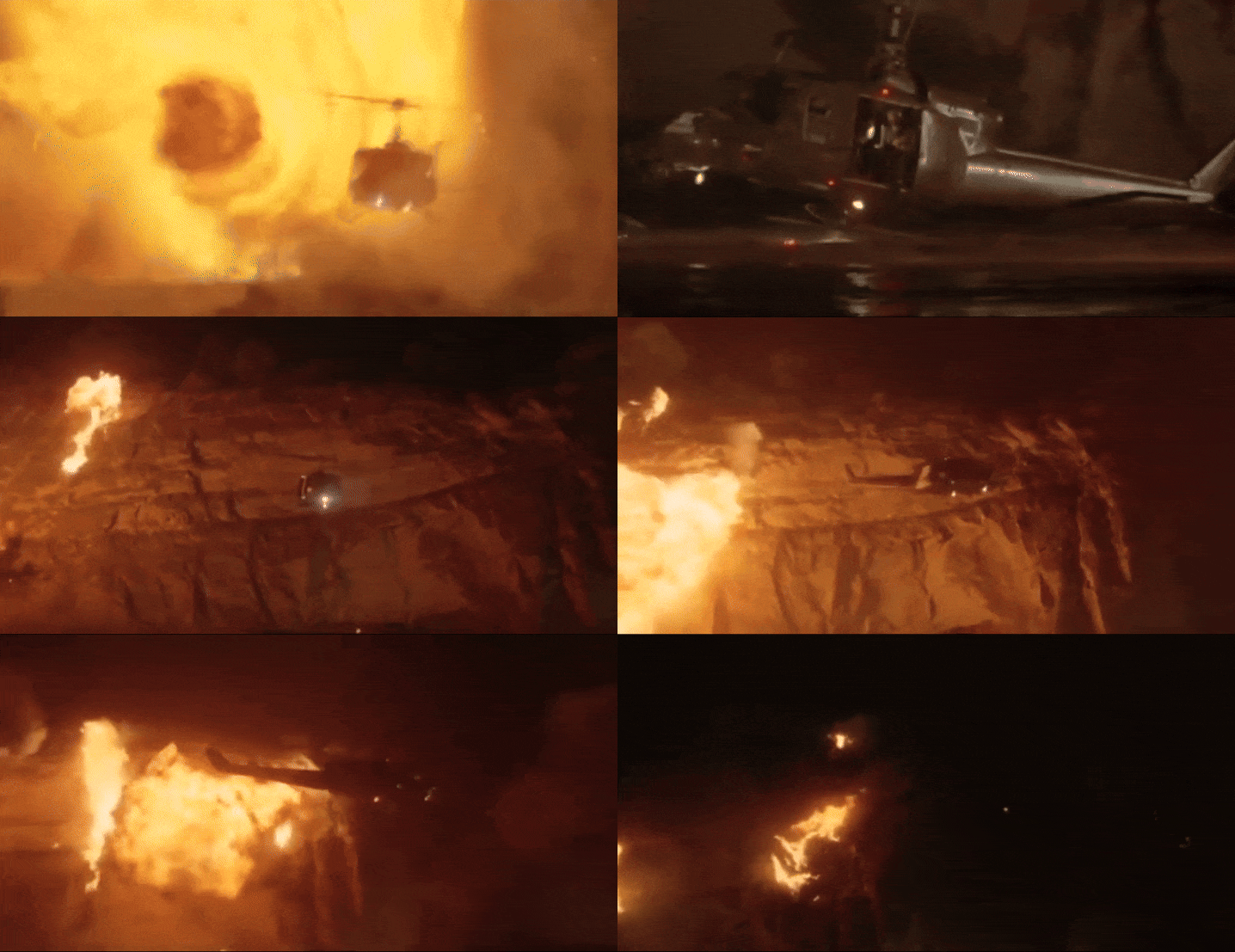
The Exterminator (1980), also shot at Indian Dunes, under Paul Stewart: “We had a helicopter fly down into the canyon and we had [gasoline] explosions around it. One explosion surrounded the whole tail of the helicopter, so it looked like it was engulfed in flames.” (LaBrecque 12) The spectators that night were dazzled by the major 11:30pm helicopter and pyrotechnics spectacle. Although the filmmakers were compelled to deny that any of the evening’s shots constituted “stunts,” per se, the NTSB later determined them to be such, according to the standards of the industry.
Cynthia Nigh, Folsey’s assistant, recalled Folsey’s rather incriminating aside as they watched the 11:30 shot
(Grand Jury) :DA (Kesselman): Did Folsey say something as explosions going off.
CN: Well, he said that he was glad his wife and kids didn’t come, they were going to come.
DA: Did he [appear] to be surprised or shocked at their magnitude.
CN: Yes.
DA: What did you understand Folsey’s comment to mean?
CN: That it was—I guess, that it was dangerous, and also that it was so late.
DA: Before the explosions went off, he didn’t say, “it’s late, I’m glad they didn’t come?”
CN: He could have, he said he was waiting for his kids and wife to come.
DA: First time he said glad wife and kids didn’t come was as these explosions were going off?
CN: Yes, it is.
DA: Matter of common knowledge among many spectators that this last scene was going to be a spectacular series of explosions?
CN: Yeah, it was just going to be a big finale with five cameras. Just big.
DA: This is what Landis had expressed even in the office, that this was going to be a big, big explosion or explosions?
CN: A big finale.
By the time the rattled flight crew set back down, most of the rest of the crew had migrated to the cast and crew “lunch” taking place at the canteen about a quarter-mile away.
The spectators were unaware that during the shot the pilot
(Dorcey Wingo) —a Vietnam War veteran, who had never worked a film before, and neglected to walk the set beforehand to learn the location of the explosives—had a startle response, and turned to his left, into the village, opening up its flank to the next explosive blast, which he had no idea was coming. Flames roasted the open cabin.The flight list for all three shots that night was:
- Dorcey Wingo (Pilot)—later charged with three counts
- Dan Allingham (UPM)—later charged with two counts
- Gary McLarty (Stunt Coordinator)
- Kenny Endoso (Stuntman #2)
- Roger Smith (Camera D)
- Randall Robinson (Camera D Ass’t)
DW: Chickenshit! Chickenshit! Chickenshit!
DA: That’s too much, let’s get out of here!
DW: This is bullshit! They didn’t tell me about that! They didn’t tell me about that!
As they landed, the Pilot (Wingo) complained to the Unit Production Manager (Allingham) about the near miss, and demanded that further precautions be taken. He was furious and wanted to address Landis himself, but the UPM said he would take it up with Landis directly. Typically, Unit Production Manager is an office job—and indeed Allingham was only charged on the “office counts,” pertaining to the illegal hiring. However, on this occasion, Allingham was helping out the production by manning the heavy “Nite-Sun” spotlight, functioning (narratively) as the helicopter’s searchlight, tracked on Morrow and the children as best it could.
DA: You’re right, Dorcey, safety first. I’ve got a vacation to start this weekend. Safety first.
RR: He was as startled as I was. Yeah it wasn’t much fun. I didn’t want to have to do that again. And I wanted to make sure that...—and I knew that Dorcey was angry because he was fuming about it all the way down, to Dan Allingham, about it. Dan kept saying, “no, no, you’re right. Safety first. ‘Ta-da-ta-da-ta-da,’ so forth.”
(Grand Jury) By the time the helicopter landed, Landis was across the water at the village set, but only Allingham had on his waders. Wingo and Robinson bided their time to hear their concerns addressed. Eventually they found Landis up in the basket of the Chapman crane, working out the angle of Camera B (Wide master, Steve Lydecker) for the final shot.
RR: I wanted to be there when this meeting went on to let them know we weren’t too happy about it. So I went down to the shore there and stood with Dorcey, and Landis was in the water wading just in front of us.
RR: I asked Dorcey about it and whether the intensity was a little much. I mean, I was trying to get feedback from the people on the ground as to whether or not I actually went through what I just did. And he showed me his face and said, “It practically scorched my face when I looked out the window.”
RR: And right at that moment Landis turned around with kind of a grin on his face and said, “Well, that’s just a warm-up for what’s coming later,” and just sort of laughed like it was a joke. Then they broke for lunch, and then they left. That was the end of that.
RR: When Landis turned around he said, “That’s nothing, that’s just a warm-up for what’s coming.” Something like that.
District Attorney (Kesselman): What was your reaction to that?
RR: Well, you know, I tried to put all this down. I was trying to get feedback on the ground from everybody during lunch whether or not I really was a little wrong about the intensity, or if that was just average, because it seemed a little much to me.
RR: I’d worked in the film industry 16 years, since I was 19. I had worked on MacArthur and shows like that where they were blowing things up all the time. But they blow up cork. Never have I been anywhere near any intensity like that ever, period, in my life.
The dozing families were woken up some time after midnight.
Dr. Le:...About one-thirty. We slept right through lunch. They had lunch at twelve-thirty. We slept right through. Nobody came and woke us up. We slept right through. This about two o’clock, not very long before the accident, about two o’clock they come. The lady, I have her name, this Hillary Leach.
NTSB: Yes.
Dr. Le: She come with walky talky, she come to the trailer. She knock at the door. Now time to take children to go to the set. So, I and My-Ca were sleeping. We were awakened by her coming and knocking on the door.
NTSB: Then they brought you to the set?
Dr. Le: So, she took children to the trailer next door to get dressed and make up again. They put the old clothes, that were wet, so they put those clothes on. Then they took us by the Jeep to the set, straight to the set. And then I was standing there with George Folsey and a lot of people right at the set to see they get ready for the shooting. And then Rene’s mother, at that moment she was a little bit scared. She was standing near to me. And then George came right over and talked to me and her at the same time. “It may be scary but very safe, don’t worry.”
NTSB: What was scary?
Dr. Le: We look at it. The people get ready for the shooting. Rene’s mother had some senses, feeling there may be danger to her daughter. And then George came and reassured me and Rene’s mother...
Shyan-Huei Chen NTSB interview, cont’d:
NTSB: After lunch, when was the next time that Renee then went out for more filming?
PC (Peter Chen, translating for SC): About 1 o’clock. Mrs. Chen and another lady with a pair of glasses took the children and their parents to the scene. At that time Mrs. Chen smelled the gas. They took the children from the scene and then brought the parents back to the other side of the river bank, and at that time Mrs. Chen again asked George Folsey as to whether it’s going to be dangerous, and George again said it’s going to be noisy but no danger.
Note that Mrs. Chen herself (through Dr. Peter Chen’s translation) reports asking Folsey about the danger on two separate occasions: after the 9:30pm shot (when Folsey put his hand on her shoulder), and before the 2:20am shot.
After being informed of the helicopter’s frightening near miss, around 12:30am or 1:00am, Landis led a small group of technicians with waders through the village shoreline, which included one wooden “sampan” boat attached to a long flimsy dock, four closed-air huts, and one open-air fish-drying hut. Somehow two additional explosives were placed close together, one on the shore, and one under the bamboo floor of the fish-drying hut.
This is significant because the helicopter pilot directly warned both the director and the Special Effects Supervisor that there must be no debris whatsoever under his rotors; and the Special Effects Supervisor had told the Fire Marshal that there would be no detonations inside any of the huts, per the conditions of their fire permit.
Stewart, interviewed on August 4th, 1982, suggested the open-air fish-drying hut didn’t actually count as a “hut”:
“This really was not a hut, it was just a four legged thing with a cheap thatched roof.”
(Police Report) -
2:00am shot (footage intended for Executive Producer’s documentary)
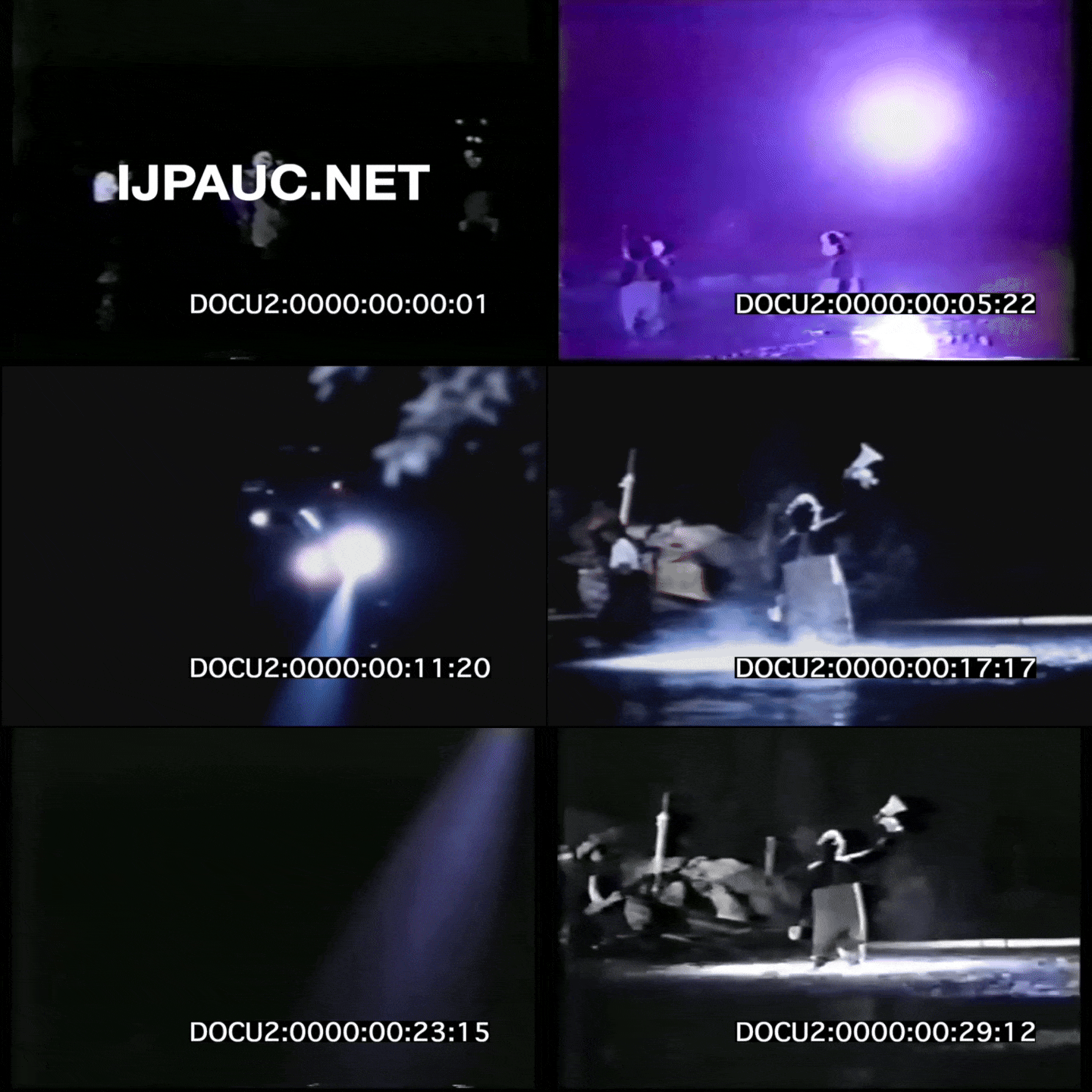
DOCU/2:00 At approximately 2:00am, a shot was taken (Camera C), slated “DOCU/2:00,” for the sake of Marshall’s intended “The Making Of...” documentary. This shot, apparently documenting technical preparations of some kind, was later used by the defence to support their contention that the fatal scene had been well-planned.
Shortly before 2:20am, the DGA trainee (Leach) led the kids once again from the makeup trailer to the village, where Landis gave them and Morrow their final remarks, as he prepared for his heroic 100-foot dash.
Landis then returned to his spot near Cameras C & F as the helicopter took flight. Standing with him were the 1st AD, Elie Cohn; Jerry Williams; and the propman, Mike Milgrom.
Milgrom had just finished his last official duty of the night by giving Renee the “broken and naked Barbie doll” prop called for by the fourth draft, and had been recruited by the Special Effects Supervisor
(Paul Stewart) and an SFX technician(Jerry Williams) to fire a powerful marble gun along Morrow’s path to simulate the helicopter’s guns strafing the water.He wasn’t the only crew member moonlighting that night: one of the truck drivers was also manning a marble gun, the Unit Production Manager, Dan Allingham, was managing the Nite-Sun up in the helicopter, and the Stunt Coordinator, Gary McLarty—who was also Vic Morrow’s stunt double—was firing one of two machine guns full of blanks from the helicopter. (Since he was not classifying the shot as a “stunt” per se, he was free to work as a technician.)
Williams had wrapped himself in a blanket as protection from the sheets of dust that had stung his eyes during the 11:30 shot. The other SFX technician triggering explosives
(James Camomile) , standing downriver, was wearing a welder’s mask. He was standing with the SFX Supervisor (Stewart), whose role in the shot was to cue Camomile when it was his turn to fire, and then to radio a third SFX technician(Harry Stewart) , further downriver, for his cue to fire two very large mortars near the dam.Standing further behind Landis was Production Designer Richard Sawyer. He was proud of the set he’d built. Earlier in the night, “one of the biggest producers in Hollywood” had put his arm around him and welcomed him to the big time
(Cursed Films, S01E05) . He’d just rebuilt the set, following the disarray of the 11:30pm shot, and lacquered the huts’ thatched roofs with liquid cement used as “fire fuel” in preparation for the final shot.Fourteen “mortars”—iron pots filled with gunpowder, gasoline, and sawdust—had been dug into the ground. The plan was that once Morrow and the kids were about 15 feet away from the village, the three members of the SFX team would begin triggering their respectively assigned series of explosives.
Using the large white bullhorn, Landis turned towards the spectators gathered around the crane.
He was widely witnessed to announce something to the effect of “I do not want anybody sitting down, I mean it.”
The 1st AD (Cohn) told the grand jury:
...He [Landis] turned around and with a bullhorn he asked people “to stand up rather than being sitting down. I went to him and I said “why did you say that?” I definitely don’t remember that he said that before. And he said “because of the shock wave of the explosion. It will be easier for people to deal with.”
DA (Kesselman): From that did you infer that he was expecting shock waves?
EC: Yes.
-
2:20am shot
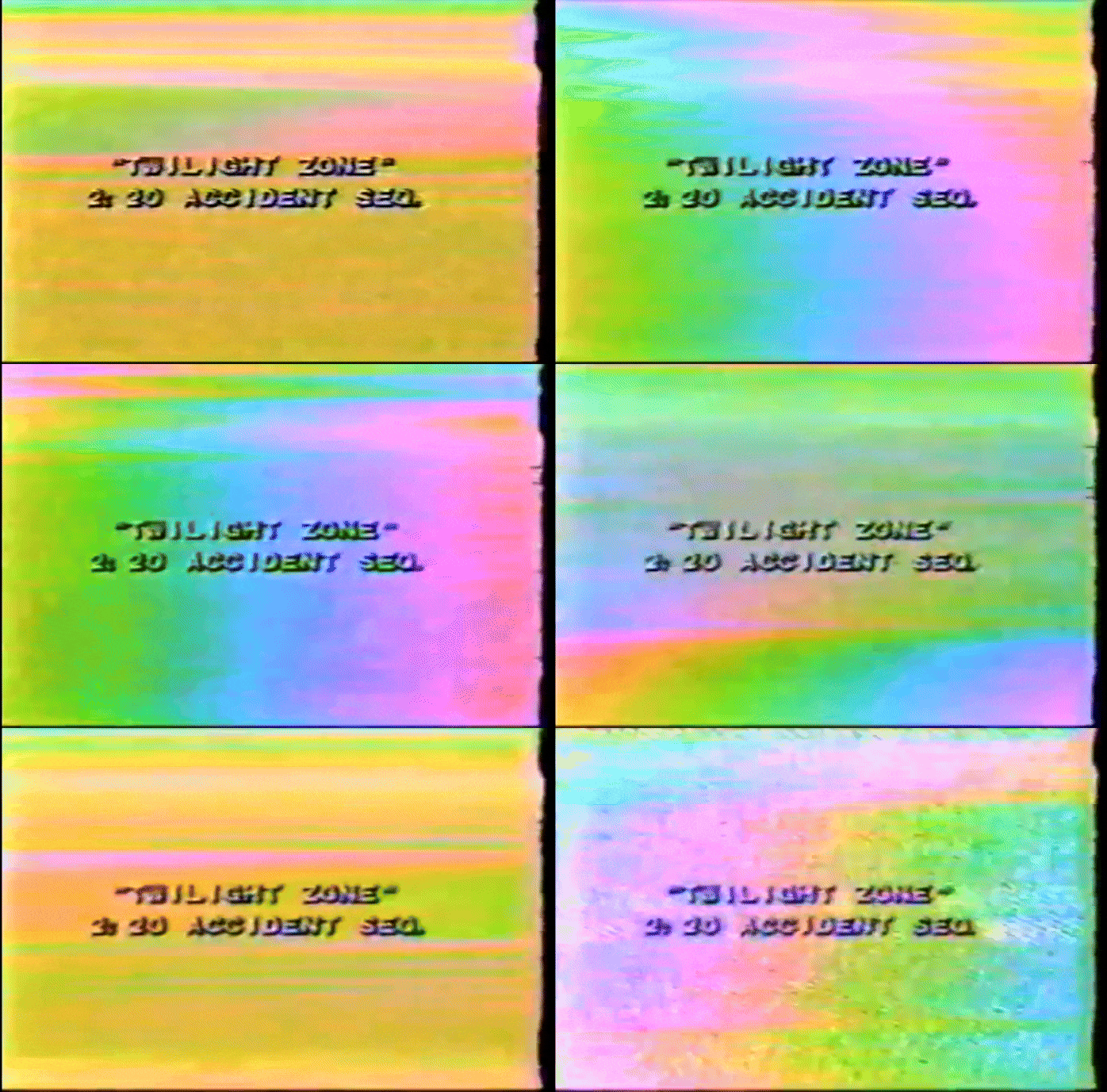
Courtroom tape title card. “Lower, lower, lower...!”
“Fire, fire, fire...!”
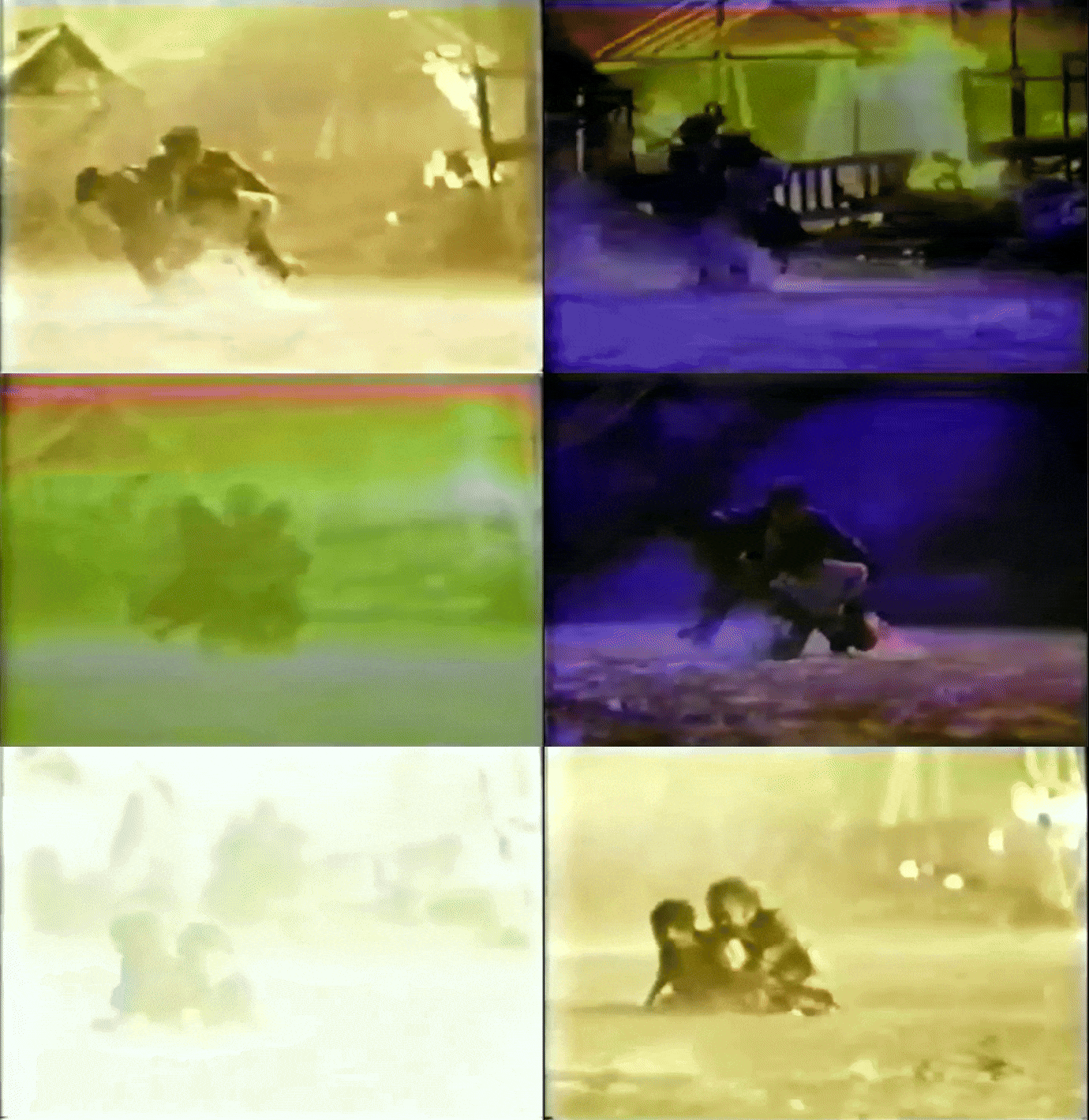
Camera A Benda (150mm; Close-up) 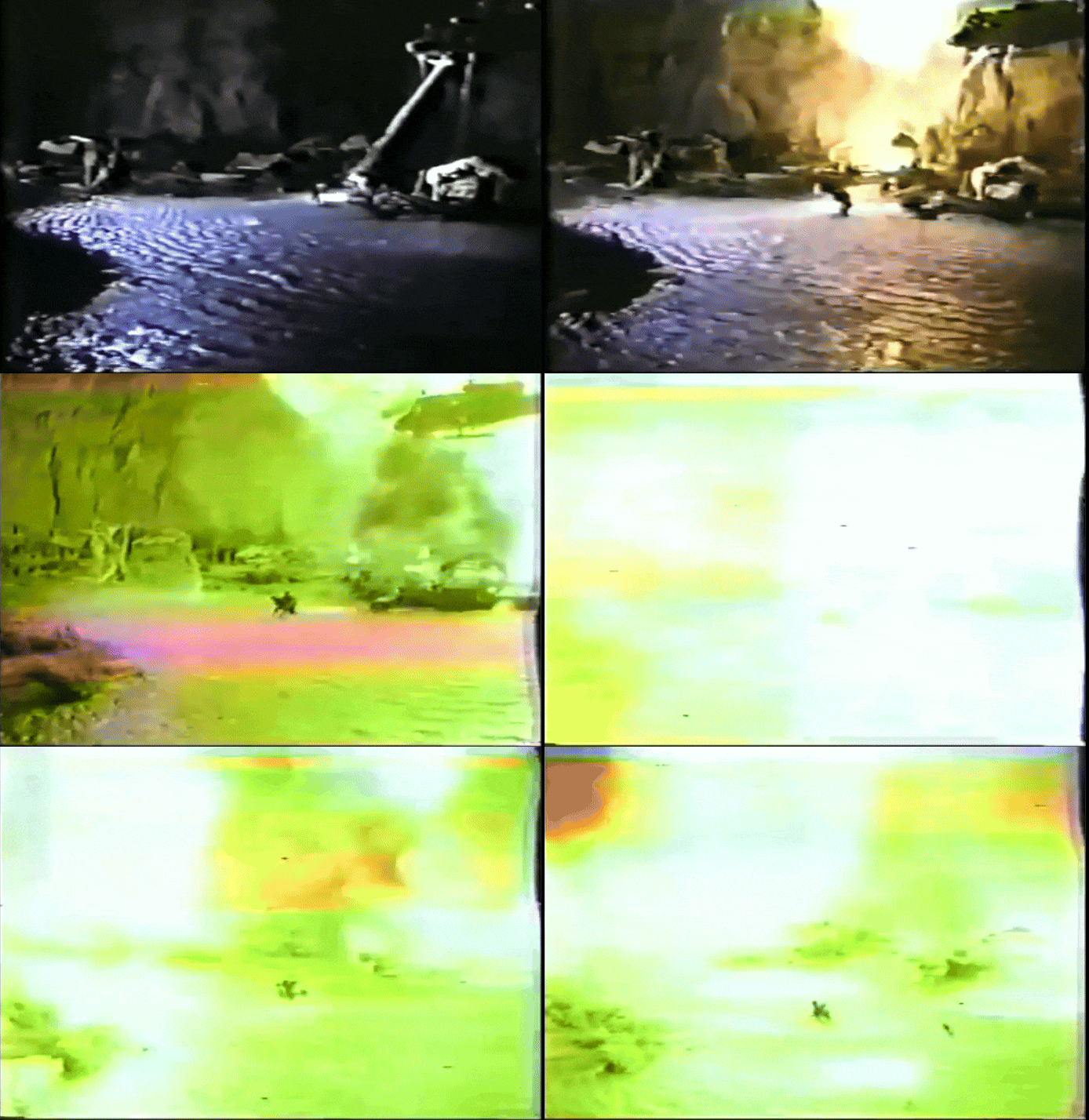
Camera B Lydecker (Master) Camera A was standing in the water below, getting the close-up. Camera B was the Wide/Master, filming from the platform of the Chapman crane.
Meanwhile, two more cameras (C & F) were positioned to get nearly redundant profile shots of Morrow and the kids traversing from left to right, bathed in the Nite-Sun spotlight
(the very same one used in the truck scene in Close Encounters) as they pass a wooden “sampan” boat, and explosions go off at their backs, and then in the distance behind them, so that the flames illuminated the water in the foreground .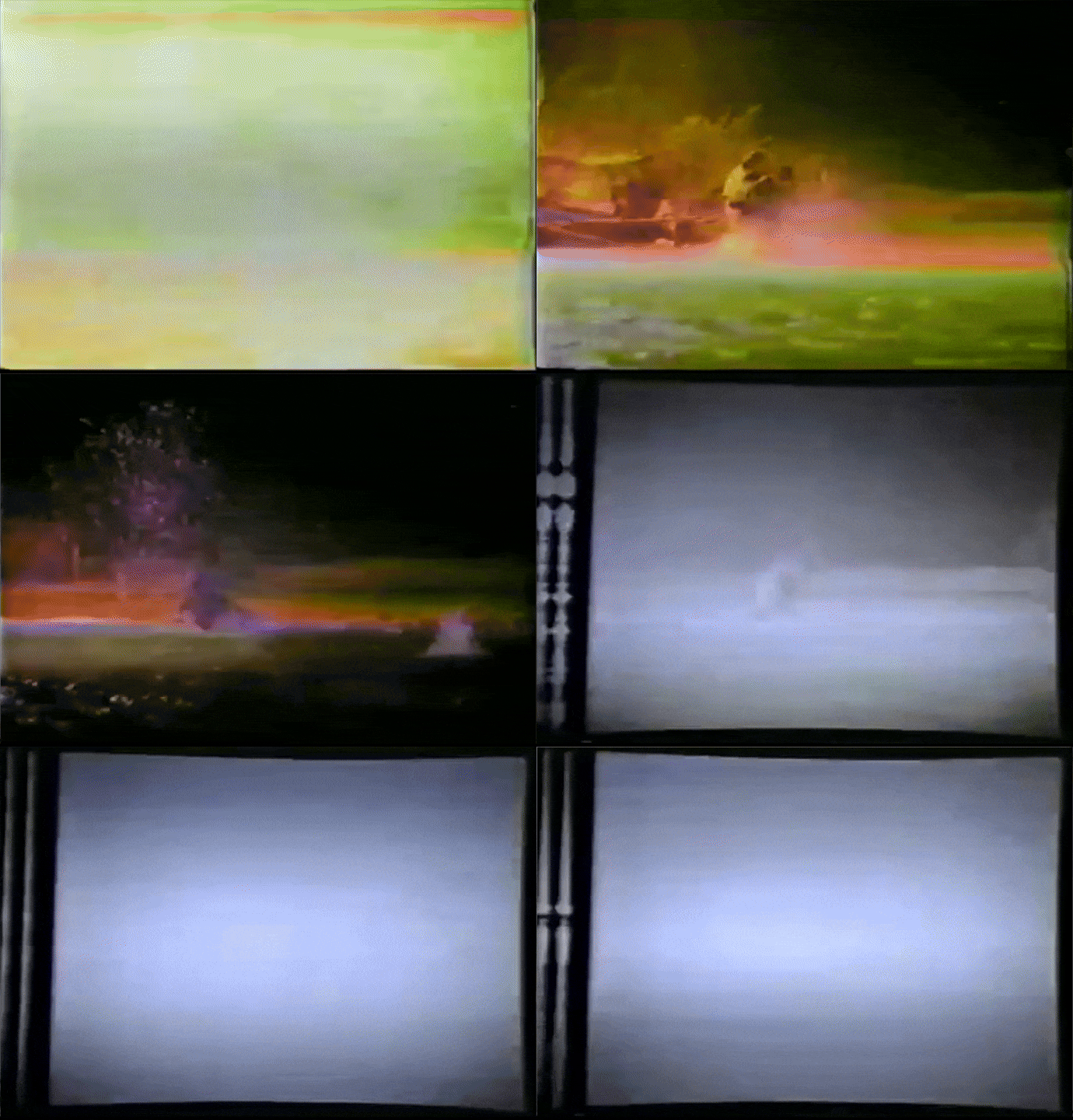
Camera C Connor (100mm; Profile) 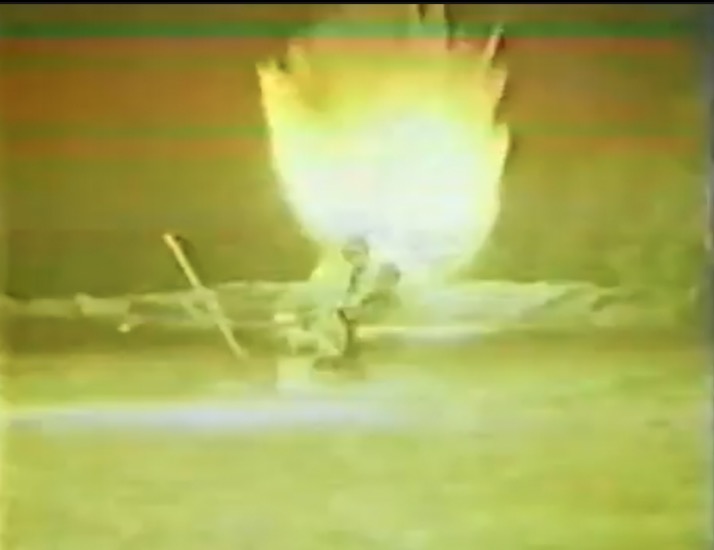
Camera C Snapshot Just as Morrow passes the eucalyptus stick used as a marker by the Special Effects men. Landis testified: “That’s when we put the stick there for Mr. Larner, actually (Camera F). That is when the stick was placed in the water for a visual cue to line up with the actors and the dam.” 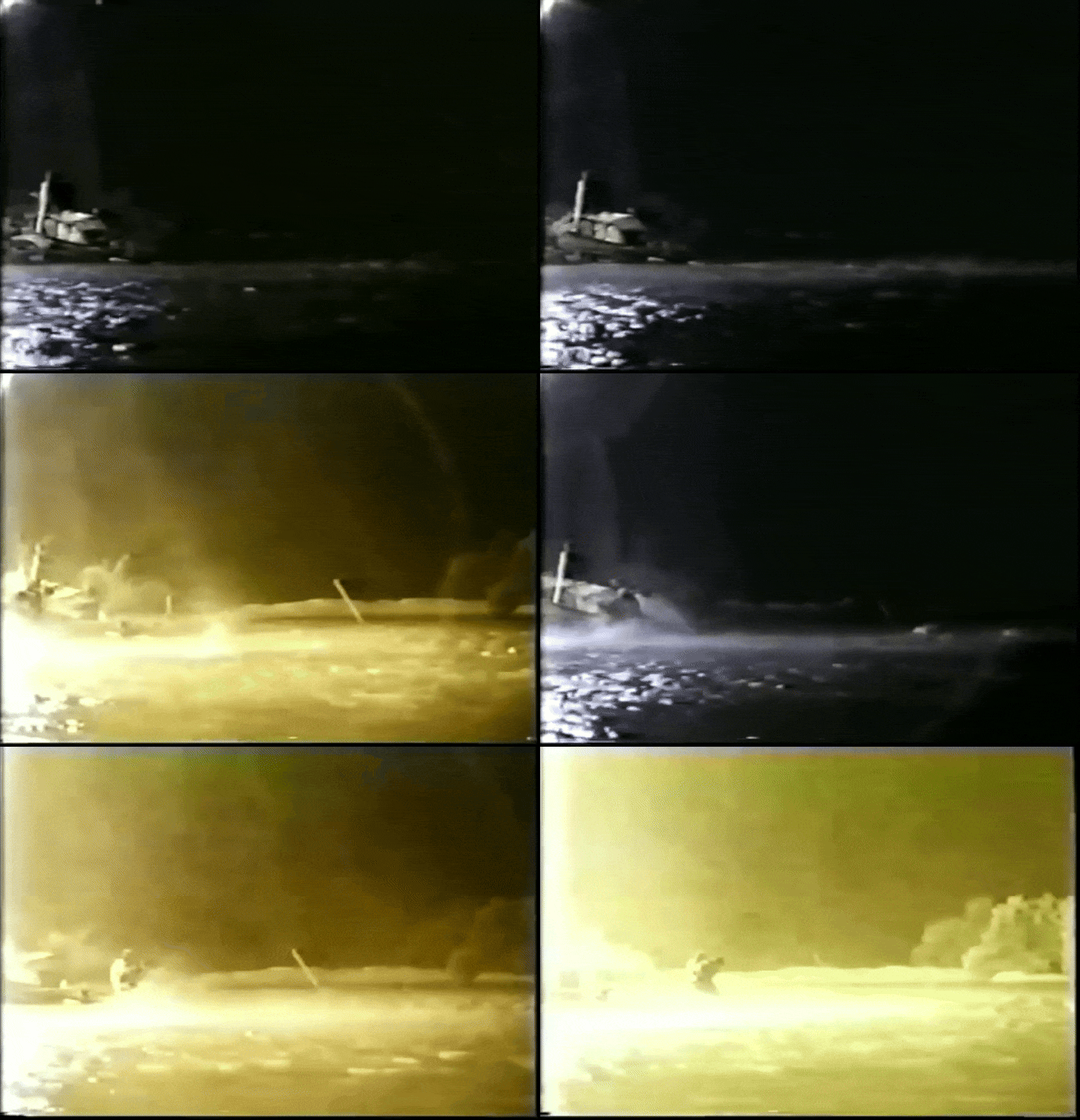
Camera F Larner (DP) (Backup) The last two cameras (D & E) were aerial shots to be used as cutaways: one a 90-foot bird’s-eye view from over the cliff, and the other from the helicopter, getting one of the two machine gunners’ POV downwards.
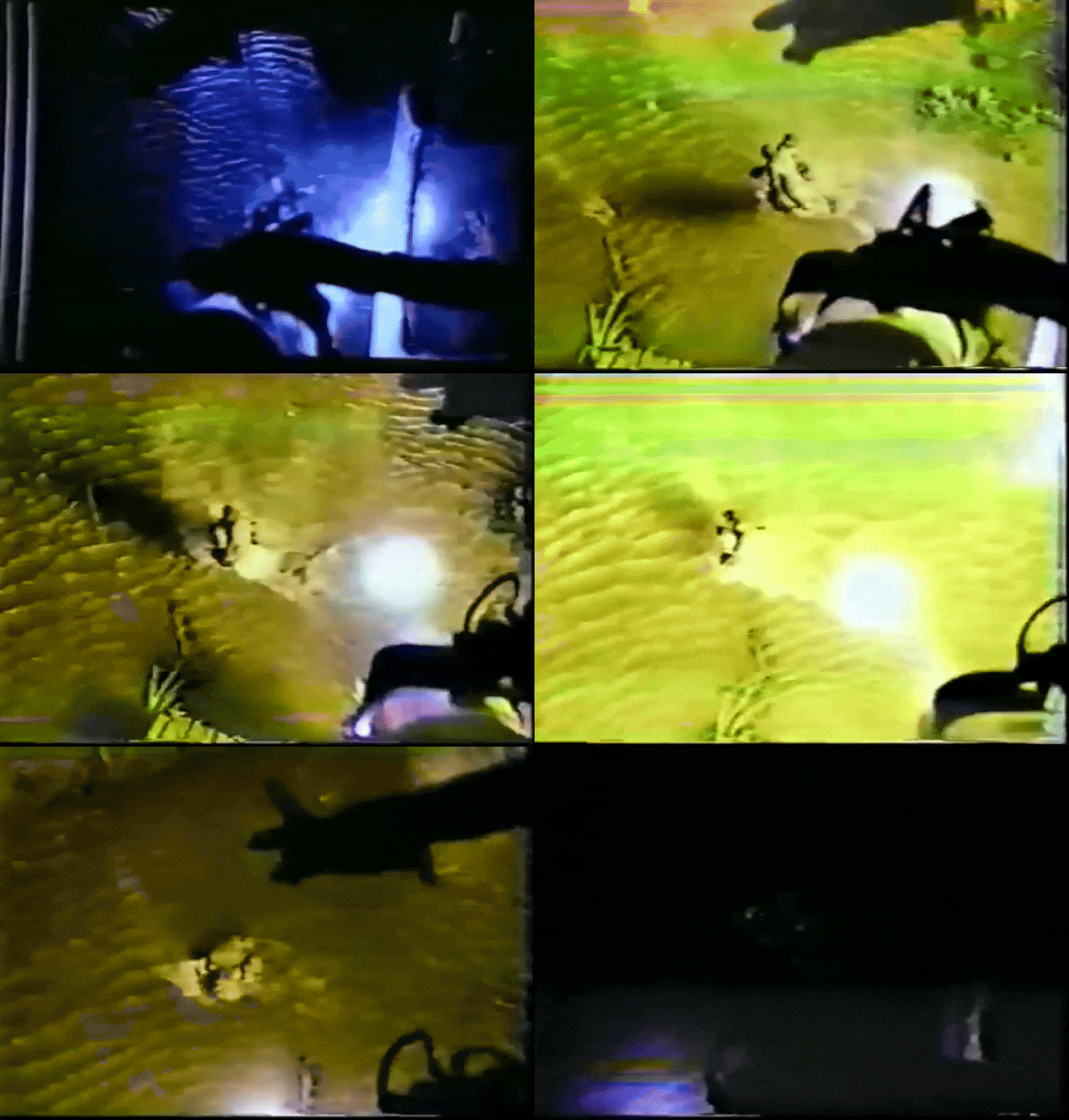
Camera D Smith (Helicopter) 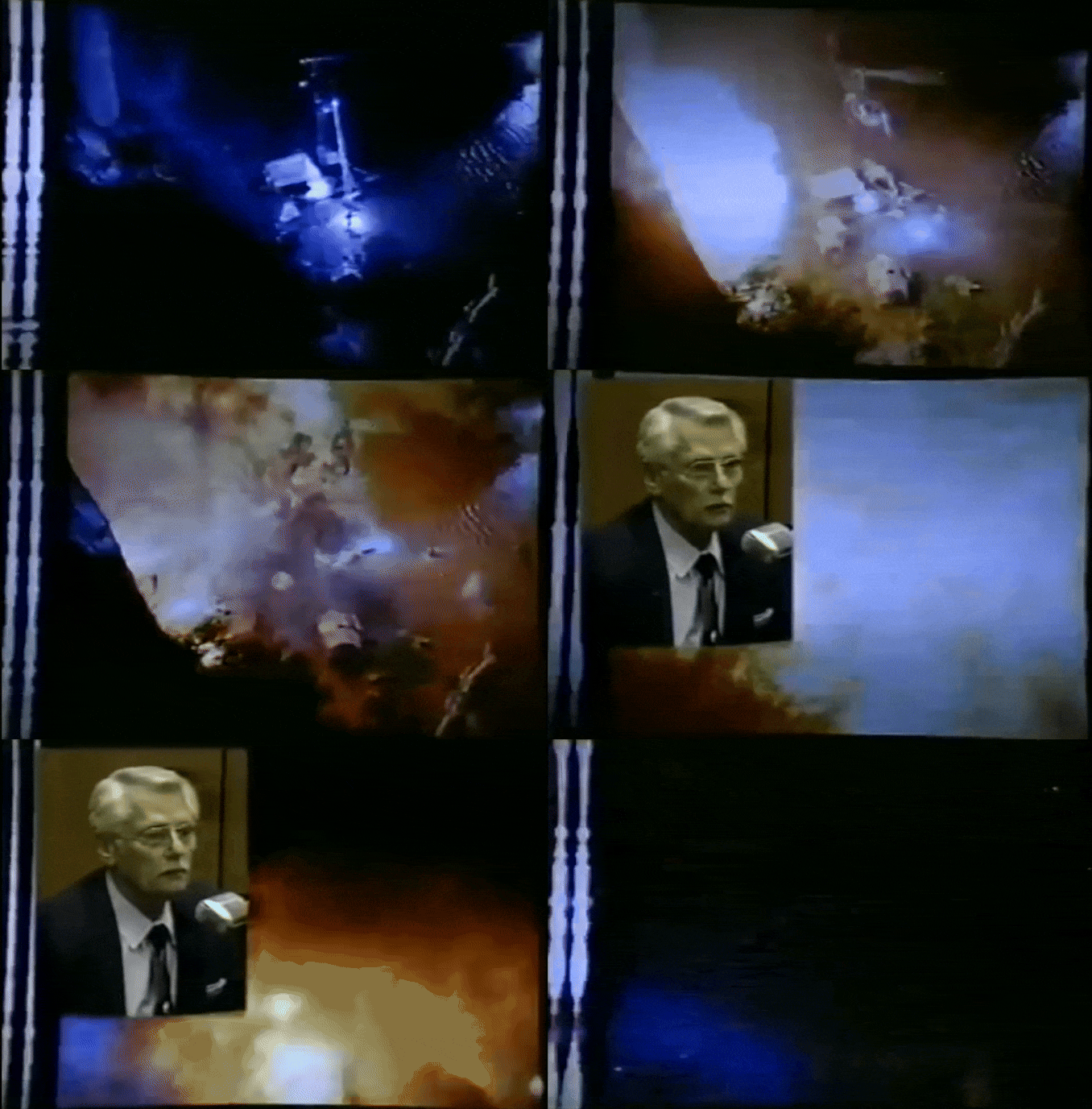
Camera E Scott (35mm; Cliff—Bird’s Eye) Morrow stumbled to his knees and was struggling to hold onto Renee, who had momentarily slipped out of his grasp and into the water below.
The fourth explosion propelled a fireball up through the bamboo floor of the fish-drying hut, destroying the tail rotor of the helicopter and sending it into an uncontrolled spiral, just as the entire village began to thunder from a fresh, climactic round of background pyrotechnic blasts.
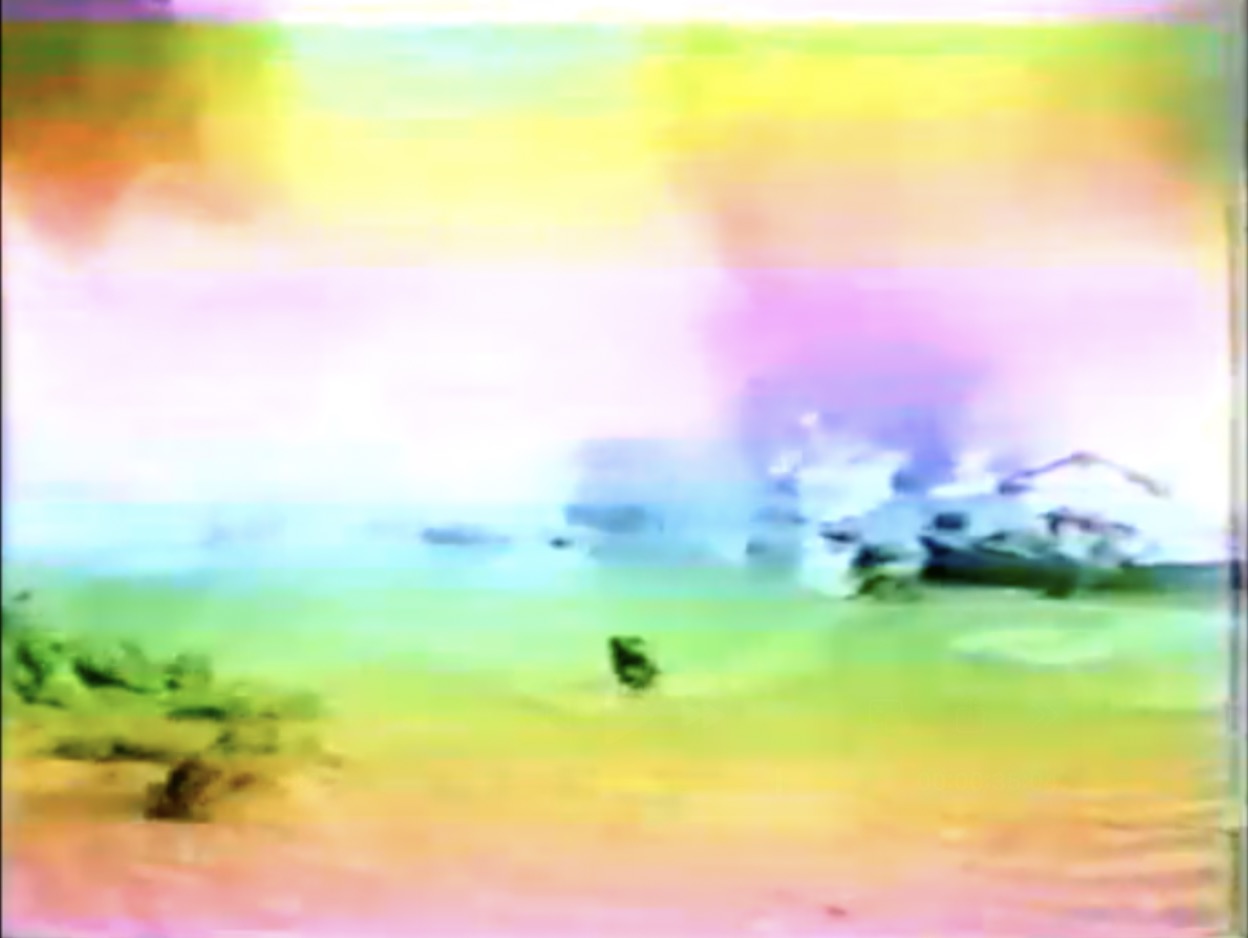
NTSB: After the third explosion, after the third explosion, you said you felt some concussion, some forces on you, when you fell to the ground.
Dr. Le: Yes.
NTSB: And you mentioned some debris.
Dr. Le: Yes.
NTSB: Do you remember what type of debris that you felt?
Dr. Le: Dust.
NTSB: Dust?
Dr. Le: A lot of dust flew over me, a lot of dust, and, I think, the wind; just like a strong wind blow.
Thankfully, Folsey, Jr. was there to help, and just in the nick of time.
And I grabbed the two parents of the two children who were standing with me and turned and pulled them and ran and dove into some bushes that were about 25 feet away from where we had been standing. And then we came back the helicopter was down. And I noticed that the... I didn’t realize this until I testified before the NTSB... that the—that rotor blade, that I think is part of the tail rotor of the helicopter—ended up exactly where the parents and I were standing to observe.
(Grand Jury) Despite the accident being witnessed by some one hundred crew and guests, by the time the first police officer arrived at 2:45am, fewer than a dozen remained
(F&G 145) .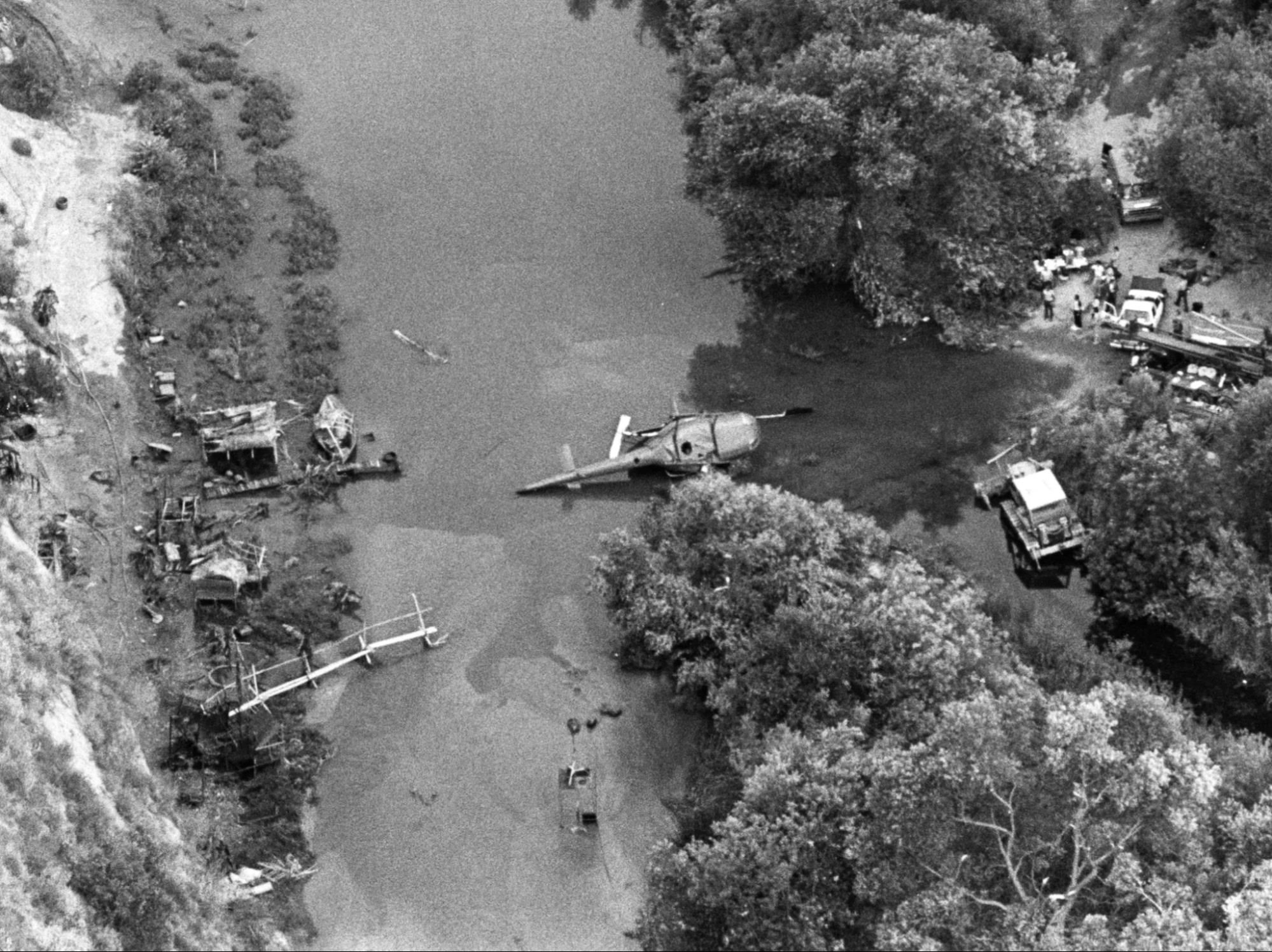
The morning after. 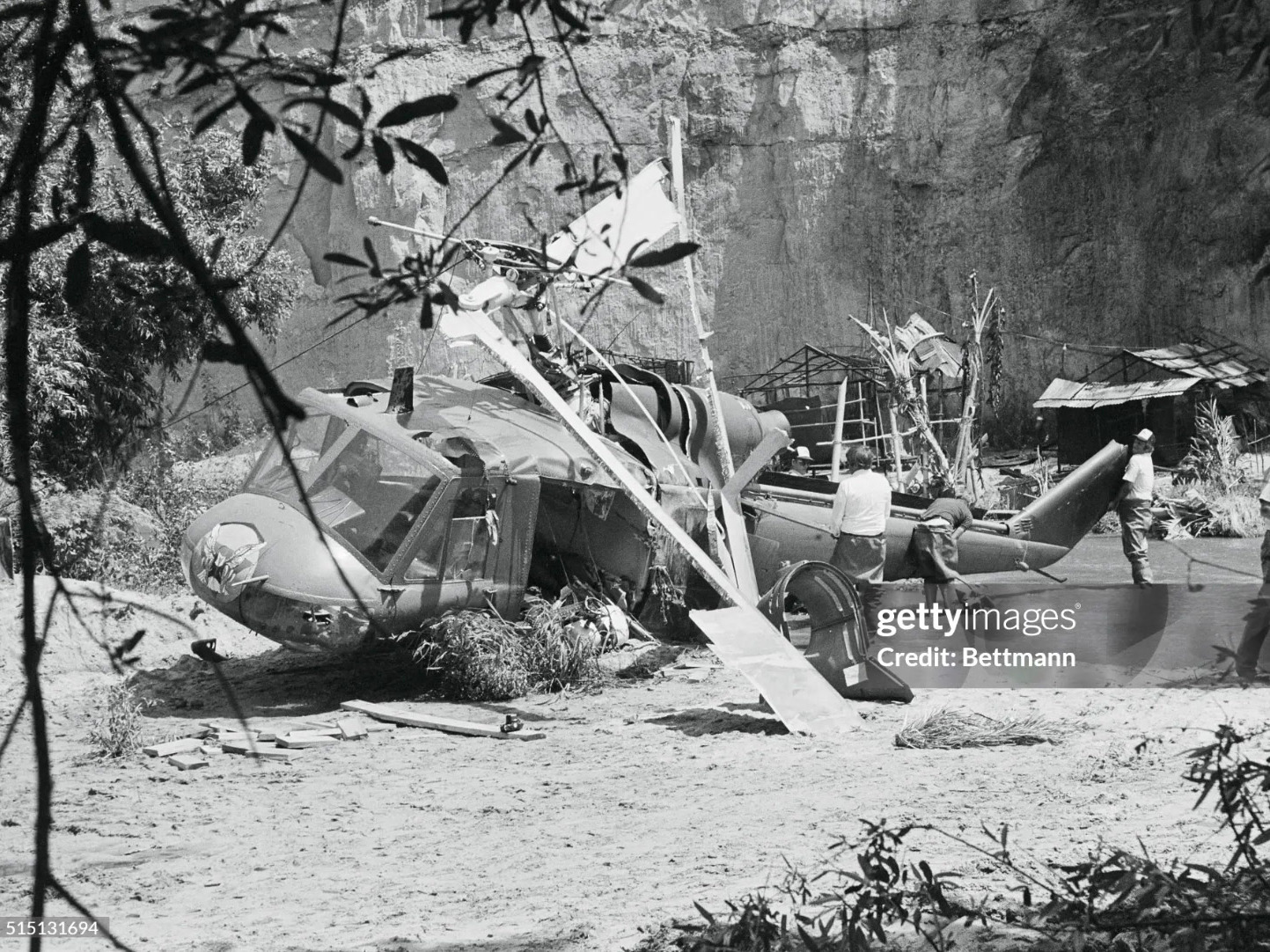
The helicopter after being righted.
#02. Extreme negligence
California Penal Code...
Homicide...
Manslaughter...
...§192. Manslaughter is the unlawful killing of a human being without malice. It is of three kinds:
- Voluntary—upon a sudden quarrel or heat of passion.
- Involuntary—in the commission of an unlawful act, not amounting to a felony; or in the commission of a lawful act which might produce death, in an unlawful manner, or without due caution and circumspection. This subdivision shall not apply to acts committed in the driving of a vehicle.
- Vehicular... [prosecuted as a distinct category, owing to its nuances and larger body of precedent].
This section partially consolidates clear warnings, negligence, and escalation leading to the fatal helicopter crash, supporting the California Penal Code §192 involuntary manslaughter charge.
Landis and his subordinates conceded that they had hired the children illegally
The state concedes that although the defendant
Although one would expect that the basic elements of the scene
-
Early warnings
June 16th & 18th — Marci Liroff’s warnings
Marci Liroff (casting agent) warned Landis, Folsey, Allingham, and Marshall about Landis’s plans to hire children “off the street.” She said the scene “sounds kind of dangerous.” Marshall told her that he would “take care of it.”
(Police Report; Trial testimony) June 13th–July 23rd — Office conversations overheard
Donna Schuman, Cynthia Nigh, and Kathryn Wooten reported statements by Landis and Folsey.
Schuman and Nigh overheard Folsey on calls to what they assumed were the parents of Myca and Renee. Folsey was heard saying: “It is going to be like watching fireworks.” He claimed the helicopter and explosions would not be dangerous to the children.
Schuman asked why he mentioned the explosives if they weren’t dangerous. “It is the right thing to do,” she quoted him as saying. “When we are going to have explosions on the set, you ought to tell everybody up front. I mean, you know, God forbid anything goes wrong, and then if you tell everybody then you are covered.”
(LaBrecque 21) Schuman asked what the penalty was for using children without permits. Folsey replied: “A slap on the wrist and a little fine—unless they find out about the explosives, and then they’ll throw my butt in jail.”
Nigh recalled Folsey joking to Landis after a closed-door meeting: “We’ll probably be thrown in jail after this, just because of the kids.”
On another occasion, Nigh and Schuman said Landis walked down the hall and threw up his arms, saying: “Arrrgghhh, we are all going to jail.”
June 17th–22nd — Anderson House tries to intervene during pre-production
-
June 17th–19th: After reading the script, House asked if they were using a soundstage. Allingham told him they would shoot night-for-night, even though it was illegal.
(Grand Jury) -
June 19th–21st: House researched alternative stunt performers or dummies. Allingham dismissed the suggestions. “His indication was vague, but it seems to me that although it was vague it was also clear.”
-
June 20th–22nd: House made one final call. Allingham said the decision was closed and not House’s responsibility.
July 15th–22nd — Anderson House tries to intervene on-set
-
July 15th–16th: At Franklin Canyon, House again raised the issue, warning that Warner Bros. could lose its license. Landis turned around and said, “Oh.”
July 22nd: After the 9:30 shot (the second time Morrow had dropped a child into the water), House told Cohn to warn Landis about drowning risk. Cohn said he had talked to Landis already: “No problem.”
(Chain, ch. 20; cf. ch. 26) .
-
-
Prospective helicopter pilots
The Unit Production Manager (Allingham) was tasked with vetting potential helicopter pilots for the segment.
1st Pilot/Rental House—Clay Wright:
Clay Wright had flown stunts for a similar segment in The Exterminator (1980), which was also shot at Indian Dunes, also used SFX Supervisor Paul Stewart, and provided John Landis creative inspiration for the sequence. Bid: $1,200/hour.
2nd Pilot/Rental House—John Gamble:
After hearing the scene described, Gamble told Allingham, “the most dangerous position for a helicopter is to be in a hover.” As well, he asked, “What about all this wood and debris? I doubt if you will crash the helicopter, but you’re certainly going to do severe damage to it.” According to Gamble, Allingham never mentioned to him that there would be children in the scene
(Trial testimony) .3rd Pilot/Rental House—Dick Hart:
Allingham told Hart that the Nite-Sun was to be used to shine a light down on Vic and the kids in the dramatic exploding village scene. “Hart happened to have the same Nite-Sun Spielberg used in Close Encounters in the famous shot where the light shines down on Richard Dreyfuss and his car gets lifted up.”
(Chain, ch. 4) .Bid: $900/hour.
Allingham eventually declined, but returned to rent the Nite-Sun spotlight. Hart advised him that the heavy spotlight was difficult to manoeuvre, and offered himself as an experienced technician at no additional cost, an offer Allingham also declined.
4th Pilot/Rental House—Dorcey Wingo:
Experienced Vietnam combat helicopter pilot with no experience flying in films but eager to get into the industry.
Bid: $800/hour (accepted).
-
Disorder and danger on the set (in general)
Early July—Extras locked in railway car during electrical fire:
July 5th–7th (Universal Backlot): Bob Westmoreland (Makeup Artist) reported an incident in which extras were locked in a railway car when an electrical fire broke out. The director had to be located, and the key found before they could be released.
(Chain, ch. 20) Mid-July—Guns used around trained dogs without warning:
July 12th–16th (Franklin Canyon): Dog trainer stated there was no prior mention of gunfire in the scene involving dogs. Just before filming, Cohn offhandedly mentioned shotguns would be fired overhead. The trainer objected, noting the dogs were gun-shy. Cohn spoke briefly with the director, then insisted they needed the shot. The trainer reluctantly agreed. As expected, the dogs were terrified. She said the gunfire came as a complete surprise.
(Police Report) July 20th—Live ammunition used on set
During production of the Vietnam sequence, live ammunition was proposed and used on set after simulated effects proved inadequate.
-
Landis’s bullying at Indian Dunes
Helicopter Pilot (Dorcey Wingo)
While Wingo was positioning the aircraft, Landis launched into a tirade over the radio. “What the fuck are you doing up there?” “Tell him to keep his shirt on,” Wingo said to Allingham. Wingo later told investigators, “There’s no mistaking John when he talked. He was pretty abrasive at that point. And I was a little surprised to hear that kind of language over the radio because the FCC [Federal Communications Commission] does monitor radios. And it’s a good way to lose your ability to use radios.”
(qtd. in LaBrecque 29) Camera B (Steve Lydecker)
Camera B (Steve Lydecker) testified that on Tuesday, July 20th, he expressed concern to Landis that the concussive effect of bombs detonated in front of the cliff could be reflected back over the village. Landis replied (albeit in jest) “well we may lose the helicopter,” and the matter wasn’t raised again.
Mr. Lydecker stated that on that particular night [July 20th] when the helicopter came over the cliff, the rotor wash had apparently caused some scaffolding, on which this arc light was placed, to sway. Mr. Lydecker stated that he heard the “best boy” voice this concern to the director, John Landis, telling him that the scaffolding should be tied off. He said Mr. Landis’ response was to the effect, “Where am I going to find someone who isn’t chicken shit to climb up on those lights?” He stated that the “best boy” got very upset and told Elie Cohn that he was angry at John Landis. He stated that Dan Allingham interrupted this conversation and that Mr. Allingham and the “best boy” walked away together, yelling back and forth at each other.(Police Report) Camera C (John Connor)
Camera C (Ass’t) (Lee Redmond) told of an incident involving Camera C (John Connor) who was asking Paul Stewart if his camera placement was safe in relation to the upcoming mortar explosions. According to Redmond, before Stewart could answer, Landis testily interrupted and said, “It will be safe and if you don’t want to operate the camera you can go home and I will do it for you.”
(qtd. in LaBrecque 28) Make-up (Virginia Kearns)
On 1-6-84, Sergeant Budds interviewed VIRGINIA KEARNS, ████ █████████ ██████, █████ █████████, (███) ███-████. Ms. Kearns stated that she had been hired by Robert Westmoreland as a hairdresser for the Landis Segment of the “Twilight Zone” Movie. She stated that she was on the set the night of the crash. During the 11:30 filming, she was in the vicinity of the man-made dam in the village side of the movie set. While standing in the area of the village and the dam during the 11:30 filming, the heat from the fire balls, generated from the special effects explosions, singed her hair. After the 11:30 filming, she overheard Katherine Wooten tell John Landis that they couldn’t do the next shot, because it was too dangerous to bring the helicopter in lower. Ms. Kearns stated that Mr. Landis’s response was to tell Katherine Wooten to shut up.
(Police Report) Camera D Ass’t (Randall Robinson)/Pilot (Dorcey Wingo):
Camera D Ass’t (Randall Robinson) and pilot (Dorcey Wingo), after the nearly disastrous 11:30pm flight, finally tracked down Landis around 12:15am, while he was checking the B camera up on the Chapman crane platform.
Wingo: “What the hell are you trying to do? Kill us?”
Robinson (Camera D Ass’t): “Do they realize how intense that blast was?”
Landis: “That’s just a warm-up for what’s to come. You ain’t seen nothing yet.”
Wingo: “How would you like a fireball under you right now?”
Landis: “Now, don’t be squeamish.”
(LaBrecque 42–43; cf. Chain, ch. 5) -
One of the children tells Landis they can’t swim (9:30pm)
During the 9:30pm shot, 2nd AD Anderson House, and Morrow’s stand-in, Robert Liddle, witnessed Morrow scoop up the children, one under each arm, and then run out of frame before two explosives were fired. Morrow didn’t slow down: he ran approximately 50 feet into the middle of the man-made lake before stopping. Renee had fallen out of his arms into the water; an issue that would repeat itself during the 2:20am shot. In a previous, unfilmed practice-run for the 9:30pm shot involving the children, with the same staging, House had observed Morrow that time drop Myca into the water.
House told a grand jury that he raised his concerns with 1st AD Elie Cohn, who informed him that he had already made this concern known to Landis: “No problem.”
Landis testified that after this shot, “I asked the children if they could swim. One could and one could not.”
Why, then—to say nothing of everything else—did Landis continue to subject that child in particular to night-time “water-work”?
-
The 11:30pm near-miss
During the second (11:30pm) setup of the night, the pilot
(Dorcey Wingo) was startled by an explosion and nearly crashed.He along with several others among the crew complained to Landis about the close call.
-
Unrehearsed last-minute story change (“The Stumble”)
Landis testified that Morrow’s stumble during the fatal shot had been staged. Landis claimed they improvised it together about twenty minutes prior to the fatal shot, during the 2:00am technical rehearsal.
But if this was true, then neither the children, nor their parents, had been apprised of this last-minute change of plans.
-
Drugs and alcohol
The bulk of the hard evidence gathered by Budds, however, spoke against the likelihood that drugs or alcohol were a relevant factor. Kesselman calculated that he and Budds devoted more than one thousand investigative hours solely to the issue of drug and alcohol use.
(LaBrecque 92) See also Beer and liquor runs for the SFX team.
-
Fire permit violations
“The actual sales records, overlooked for over five years by the police and DA’s investigators, showed that the smallest-sized explosive charges purchased for the fatal scene were 8-oz. charges. Also overlooked was special permit No. 55926 issued by the fire department to Paul Stewart ten days before the crash. It gave him permission to purchase 200 feet of 100 grain prima cord. This amount of “high” explosive was capable of knocking down as many as 70 telephone poles, “like matchsticks,” according to special effects experts. Both of these pieces of evidence ran contrary to all SFX accounts that the highest-powered explosives on the set of the TZ crash were 6-oz. “low” explosives. A “high” explosive far more lethal than the black powder bombs admittedly on the set that night, the prima cord was never mentioned by SFX crew members.”
(Chain, ch. 29)
#03. Five corporations and nine individuals
On August 2nd, 1982, within two weeks of the incident in question, a civil action Chen et al. v. Warner Bros. et al. was filed in pursuit of damages estimated at $200 million. The complaint, filed in the Superior Court, named numerous entities—corporate and individual—as defendants. Such breadth in initial filings is consistent with litigation arising from complex incidents involving multiple parties, where ensuring inclusion of all potentially liable contributors is a strategic necessity.
The complaint named the following five corporate defendants:
- Bell Helicopters, manufacturer of the helicopter involved;
- The Burbank Studios, the lessor of land to Warner Bros. Studios;
- Newhall Land & Farming Company, owner and lessor of the Indian Dunes site;
- Warner Bros. Studios, the principal production entity;
- Western Helicopters, supplier of the helicopter and pilot in question.
Additionally, nine individuals were named in their professional capacities, as follows:
- Dan Allingham, Unit Production Manager;
- Joe Dante, Co-director (Segment 3);
- George Folsey, Jr., Associate Producer;
- John Landis, Co-producer, Director, and Writer;
- Frank Marshall, Executive Producer;
- George Miller, Co-director (Segment 4);
- Steven Spielberg, Co-producer and Co-director (Segment 2);
- Paul Stewart, Special Effects Supervisor;
- Dorcey Wingo, Helicopter Pilot at the time of the accident.
On May 23rd, 1983, the Le family was added to the action. While no specific monetary figure was sought, Dr. Le indicated that part of any resulting award would be contributed in Myca’s memory toward the establishment of a safety education department at USC’s School of Cinema-Television
The matter was settled out of court on May 7th, 1987—two days prior to a scheduled deposition by Spielberg
#04. Serious threats of blacklisting
Steve Lydecker (Camera B—Master shot):
Camera operator Steve Lydecker believed in the power of blackballing. He had worked regularly in the movie industry for twenty-two years and believed that his six months of unemployment was due entirely to his outspoken criticism of the production after the crash.
Steven Lydecker, an experienced camera operator who had worked steadily in Hollywood since doubling for a child actor in the 1948 John Wayne vehicle Wake of the Red Witch, has not worked in the movie business since December 1982. He believes he was blackballed because of his damning statements about Landis. “Friends of mine have put my name in for jobs,” Lydecker says, “and producers say I’m a troublemaker.”
Lydecker came from a storied Hollywood family; both his father and uncle were well-respected special effects artists
At the time of the accident, Lydecker was perched on the extended platform arm of the Chapman crane, “elevated approximately 25 feet above ground level”
Lydecker had filmed the same angle at 11:30pm, earlier, and was under the impression that the helicopter had been established and was now being used just to provide a mobile wind and lighting-platform effect, as it had been used during the 9:30pm shot earlier. Landis told him as much directly.
He’d watched on July 20th as Landis oversaw the use of live ammunition on set; on July 21st as Landis chewed out a member of the electrical team for being “chickenshit;” and, when he himself pointed out that the position in which some of the mortars were being installed presented a potential ricochet hazard, Landis glanced at him and quipped: “Well, we may lose the helicopter.”
Lydecker was also present—up in the crane—as the pilot (Wingo) and the Camera D assistant (Robinson) confronted the director after the 11:30pm near-miss.
Dorcey Wingo (Pilot): What the hell are you trying to do? Kill us?
Randall Robinson (Camera D Ass’t): Do they realize how intense that blast was?
John Landis (possibly confused): That’s just a warm-up for what’s to come. You ain’t seen nothing yet.
DW: How would you like a fireball under you right now?
JL (in jest): Now, don’t be squeamish.
The helicopter, in its uncontrolled descent, arced toward the extended crane arm. The still photographer
Roger Smith (Camera D):
Anderson House (2nd AD):
Anderson House had worked with Spielberg previously on E.T. (1982), and was excited to be asked back for Twilight Zone: The Movie. As soon as he was brought on, he flagged the scenes using the children as ambiguous and problematic. He brought up safety concerns with his superiors, Landis, Folsey, Allingham, and Cohn, not once, but five times, and was summarily deflected, disrespected, and ignored each and every time. Unfortunately, despite his protests, he participated in the conspiracy to conceal the children’s presence on-set.
After the accident, House was torn between telling the full story to investigators, and protecting his career interests.
In the end, House successfully petitioned the DGA to have his name removed from Twilight Zone: The Movie, and served as a critical witness for the prosecution.
Alpha Campbell (Studio-assigned typist):
...Complained about being threatened, saying that she’d received anonymous telephone calls during which a male voice warned her that if she said anything unfavorable to Landis, “You are aware you would lose your job”
Twice, Landis was seen menacing witnesses in plain view of the court:
Gail Rochlenback:
Landis pointed his finger at a witness like a gun, as witnessed by one of the lawyers for the defence, Eugene Trope (Wingo’s counsel)
(LaBrecque 156–157) .“Yesterday while I was escorting Ms. Rochlenback
(a friend of Donna Schuman’s who corroborated her “unless they find out about the explosives” testimony) upstairs in the elevator, she indicated to me that during the break, while she was still sitting on the witness stand, Mr. Landis looks at her and goes like that toward her. Like she was being shot.” The detective extended his right hand, as if in the shape of a pistol, index finger straight out, thumb raised, and the remaining fingers closed. “My concern is it’s been difficult enough getting these witnesses here, let alone having them put under . . . what I feel is intimidation.”Neal angrily interrupted Budds, saying, “I would like the court to hear from Mr. Landis on that. I mean, I deny that.”
Boren quickly concluded the gesture was “not in contempt of court at this point, because I did not see it. If, in fact, it occurred, that would be cause for grave consequences.” He then looked up at Neal, and waved him to warn Landis.
“I wouldn’t even finish the trial if he did something like that, and I’m satisfied that he didn’t,” Neal said.
What Neal and Landis apparently didn’t know is that Eugene Trope could easily have put the Nashville lawyer to the test on that rash promise.
“Yes, I saw the gesture,” Trope later told me.
[...] Marci Liroff:
Landis blocked the path of a key witness as she returned down the well of the courtroom, witnessed by LaBrecque himself.
I watched Liroff stop when she saw that Landis impeded her exit. “Excuse me,” she said, standing inches away and looking down at the director. Landis continued writing and did not look up. Liroff hesitated only a few seconds before awkwardly stepping over his legs. Her annoyance was apparent as she concentrated on keeping her balance. She walked briskly out of the courtroom, shaking her head angrily, followed by a glaring stare from Landis, who had looked up as soon as she had passed him. When Neal stood up a few seconds later, Landis quickly pulled his legs back to let him pass. (161)
According to Chain, Liroff said she felt that she had suffered professionally as the result of her testimony. Farber and Green note that “although she had cast several films for Steven Spielberg and Frank Marshall before Twilight Zone, she has not worked for them since 1983.”
(F&G 378)
In all, eleven witnesses before the grand jury claimed that their work time had fallen off drastically since the accident
#05. A grand jury hearing, a preliminary hearing, and an appeal gone awry
Grand Jury (May/June 1983):
Kesselman conducted a tour-de-force, involving over thirty witnesses, and all five defendants were indicted: Landis on all five counts; Stewart and Wingo on three; and Folsey and Allingham on counts 2 and 4 (the office counts)
Preliminary Hearing (January/February 1984):
At this point, the defence had sharpened their “delamination theory,” arguing, effectively, that the helicopter’s tail rotor hadn’t been blown off, per se, because the explosives they were using shouldn’t be that powerful, but rather that its skin had “delaminated” under extreme heat. The defence argued that this so-called “delamination” was unique in aviation history and therefore, necessarily, unforeseeable. Although Judge Crahan was skeptical about the delamination argument, he decided to let the three office defendants off the hook for the office counts.
Appeal Hearing (November 1984):
The defence pushed their luck. They gambled on an appeal hearing requesting the case be thrown out altogether. Instead, Judge Ringer re-introduced the two office counts as having been incorrectly dismissed!
Interim (1984–1986):
In the interim, both Landis’s lead counsel, Harland Braun, and the DA’s prosecutor, Gary Kesselman, were replaced. Braun was demoted in favour of Watergate prosecutor James Neal, but stayed on as Folsey’s lawyer; and Kesselman was taken off the case shortly after a “taxi dance” club he co-owned was raided by police and found to be employing illegal immigrants.
As well, Kesselman was not liked by the incoming DA Ira Reiner. Kesselman, still unsure about the significance of the delamination theory, favoured accepting a plea deal offered by the defence: plead guilty but no jail time. Reiner was more bullish: “What the hell, does anyone care whether it is delamination or debris? You’ve got two dead kids. You’ve got a helicopter. You’ve got explosives. What more do you need? ... Landis is going to go to the state prison on this!”
Kesselman was replaced by Lea D’Agostino, who had a successful track record prosecuting career criminals and sex offenders but was inexperienced in the vagaries of “Involuntary.”
In 1985, Braun sent two letters to the DA intending to point out the unfairness of prosecuting the office counts when several other high-level executives could also be presumed to know about the illegal hiring: why weren’t they being prosecuted? It didn’t bother these “acknowledged experts” at the time, evidently; ergo, those charges should be “disposed of” against Braun’s clients.
It was of no use, however, and the case was off to trial.
#06. Missing evidence
One of two audio recordings
The lone recovered audio recording was used as evidence in the preliminary hearing.
Two separate audio teams were hired to record the sound for the 2:20am shot. In the chaotic aftermath of the accident, for several days, the footage and sound recordings were withheld by the studio. One of the audio recordings had gone missing. This was of particular significance in the earliest stages of the investigation, as investigators hadn’t determined who was calling the action through a white bullhorn.
The on-set photographer’s negatives
On 3-10-86, Sergeant Budds interviewed MORGAN RENARD, via telephone. Mr. Renard stated that he was employed as a Photographer to take still publicity photographs of the “Twilight Zone” movie. Mr. Renard stated that he had taken approximately 108 photographs. Following the fatal crash, Mr. Renard took his three rolls of film with 36 photographs each, to Mr. Robert Friedman, Director of Publicity for Warner Brothers. He stated that he personally handed these three rolls of film to Mr. Friedman.
On 3-10-86, Sergeant Budds telephoned MR. ROBERT FRIEDMAN at Warner Brothers Studios. Mr. Friedman stated that he will try and locate the above photographs. As of the writing of this report, the photographs had not been located.
(Police Report) The Executive Producer’s “Making Of...” documentary
Marshall had overseen the production of The Making of Raiders of the Lost Ark and The Making of Poltergeist, used to promote the movies to theatre owners, but which had been surprising hits on hospitality TV services and pay-per-view.
He was also making The Making of Twilight Zone... but only a single shot was ever released. It had been slated: DOCU/2:00.
Kathryn Wooten (Script Supervisor) to the NTSB:
NTSB: Do you remember any documentary shots being taken?
KW: They were supposed to fire those off when they could. Prior to that shot, I don’t know if any of them did or not. They were real bad about letting me know so I could enter it in my journal. I said tell me if you do it but all the time they would do it, and Frank Marshall would run around and say, oh, shoot this real fast, you know. You might say make a doctored shot of this or there is John directing the (Unintelligible). Sometimes they would tell me about them and sometimes they would just, you know, they don’t bother by doing that and so they would just sort of roll it and the cameras would print it, but I don’t know if they did any that night or not. I don’t know. Nobody told me if they did.
NTSB: But in any event under normal shooting, you would be told if they were doing documentaries so you could log it in your journal?
KW: Yes, I could log it, but they were just constantly real bad about that, you know, unless I happened to be right there and know they were rolling. Sometimes they would yell out, you know, oh, we just shot, you know, such and such and I’ll put a tail plate on it when you want me to call it and I was keeping a log, you know, docu 1, docu 2.
The fourth draft of the script
After the third draft was written and Landis set his intention to go about casting it illegally, he ordered his studio-assigned secretary/typist
(Alpha Campbell) to keep it under lock and key. Later on, after the disaster, he ordered her to destroy all remaining copies.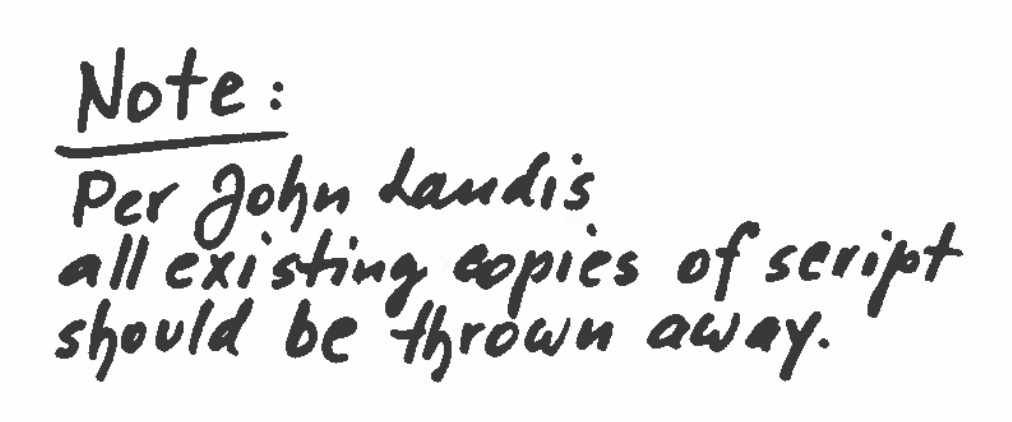
Written note on the cover of the third draft (detail) Campbell, however, who was discovered as a witness in March 1983, simply kept them locked away, and was therefore ultimately able to provide investigators with all four of the different drafts.

Index, police report (detail). However, Sergeant Budds’s original police report lists only the third draft (6/13/82) as evidence. The fourth (6/26/82) survives, with the other drafts, in LaBrecque’s archive, but it appears never to have been examined by the prosecution.
Several “thumbnail sketches”
On July 28th, 1982, Landis was grilled by Cal/OSHA and the NTSB during a panel interview.
“He was asked whether there were any written plans for the sequence with the helicopter flying and the explosions going off. Cavalierly, the director allowed, ‘There were lots of thumbnail sketches.’ As for blueprints, he couldn’t remember.”
(Chain, ch. 16; cf. ch. 26) These sketches, however, never turned up.
All graphic and visual materials relating to the film’s production
With the additional $200,000 budget, especially for such a technically involved shot, the scene would certainly need to be planned out in some respect, and indeed designers were hired for the task: Richard Sawyer, Gregory Pickrell, and Tom Southwell. They worked in Southwell’s garage.
(Chain) Still, when the state requested the defence turn over all visual materials pertaining to the segment, such as scripts, notes, and graphical layouts, they resisted, until ordered to do so by an assistant US attorney on behalf of the NTSB, and only turned over a single drawing, known as the spotting plan.
#07. “The spotting plan”
The spotting plan looked very much like a top-down diagram of the set.
Remarkably, it included a helicopter that appeared to be labelled “crashed.”
Budds had been puzzled by the image.
It depicted the Vietnamese village with a crashed helicopter (tail missing) and was located approximately 20 feet from the actual crash position. He took the graphic drawing to the Sheriff’s Photo Lab where it was photographed.
Later, he inquired with the set designer, Gregory Pickrell:
Mr Pickerel [sic] stated that he was one of the artists for the Landis episode of The Twilight Zone. He stated he was the individual who had drawn the graphic which depicted the crashed helicopter in the final scene of the Landis episode.
He stated that he put a crashed helicopter into this artist’s conception because following his research about Vietnamese villages he thought it would add authenticity. He concluded that this concept was solely his idea and that he had suggested to his boss Richard Sawyer that a crashed helicopter be considered for this scene but he had not heard any more about it.

Richard Sawyer explained it to the grand jury as follows:
(Notes by stenographer)
Hired Greg Pickerell to do some artists renditions of village—his job is a set designer who lays out the plans of the sets. Says he had a four week prep to do the show. Got sketch in June. It shows a downed helicopter, a crashed helicopter, in about position it really happened, without rear rotor.
To clarify, Kesselman asks him questions about Landis—he says Landis never said he wanted downed helicopter in sketches and never mentioned that there would be be [sic] crashed helicopter at Indian Dunes.
Pickerel knew of helicopter in basement of Paramount and he said “gee, you know it would be a great idea, since we are showing a village under attack, why don’t we have a helicopter in the water?”
Sawyer says he told Pickerel that he didn’t think it would work but to finish drawings and they would get back to him.
Pickerell said it was a result of his own research that he put helicopter that way.
DA: “As far as you know this is strictly an ungodly coincidence?”
Sawyer: “Yes.”
#08. Twilight Zone crew list
THE TWILIGHT ZONE—Landis Episode
CREW LIST
Executive Producer: Frank Marshall –
Director/co-Producer: John Landis –
Assoc. Prod. (Landis Episode): George Folsey, Jr. –
Production Manager: Dan Allingham –
Director of Photography: Steve Larner –
Camera Operator: Arnold Rich –
1st. Asst. Cameraman: Rich Benda –
2nd Asst. Cameraman: Don Cropper –
1st. Asst. Director: Elie Cohn –
2nd Asst. Director: Anderson House –
Asst. Dir. Trainee: Hilary Leach –
Casting: Fenton & Feinberg –
Prod. Designer: Richard Sawyer –
Set Designer: Gregory Pickrell –
Set Decorator: ██████████ –
Lead Lady: ██████████
Swingman: ██████████
Swingman: ██████████
Costume Designer: Deborah Nadoolman –
Men’s Wardrobe Supv.: ██████████
Addt’l. Men’s Wardrobe: ██████████
Women’s Wardrobe Supv.: Sue Dugan –
Makeup Artist: Bob Westmoreland –
Spec. Effects Makeup: Craig Reardon –
Hairdresser: ██████████
Propmaster: Mike Milgrom –
Assistant Propmaster:
Script Supervisor: Kathryn Wooten –
Location Manager: Dick Vane –
Sound Mixer: ██████████
Boom Man: ██████████
Cable Man: ██████████
Key Grip: ██████████
Add’l. 2nd Grip: Bob Farnsworth –
Dolly Grip: Bobby Jaynor –
Additional Dolly Grip:
Gaffer: Allen Goldenhar –
Best Boy: Steve Shaver –
Add’l. Best Boy: Larry Peters –
Lamp Operator:
Lamp Operator: Ishmael Ruiz –
Electric:
Electric:
Prod. Illustrator: Tom Southwell –
Sr. Set Designer: Greg Pickrell –
Const. Co-ord: ██████████ –
Propmakers: ██████████, ██████████, ██████████, ██████████, ██████████ –
Labor Foreman: ██████████
Paint Foreman: ██████████
Paint gang boss: ██████████
Const. Foreman: ██████████
Stunt Coord.: Gary McLarty — HO 22
Central Casting: ██████████
Animal Trainer: Frank Inn (Cindy) –
Transportation Coordinator: Jeff Renfro –
Driver Captain: Tom Roberts –
Camera Car Driver: Byron Nashold
Camera Car Driver: Scott Benson, Kenneth Day –
Special Equip Driver: Allan W. Herendeed –
Special Equip Driver: Allan Tietjen –
Special Effects: Paul Stewart
Special Effects: Kevin Quibell
Special Effects: Jerry Williams
Special Effects: Harry Stewart
Caterer:
The Flash: Donna Schuman
Production: Cynthia Nigh
Production Assoc.: David Monkarsh
Production Assoc.: Barry Pener
Production Assoc.: Carolyn Epstein –
Old Cars:
Publicity: Saul Kahan
Still Photographer: Morgan Renard
POST-PRODUCTION
Editor: ██████████
Asst. Editor: ██████████
Asst. Editor: ██████████
PRODUCTION CONTACTS
WARNER BROTHERS
MARY RADFORD (Assistant to Frank Marshall):
FRED GALLO (V.P. World Wide Prod. Mgmt.):
ED MOREY (V.P. & Exec. Prod. Mgr.):
██████████(Asst. to Ed Morey):
██████████(Industrial Relations):
██████████(Insurance):
██████████(Transportation):
JIM HENDERLING (Warner Bros. Representative):
BONNE RADFORD (Accountant):
██████████(First Asst. Accountant):
JOAN RADFORD (2nd Asst. Accountant):
██████████(First Aid):
#09. You’ll Never Eat Lunch in This Town Again (index locorum)
At the 46th Academy Awards, The Sting (1973) celebrated a monster year. It had been a surprise hit at the box office, stealing The Exorcist’s thunder by opening faster and wider. Then, the word of mouth made the movie into an experience, and had friends and families coming back all summer long.
Julia Phillips became the first woman to win an Oscar for Best Picture, and remained the only one until Wendy Finerman became the second in 1995, with Forrest Gump.
Phillips would go on to produce—alongside her ex-husband, Michael Phillips—Taxi Driver and Close Encounters, two of the defining movies of the late ’70s. While her ex-husband took the lead on Taxi Driver, Phillips took the lead on Close Encounters.
At the same time, since about 1973, she was maintaining an escalating cocaine addiction, which peaked in about 1978–79 as a freebase addiction. She eventually went through a successful rehab process, and began working again in 1981 with a new development deal at MGM.
Her relationship with Spielberg was never the same, and the two went from close friends to cordial strangers in a matter of years, without so much as a conversation in between.
In 1991, Phillips, with the encouragement of her friend, the author Anne Rice, finished her memoir, You’ll Never Eat Lunch in This Town Again, which went on to be a New York Times bestseller, and to sustain a lingering cultural relevance.
“Steven” is one of the story’s main characters, who travels with the protagonist along the story’s central arc. On September 13th, 1977, at the tail end of post-production for Close Encounters, while renegotiating merchandising rights with a beleaguered studio, Phillips is banned from the Columbia lot, which quickly becomes a gossip column headline and an embarrassment to the production, before descending further into—and eventually escaping—her addiction, to write her own book about her own experiences.
“Don’t get mad, get even,” a career rival, Dan Melnick, had told her early on, after she’d piqued his professional interest in The Sting, only to use that interest as leverage for a better deal with Universal. And Melnick had been there too, that day, September 13th, 1977.
§1. New Hollywood
90: I am a spotter of trends:
the drug paranoia underlying the movie [Easy Rider] is rampant in the alternative culture that has sprouted.
It amazes me that this is not obvious to the people releasing the picture.
104: and so, with little money in our pockets, we start to organize weekend-long soirees.
People have such a good time, and are so impressed with who they meet, they bring more interesting people the next week. These enterprises grow and grow and it is possible to see Robert Redford and Liza Minnelli, the veteran famous, along with Brian De Palma, Marty Scorsese, and Steven Spielberg, unheralded and barely known, drinking wine, eating steak, walking on the beach. A rare mixture of haves and have-nots. Plus there is a fascinating beach community: the Dunnes, the Moores, Katherine [Katharine] Ross and Conrad Hall, Lee Grant and Joey Feury... And always, always, talk—grandiose talk—about movies, about the state of movies and how much better they will be when we make them. Pot is around, some psychedelics, and there is a whole branch that is getting into arica.
123: SCENE FROM A MOVIE WITHIN A MOVIE:
OVO: I am standing on a chair, having a face-to-face over a glass of wine with Michael Crichton one afternoon at Margot and Jennifer’s, early seventies.
He and Paul Lazarus are making a movie called Westworld over at MGM with Dan Melnick. HANDHELD CAMERA CIRCLES AND WEAVES THROUGH YOUNG HOLLYWOOD: Scorsese, Dreyfuss, Milius, Spielberg, Schrader, etc. A rogues’ gallery of nerds. There is not a single guy here I would have dated in high school or college. Outside of Michael Phillips. Michael Phillips and Michael Crichton know each other from Roslyn. They used to do the circle jerk as Cub Scouts together. Male bonding. It is amazing how many people from Great Neck and Roslyn there are trying to make their way in show biz. A number of them do...
133: The Sting is coming out right in the middle of a marketing revolution.
Up until The Godfather, every time you had a picture you thought was going to have reviews and audience appeal, you let it out slowly in a handful of chichi theaters in the major cities, and let it build. Then you went in ever widening waves. But Frank Yablans had released The Godfather, and then Love Story, as if they were two-week actioners, and now everyone was figuring out that a quality picture could really rake in the dough. Fast and long. Not one or the other. The revolution has not yet occurred at Universal, which at this point in its career has not decided if it is in the movie business or not. It is definitely in the TV business, but not too many people there are in the movie business. There are George Roy Hill and Steven Spielberg, and Sid Sheinberg and Ned Tanen. Outside of them, nobody at Universal knows that there is a marketing revolution going on. By the time they release Jaws for Steven, they will know it and go with a thousand theaters. But just now, they are going with about thirty-five in key markets, and I am checking out with Lederer and Leo, who together form a pretty dynamic marketing duo for Warners, if I should take a stand or not. I have made myself learn a lot about this part of picture-making on Steelyard Blues, and I figure I should apply it to The Sting.
224: I am going to New York for some precasting sessions with Richard and Steven.
We all agree, even Michael, that I should bring our still unapproved workprint of Taxi Driver to New York and show it to a couple of critics. These guys have all been cultivating Pauline Kael, whom I have met at least five times and who never recognizes me.
353: I loved Milius’s writing, and even his bluster, it was basically so harmless, but he had awful yellow teeth that surely he could afford to have fixed.
And he smiled and snarled a lot. I got pretty hung-up on his teeth. Me and Milius ended up not being friends. While we were making Close Encounters, Steven, to whom I had introduced Milius, kept telling me stories about the terrible things Milius was saying about me. What for? What’d I do to him? What could he possibly be pissed at me about? Maybe it was my use of drugs, Milius being as straight as he was, maybe I was supposed to fuck him and didn’t understand. Maybe it was just another Hollywood Thing. Beautiful people doing beautiful things, as David Debin said. Just about every morning that I ever lived on Nicholas Beach, I watched the real California surfers, the kids who waited in a row at Point Zero on Nicholas Beach, out past the Bad Vibe Roy Ashe house that jutted out and cut off the view of Santa Monica. They looked like ducks on a pond. Milius was so far behind them he was beneath last.
§2. CE3K
139: I don’t know what he means by it,” I lie, “but Steven says he wants to do a movie about UFOs and Watergate, and I want to do it with him.”
I am leaning on the edge of Begelman’s desk, because when you are in his office, it is best to stand. He likes to keep the heat up and the Muzak just at the edge of your consciousness. He likes the vibe soporific. He likes to keep the meetings short and docile. I like to walk around anyway. It helps me to keep my naturally circuitous thinking patterns linear. I make more points walking, and I slamdunk on the sudden stop or the lean against the desk. Begelman stands up; now he is taller than me again. “I’m in,” he says. “Let’s go.” Lies work. Just sweep him along on pure excitement. How am I to explain to D.B. that anyone who has ever dropped acid and looked up at the sky for a while or smoked a joint and watched the Watergate hearings on TV is waiting for this movie? And that it is uniquely this group of people who is going to give it to them? Hubris and youth and the promise of really good drugs fire these ambitions. There is no question in my mind that this group—weak as we are on story and screenplay—can pull it off. It will be like building a city.
140: ...Steven and Michael and me wait in the holding area outside Begelman’s office.
We wait for Begelman, but more to the point, we wait for Guy McElwaine, a star agent at ICM. He represents Steven, so he is going to represent all of us on Close Encounters. We offered to do that to guarantee Steven staying in the project. Steven was hanging out with men who were too old for him. Who bet and drank and watched football games on Sunday. Who ran studios and agencies. [...] We got Steven outta Guy’s house in the Bev Hills flats, and on to the beach, where people were still discussing art and greatness, and were occasionally smoking a joint. Where the ambient sound was rock ’n’ roll, and the house wasn’t so decorated that even the inhabitants felt like guests. Steven was the most talented contemporary we knew. He and Michael had become friendly while we were at Universal and we’d seen some dailies of Sugarland Express. We wanted to guarantee his staying in, and Guy and ICM hitting us seemed reasonable.
184: I have Columbia spending constantly.
On tests, on more assistants, on one under-the-table rewrite after another. The Beges has agreed not to read Schrader’s first draft, called Kingdom Come, because I told him it would make him not want to make the movie. Certainly it was not a screenplay that Steven wanted to direct, although it very much created the Roy Neary character, a man obsessed by something way beyond his intellectual but within his visceral comprehension.
188: Producing Close Encounters is beginning to get to me.
I have met a couple of “line” producers, exalted production managers with production manager mentality. Aggressively noncreative money-watching types who are afraid to talk to the director. This is still an era where the producing job isn’t so subdivided.
Michael has made it clear he ain’t doin’ it; he’s planning to go around the world in search of the soul he doesn’t have. Originally Verna Fields, who edited Jaws, was going to be associate producer, but then Steven started to resent all the credit she was giving herself for its success and asked me to kill her off. Which, to be honest, was fine with me, because I hadn’t liked her from the start. She was my mother: angry, bitter, middle-aged, frustrated. Mad at all the kids having their big shots. Being the Big Shots. Once she and I were invited to speak to a convention of Eastman Kodak types in Rochester, New York. I had just done one of those silly commercials for them that appeared in all the Film Digest magazines. I had mentioned her in the body of the copy and Steven had cut her out and said, Come up with another woman. I had put Marcia Lucas’s name instead.
189: “Maybe you’ll be executive producer on Fear of Flying...
tell the Beges you’ll take it over if I fuck it up...” Steven nods, yes, maybe, as long as I understand Close Encounters comes first. My life on hold, my dreams on hold... “All great movies are the product of one person’s obsession,” he keeps telling me. My obsession, his film. Not a very good deal. But I’m not into deals. I am into one step in front of the other, up the ladder, don’t get stuck, stuck here on the ladder of my life...
226: Grady doesn’t think twenty-five grand is enough money to sit in Francis’s suite with Steven and learn how to write movies.
He complains about the money constantly. I keep him provided with blow, to take his mind off the money, and he complains about that too. He has actually managed to make me feel like a failure getting him only twenty-five. He should know what it was like getting twenty-five for him from Stanley Jaffe. When I first asked Stanley for the money he dismissed the request and told me that friends did rewrites for free. I tried to explain that Grady was a friend, but he was also from television, and was routinely paid fifteen hundred bucks just to watch someone else’s run-through and write a couple of jokes. I tried working it out with Stanley, teasing cajoling flirting but he was resistant. I kept telling him that this was who Steven wanted and we had already gone through a number of writers for free. We had gone through some writers for money, too. The best ideas were freebies from other film-maker types we were hanging out with. Brian De Palma came up with the implantation of the mountain. I never really knew whose idea was what, not even my own anymore. Steven would call at night sometimes, and chat about ideas. With Tubular Bells playing in the background. I never knew if they were his ideas, or Barwood and Robbins’.
245: The test had been sitting in the projection booth all day, but I was so busy I was forty-five minutes late on everything and long overdue for a bathroom visit.
If I didn’t see it right away, though, Steven would think I didn’t care. And if I didn’t care enough he might commit to another picture. I had once written in lipstick on his bathroom mirror, “Stop me before I make another deal,” and he’d laughed but he continued to read scripts. It created underlying pressure at all times and it gave me a big headache every night at about six thirty.
253: Steven has bought a scooter and gone off driving on it during lunch hour.
He has a Jewish nerd’s touch with wheels. He is a lousy biker, and I start going along for the ride, although what I think I can accomplish more than to get two people killed instead of one, I don’t understand. I can scream Slow down in his ear, and hope he will listen. I do, after all, as they like to say, have his ear. It is actually remarkable, considering, how far I seem to be going by having someone’s ear. Redford. Streisand. Steven. No power of my own, just the power to have someone’s ear.
§3. Steven
196: Basically, though, I am here with David Begelman’s money babysitting Steven while Jaws opens in New York.
I have worked long and hard keeping Steven’s interest in the project. Today he has gone around the City in a cab with Albert Brooks taking home movies of the lines of people waiting to get in to the theaters. The boyish joy and pleasure he expresses make me, a natural cynic, feel more hopeful. He is so blatant in his excitement for himself that he is adorable. I do not notice for at least a year that this kind of behavior bespeaks a childish self-preoccupation that tends to remove all hope. In the end. Because cynics are hopeless romantics, and they get more disappointed.
203: We ride up the elevator, chatting lightly, and Steven starts to stutter.
I can never figure out if this is a sign of nervousness or a manipulative device.
244–5: [On François Truffaut, whom they’d cast as one of the leads in Close Encounters:]
“Steven, I’m telling you that left-ear shit is as authentic as the gimp.” A couple of sentences per day were devoted to this subject.
“He’s deaf,” Steven argued. “He makes me repeat everything several times, even with Sally translating.” It didn’t occur to Steven that he was being pimped. People as manipulative as Steven never think that they could be just players in other people’s mind games. “Making you repeat stuff could be any number of things,” I pushed. “He could be trying to understand his part, which is the nice interpretation. Or he could be pulling a power play. Making you repeat yourself too many times for you to be the boss.” Silence. It was either too easy or too hard to get Steven Spielberg’s attention. That’s why he was such a great director: for him it had to be perfect small moments between people or Barnum & Bailey. Lots of directors were doing small moments but no one was doing the circus quite so well. Halfway through dinner I whispered “François” and he turned minutely in my direction. Of course, Steven argued that it was an inconclusive gesture, and he welched on the bet. I know I won because it earned me François’s eternal enmity. When the dinner was over and we had all said our goodnights, we got back into Steven’s car. We sat in silence for a moment while the car warmed up. We turned to each other. For no particular reason, I put my arms around his neck and stuck my tongue in his mouth. We had a good long kiss. He pulled away. His glasses were tilted at a ridiculous angle; he looked frightened. “Jul-ee-a, that was a real kiss...” Treasure it, pal, it’s the one and only. More silence during the drive to Burbank and I patted his hand in a comforting gesture before I got out of his car and into mine. I drove home very fast and brushed my teeth twice before I went to bed. The things a girl will do just to make a great movie...
247: Steven laughed. Best defence with me...
So we drove off to dinner together in Steven’s rattly little Mercedes 280, which meant we’d have to drive back after to Burbank to get my car. Inefficient, but we were into spending a lot of time together. As far as I was concerned, I was protecting my interests.
250: Steven calls out to me to get on the cherry picker so I can see the shot.
With the exception of Melinda stumbling every time on her walk up the hill, it looks very wonderful through the camera. He is a genius, no question about it. He is very generous with his knowledge. Just so long as they never print any photos of me looking through the camera.
256: The Neary house is a temper tester.
No air conditioning, blacks encasing the house so we can shoot day for night. We seem to be getting hung up on the mashed potatoes and the mountain. Every time the mountain gets bigger, Dreyfuss taps on it and yells, “Victoria, Victoria Principal, are you in there?” Steven ran with her for awhile, somewhere between Sara Miles and the Bimbo. Steven’s taste in women is on a par with my taste in men. As in, not so hot.
264: Grady has come and gone, as it were, spilled the beans, so now Izzy is real anxious to visit.
He overcomes his fear of flying to visit over July Fourth weekend. Amy Irving comes down for a visit with Steven, too. They’ve been an item since they met at a fancy screening Brian threw for Carrie. “I met a real heartbreaker last night,” Steven told me at breakfast the next morning. [...] “I feel very bad about Izzy,” I confide to Steven as we watch a flower grow by itself and the screws in the grating unwind. “Same here. I wish she hadn’t come...” In the distance, thunder. “She keeps crying and I keep wanting to say, ‘Don’t you understand, I’m fucking my movie...’ [...] “Me and Izzy,” I say. “Me and Amy,” he says.
273: Steven and I have a fight while he is shooting on the Notch, a duplication of part of Devil’s Tower, the last portion of Roy’s and Jillian’s break-in.
He won’t come down to talk to me. When shooting is over, I corner him. “Why are you so pissed?” “I need more time here...” “I can’t get you any more time... Veitch has taken up permanent residence at the Sheraton... I’ll bring back anything you need... How can you be like this with me... We’re friends...” We kiss and make up. The next day he sends roses. The note says: Friends...
305ff.: I light a joint and ease my way onto Mulholland Drive.
A beautiful twilight is amplified by the sun caught in various levels of smog that hang over the Valley. I am so absorbed in this sight that I almost wrong-turn down Coldwater Canyon and have to veer left sharply to continue on Mulholland. Red and blue lights fire up in my rearview mirror... [...] Involuntarily I grab my cigarette case and clutch it in my hand as he asks for my license and registration. Then the smell of the pot hits him, and he asks me to step out of the car. Now the other cop ambles over. He is dark and has a mustache and looks like he probably smokes marijuana on the weekends. The cossack asks for my cigarette case and I give it to him. No doubt he is searching for a joint, but the whole fucking pack falls into his hands and Michael’s silver coke bottle falls onto the ground. “We’ve got coke here!” he exclaims excitedly to his partner, who seems reluctant to go on. Even I know this is going to turn out to be a bad bust—a roach and the remnants of the surfer coke [...] The day after, I vomit all day. In between trips to the bathroom I call Andrea, Norman, and Steven. Andrea clucks sympathy and disapproval. Norman and Steven fly over. [...] Steven and I hang out for a little while watching television. “I hope Rona Barrett doesn’t get hold of this,” he says. “You know, she’s been asking a lot of questions about you and the drugs. You gotta stop for a while...” “No shit. Listen, thanks for coming over. But now it’s time to go. I’m gonna be sick.” He seems relieved to be dismissed. After he leaves I fall asleep. I sleep through Sunday and wake up Monday morning to Rona Barrett reporting news of my arrest. [...] It crosses my mind that Steven, not a stringer at the station, has passed the information, but I dismiss it. We are far too tight for him to do that to me. Oh, your third eye is open, the shrink said, but you put blinders on...
315–16: Steven insists we resist the urge to sleep.
He says it is the only way we will turn around Over There. Since he is far more traveled, having gone around the world with each new opening of Jaws the previous summer and fall, I decide to go his way. Besides, he needs a playmate, and that is me. Has been for a couple of years, now. His wish is pretty much my command. So we dump our bags at the Dorchester and hop back in our car. The driver takes us to Windsor Castle, and then, because it is so cold, to the actual mile-square old city of London. “They put the heads of their enemies on stakes outside the city as an example,” he says, as we step out of the car near the gate. I stop at a headstone. It says: Here lies Sir Rupert, most fearfully betrayed and murdered on this spot by his fellows, 1585. I read it twice. I look at Steven. “Most fearfully betrayed...” I say, and he smiles. The winds are really whipping around us now, so we get back in the car. “Is it teatime yet?” I ask. I want to taste a scone and rid myself of an embryonic FFA, with its aura of a migraine coming on.
330: Taxi Driver has been nominated in several categories, in both the Golden Globes and the Academy Awards, which is a few weeks after the Golden Globes.
Of all awards, the Golden Globe is the most fraudulent. Please. The Hollywood foreign press corps, nominators and voters, are maybe seventy-five to a hundred people. But it is good to show up for these pretentious gatherings. Besides, Jodie Foster wins... Steven escorts me to the Academy Awards. We sit right in the front row. When Warren presents the Best Picture award, he winks at us. The next day, hustling Amy, he tells her that Steven and I looked cozy together. Uh oh. More trouble. But it’s good to show up for these dos.
332: I am looking at the credits on the back of the album jacket while I am chatting with Steven one day.
We are in postproduction on Close Encounters and people are starting to figure out that it might really be something. Steven has insisted on total secrecy from the start: closed set, closed dailies, locked doors whenever possible. We are still cloaked in secrecy, but it is hard to have that many people in your employ trying to do that many things that have never been done before without being visible.
Plus, he and I have made it a point to show up for certain things: David Begelman’s wedding to Gladyce, held at Ray Stark’s pad, out on the lawn among the Moore sculptures; the Oscars, the Golden Globes, etc., not to mention our posts at Ma Maison, La Scala, and the Imperial Gardens. You run into pretty much everybody in town that way. The problem with showing up at these events with Steven is Amy. She didn’t like us going to the Oscars and the Golden Globes together on all those Taxi Driver nominations. I would’ve been happy to take someone else, but Steven and I are tight as can be, and it makes good business sense to show up together. [...]
When Dick Sylbert expressed a desire to meet Steven, I arranged a dinner as a foursome. Maybe Amy wouldn’t get pissed off that way, I figured. We dine at Dominick’s and I’m the last one there. Steven’s mouth twitches with annoyance. At some point the guys get it on, and Amy and I repair to the bathroom. I pee; she fucks with her hair. She pees; I fuck with my hair. Wash hands. Good little girls. Share a secret—well, maybe two. Bad little girls. And I think, Well, now we share secrets, we’re pals. Fat chance. Every time Amy is afraid she’s losing Steven, she opts for a tearful confession. Bad enough to blow your cover, bitch, tacky to blow mine... I think she’s retaliating for the Oscars and the Golden Globes.
Steven starts to complain about her... he’s nervous that he’s let her move into the house, the house I told him to buy...
“Maybe you should talk to her, Ju-lee-a,” he stutters. Steven stutters a lot. He also repeats whatever you just said to him back to you. It reminds me of my father, when he had his clinical depression. In the beginning of our mission to make Close Encounters, these personality traits seemed endearing, now they bore me. And I know he is at the end of his rope on my drugs and lateness. Still we’re tight enough for him to imply that it would be a nice procedural gesture on my part to move her out of his house. I laugh in his face. In your earhole, man.
“Are you suggesting...”
He interrupts me with laughter. Best defence with me. “Forget it...”
335: I have gotten Steven a great deal of money to shoot the ET.
Columbia, and all the bankers and the Herbie Allens, and Alan Hirschfields and Joe Fischers and David Begelmans, etc., have gone down the whole road with us. Not always happily, sometimes reluctantly, but they have stuck with us. And they haven’t seen dick. And they aren’t going to for quite some time, because we need the extraterrestrial to find focus for the “experience,” as Verna Fields once dubbed it. For the last twenty, maybe even thirty, minutes of the movie.
Every time I walk on the set, Michael is working one of the controls for the ET. He is desperately searching for a role to play on the picture, now that he’s back from his soulsearch and has an inkling of what Close Encounters is. I think he looks ridiculous and I am unbeatable. I am wrong.
At the end of two weeks, I have to force Steven to wrap the ET, or we’ll never get the amount of time he wants on the dubbing stage. We have a fight instead of a party. Clark Paylow calls me later to tell me that he and Michael have told Steven he can keep shooting and Steven has said, “Julia says I can’t shoot anymore. Without Julia there would be no Close Encounters...” I guess Clark is telling me this story to make me feel better. I am at the point where nothing makes me feel better.
Michael and I have gone to a screening and gotten into a fight before the film starts to roll. As the lights go down he says, under his breath so Mike Kahn won’t hear, “I hate you.” Tears shoot out of my eyes and I split. I go into a three-sixty spin at the corner of Schuyler and scare myself half to death. Steven calls, enraged, about my leaving the screening and I tell him the story. They run the picture for me the next day but I know I am not forgiven...
336: “I want to talk about the opening credits,” Steven says.
He has already made me pressure every writer who made a contribution to the script. When the Writers’ Guild insists on an arbitration, I get Schrader and Grady to back off their right to credits. When his lawyer, Bruce Ramer, a nice guy who wants to stay that way, also backs off from the issue, Norman and I step into the breach. Steven is going to get a “written and directed by” credit, compliments of us. Now he wants to make sure it’s in front. I do some fast thinking. “So that means our production credit is in front, too?” “Yes, how do you want it?” “A Julia Phillips and Michael Phillips Production, same height, same width, first after you at the end as well,” I say, although I have never thought about credits before now. I pat myself on the back for my business acumen... I will get to pay some heavy dues for this credit... “Agreed,” he says, faster than a speeding bullet. Now, your brother, yadda yadda yadda...
337: I’ve been waiting to see that shot all my life,” Steven says, pleased.
“And I got it for you.” We have a great deal of the footage for the end of the movie, and we have reached the point where it is smarter to put it together and then see what effects we need, than to create the effects and then cut them together. I don’t want to waste any of the money that is getting harder and harder to squeeze out of Columbia.
One day Steven calls from the editing room at the Marina and tells me to drop everything and get over there. The only other time he has ever done that was with the discovery of Cary Guffy [Guffey], so I drop everything. ...
The entire third act of the movie—the experience—flows before me. All that disparate footage, pulled together. Even without a good percentage of the effects it is coherent, beautiful, uplifting... they’ve nailed it! Hugs and kisses all around. I depart elated. I think I am one of maybe three people who knows how huge this picture is...” [...]
338: I tell Melnick I want to go to New York to see my mother.
He says if I let Steven go to the desert with no one but Clark he will come back wanting two thousand extras and four hundred fifty stallions. I let the remark go right to my ego and cancel my New York trip. We go to Lake Mirage. The desert is in bloom, plus I have been imbibing some evil reconstituted Miami shit and I get a violent case of the sneezes. I know it pisses Steven off, but between sneezes I am still nailing the particulars down for him and anticipating his needs. When we drive back through the desert, night falls in front of our eyes, first wrapping the hills in a purple blue. And then thousands of stars, crisp, clear, not like in L.A., blaze in the midnight-blue sky and the hills are black against it, and we both remember what we’re trying to do with this picture and we’re friends again...
339: Steven calls later to complain about me yelling out effects in the screening.
Great. Now Mike Kahn is a spy. It’s reached the point that I don’t know who is an adversary when there are too many elements in the room.
“Well, how else you want me to get the money for it,” I explode. “I even made up some extra ones, for the overages that will surely occur...” The things that happen...
He backs off. Later that day, going over some ADR requirements with Kendall, whom I have put in charge, Steven says, “Just tell her I know she’s calling me L.P. for Little Putz, not Little Prince...”
I don’t hear from anyone I need to hear from for two days. Then Melnick calls. “Well, I got you the money,” he says...
“Thank you-u-u,” I ooze through clenched teeth. I. Got. You. The. Money!@#? Then why didn’t you run the picture for Herbie Allen while I visited my cancer-ridden mother in New York?!@# I get off the phone and feed my anger with more blow. I have taken to storing it in plain sight, hanging from a Baggie in the middle of the bulletin board. Coke Theater.
Now the plan is to shoot in the desert in May, come back and shoot the ET and any inserts we need. It is a year since we started principal photography at Devil’s Tower. [...]
I have to start pushing on campaign three: release, marketing, renegotiating.
The whole conception of the release is a holdover from the days when the picture was opening Easter. Now that it has settled in at Christmas, I feel I need to go over everything again. I actually make a team [ream] of copies of the charts and maps and dates on the kind of cardboard Kate uses for her school projects.
Steven and I have a marketing meeting late one night with Melnick and Begelman. I bring my visual aids and rest them on the corner of Begelman’s desk. I walk them through the plan: Magazine covers starting in early November. November release in New York and L.A., November 17, a concession to Norman Levy’s requirements, which seem mainly to be that he promised the picture to the Walter Reade Organization. Record release at the same time, so that it can be climbing the charts in time for a wider release before Christmas. We go over and over it. Norman wants the picture wider in November. It is a dead time of year between Thanksgiving and Christmas. We’ll take the New York and L.A. release, that’s it. I do most of the talking, and I have made a point of no drugs for the day. I maintain a calm veneer, no matter how many times I have to go over the same speech. They all know I have no patience. I think they are making me reiterate for their amusement. I don’t care. I’m on a mission. It is a very long meeting. They say they will think about it, but when Steven and I leave the building, I’m pretty sure they’re convinced. I am nothing if not convincing. Particularly when I’m on a mission.
It is cold and dark outside and we huddle on the steps together, just to get our bearings. He hugs me, starts to say something, but I blurt his words before he gets to say them. “I know, I know, it’s the old Julia, right?”
342: I keep working in town when Steven goes to the desert.
Nick phones repeatedly to tell me I should get my ass down to location. Michael is there. I see a production still. He and Steven on board the nose of one of the planes. Matching hats. Matching beards. There are a year’s worth of stills of me on location. The one with Michael of the matching beard is the only one that will be used...
345: Steven is on the dubbing stage and cannot make it to the Cinerama Dome to check lenses.
I am informed I am his replacement at eight in the morning for a nine o’clock appointment. I am forty-five minutes late, and I don’t know dick about lenses, but somehow Veitch and I pick the right one...
Another marketing meeting; I am spent. I throw the blow right out on the table. I have become so arrogant. It is the worst public behavior I ever indulge in, and all the time I play out this scene I am thinking: What are you doing? This is not your movie...
I get a nervous call from Steven. You’re not showing this reel without my approval, is the gist. I lie and tell him I wouldn’t think of it. I haven’t perfected lying, not even on the phone. He hears right through me, but lets it pass. It’s almost done, we’ll all be watching it in a couple of days, I steamroll forward, after I have this one last meeting with Begelman...
Just fucking nail down this fucking ENDless BACKfucking-END renegotiAtion...
346: I wake up sweating from leftover flu and a nightmare. [...]
“This is going to be a very bad day,” I say.
It is September 13, 1977. It is the worst day of my life.
I check in with Kendall. “You’d better get over to Todd-AO,” she says. “Steven’s been on the phone all morning with Dan Melnick...”
Nauseated, I throw myself into an ungratifying two-minute shower. No time for negative ions today. I dress quickly: Maxfield top, black Brioni pantsuit, mascara, lip gloss, gram of coke. I take off in the limo that has been provided for the last week, I’m on such a tight schedule and I’m such a bad driver. [...]
I meet Norman at the dubbing stage. I go in to talk to Steven. [...]
“I’m going to this meeting this afternoon,” he declares. Uh-oh. I wanna see the Beges alone...
“Steven, I don’t think that’s a good idea...”
“I’m just gonna go and listen to everyone...”
“Steven, I’m asking you, please, don’t go...”
“I’m going...” Here lies Sir Rupert...”
“You know, you may be a great director, but you’re a lousy businessman,” I say, feeling earth going to dust beneath my feet. I didn’t mean that. Human being. I meant human being. Now your brother, he thinks you’re the artist...
347: We go to the Burbank lot. There is a message from Connie that Steven, Melnick, and Norman Levy will all be joining us.
I haven’t a clue who’s been cast as First and Second, but I know I get to be the Third Man Through the Door. Fuck them! I instruct Norman to go over instead, tell them I won’t attend a stacked meeting. Unless they want to close the renegotiation first. Never give up the product, Jack has reminded relentlessly, until you get the money. I wait in my office for a call from him. They need me...
They tell him that I can “retreat to the standard position of producer” or walk. He calls and tells me this news. I am stunned. There’s been nothing standard about this producing gig so far. Why start now?
I know I should stand up for myself. Go to the meeting, beard the lions in their den. But the coke, which has amplified my courage for so long, turns on me and makes me weepy. I have overplayed my hand and I have lost.
I know that I am being betrayed by the only partners who have mattered: Michael. Steven. Begelman...most fearfully betrayed... [...]
I get one last burst of energy for a telegram that I send to Herbie Allen [and Alan] Hirschfield.
It says: BELIEVE YOU ARE BLOWING A BILLION. NO ONE KNOWS HOW HUGE CE3K IS. I get no response.
Rona announces the following day that I am no longer the captain of the ship of Close Encounters. Since the picture is about to go to negative cutting, and therefore in the dock, there is no way to respond. [...]
...Randy Fields brings me a final proof of the ad. I cut all the exclamation points and excise the period after WE ARE NOT ALONE.
The answer print is run for me at Todd-AO. I sit alone in a darkened room, pad and pen with light in hand. “The experience” seems a tad leaden, cut between the beat. As it were. The effects stay on too long, congratulating themselves. I write heads and tails cuts furiously. When the lights come up, I sigh deeply and tear them up. Who cares...
L’affaire Begelman breaks... he’s in, he’s out. Columbia stock is suspended from trading for a day. How did Ariel know that? I weep for my picture. With me gone and him gone, and the power struggles and ego confrontations that will surely ensue, I know the release will be half-assed. I feel like four years of my life have slipped through the cracks. When his case comes up in Burbank, Judge Thomas J. Murphy presiding, he gets a five-thousand-dollar fine and community service... Less than me...
I half sink into drugs. I show up for the screenings in New York and L.A. A press conference has been arranged after the one in New York. I have been placed half off to the side, between Alan Hyneck [J. Allen Hynek] and Doug Trumbull, far away from Steven, which hurts me deeply. I am late and disgrace myself even further by slurring my words while answering a question. Not the best public speaking.
After the screening in L.A., Dan Melnick sends me a huge floral arrangement with a note that says: “The triumph will be remembered long after the pain is forgotten. ” Who writes your dialogue?
§4. MGM
405–408: Steven takes a tentative puff on my joint, coughs, and passes it back to me.
We haven’t spoken in four years, but we have run into each other on the MGM lot, where he is directing Poltergeist. He is supposed to be producing it, but Tobe Hooper, the director, it is whispered, has lost his cookies and Steven has had to step in. I wonder if Steven has been the first to whisper the Hooper rumors. It would fit his m.o. We are acting as if nothing bad ever happened between us, and Steven has walked back to my set of offices with me, the ex-offices of Louis B. Mayer, which I have defiled with acres of chintz.
Steven has asked for the joint, which surprises me, he is such a straightnik. Maybe it is his way of getting along with me on my terms. We hang out for a considerable period, and I am furious the entire time. I don’t indicate this externally at all, so I am working on a hell of a stomach ache. Thank God there is no Sara Lee anything around.
“Yup, all hell is gonna break loose in this room,” Steven says. “We’re gonna rotate the whole room day after tomorrow...” Oh yeah, I got a better idea of something you should rotate. And where you should rotate it.
“You love doing that sort of stuff,” I reply instead, thinking of Dreyfuss in the cab of the truck, Nick McLean, the camera operator, turning in a 360-degree circle right along with him so that all the papers and ashtray stuff appeared to be rising and floating, the result of the powerful beam emanating from the spaceship above and off-camera. They did it twice until Nick was hurled from the heavy straps that held him in.
We’d only gotten two takes, but that was enough, and both guys were green at the gills, ready to puke their guts out, anyway. Steven, oblivious, wanted another take. Nick looked like he was ready to barf all over him, something he wanted to do anyway, just so he’d get the point. Nick had great respect for Steven on the one hand, but called him Speelnuts on the other. Steven intuitively backed down.
“You should come by and see it...” he says now.
“Yeah, sure,” I say, coughing violently on the pot and my lie. I will never be on another set with you again. And being on a set with you was probably the most fun I ever had. Which gives you an idea of how much fun I’ve had in my life. We have been talking about Michael and me breaking up and the effect it had on all our pals.
“It was like Mommy and Daddy breaking up and we were all your children... it was scary,” he says.
“Yeah, but we made all those calls... we told you we’d make the business part work... we did make the business part work...” So weird, split up and keep all those projects together. Hey, but not as weird as Harry Ufland or Bob Bookman splitting with their wives and subdividing their houses so the children wouldn’t freak out. But that was business, too.
“Yeah, but it was like we had to choose...” Ah, Steven, do we really wanna pursue this? Nah... but I say: “That was in your head, not in ours...”[...]
“Jul-ee-a...” Steven says. Have I been drifting?
“Y-e-e-s-s-s...”
“I’m sorry I wasn’t a good friend...” I can’t believe I am hearing this. It doesn’t suffice, not in the least, but I say:
“Oh, that’s okay... nobody was...”
478: Ah, the Twilight Zone accident. It is the specter hanging over every production.
Filmmakers giving the people what they want. More excitement. More thrills. Take them where they’ve never been before. No bread and lots of circus for the fall of the Human Empire. I’ve done it myself. No way Steven wasn’t there, I think for a moment, he’s always been so fond of the pyrotechnics.
478–479: I flashed for a moment on an accident long ago, during a pickup for Close Encounters, the cops going over an embankment in pursuit of three mysterious lights hugging the road, and then going off into space.
It was a scene shot outside of L.A. during the winter after we had completed principal photography in Mobile. A cop car had to go real fast, then break through a fence and drop thirty feet into a clearing. Mr. Fearless gaffed the stunt, with the ramp just so at a certain angle, but he didn’t want to do the drive. Craig Baxley, the youngest son from a stuntman family, did the drive. He angled the ramp higher and he drove too fast. Maybe it was because he knew that there was so much brass there that night. Stanley... Alan... Michael... Maybe he was just a young showoff. It took a long time to hear the word action, and then the moment with all five cameras rolling flew by. Just like that. But I could tell by the inactivity from Craig’s cop car that something was amiss. I was dressed in the mink, it was that cold. Me and my mink went skittling down the embankment to see what was wrong.
It wasn’t clear immediately that his heel was crushed in forty places, because the paramedic and the other guys seemed more concerned with his head. They eased the helmet off and we were all relieved to see that there was no blood, but we could see from his eyes that he was hurt and that he was going into shock. Keep talking to him, I remembered, from other accidents I had witnessed. I knelt over him and talked. He kept asking me if we got the shot, and if Steven was pleased. Michael came down off the hill and talked to him, and while he did, I ran back up to Steven. The paramedic ran off in the other direction to call for an ambulance.
“I don’t wanna go down there,” Steven said, huddling close to Stanley and Alan.
“Just for a second, just tell him what a great stunt it was, and that all five cameras got the shot...”
I guess he decided he would look pussy in front of the big guys if he didn’t go, although they sure weren’t making any moves in that direction, because he eased down the slope and said a few kind words to Craig, who at that point was vaguing in and out of consciousness. I dismissed Steven and Michael and I kept talking. Craig looked shivery, so I flung my coat over him. I could tell the other stunt guys felt conflicted about the gesture. Well, it was a little Lady Bountiful, but it sure beat the rest of the Jews who were standing at the edge of the precipice looking, but not coming, down. Elders from an ancient tribe, looking down on some human sacrifice. A shot in a movie. Truth be told, I did retrieve the mink when the ambulance arrived a full hour later. At least in this current situation, St. Vincent’s was a stone’s throw from location, and the injured party is removed from the scene almost immediately.
...Yeah, Steven had been there for sure, I bet. And Landis. That little megalomaniacal prick. I had been coming off a plane from Hawaii and he was shooting that dog, Into the Night, with Jeff Goldblum. He stopped the whole production in the middle of a shot to say hello. Little prick. Too bad. He hadn’t started out that way. Like Simpson, he had started out a movie lover and a movie believer, if somewhat neuropsychotic. Michael and I met him when he first came to L.A., with Donald Sutherland committed to An American Werewolf in London, and some prints of his first movie, Schlock, under his arm. He had an articulate enthusiasm about him that made him childlike enough to seem like a prodigy. Michael and I were so impressed that when Steven was on the brink of hiring Tracey [Tracy] Keenan Wynn (at Guy’s urging) for the fifth rewrite of Close Encounters, Michael schlepped Landis up for a weekend to meet him.
Steven hated him, although Michael and I always wondered if he felt threatened, Landis being so child-prodigy and all, Steven pretty much feeling he had the corner on that arena. There’s always someone younger than you. Landis didn’t get the gig, but hung around Martha’s Vineyard for the summer and made serious bread as an extra in Jaws. They got to be big pals long after I had departed the scene.
492–3: As I pull up to valet park, grabbing a five out of my pocket: “‘Tang you, missy fi’ dolla, hab a ni’ deener...” I see Steven and Amy chatting with Peter Morton.
When they see me, Peter and Steven smile, Amy gets tight-lipped. Hey, babe, better a has-been than a never-was... “Hey Jul-ee-a, you look cool...” Steven smiles. I am in black-and-gold Alaïa and Porsche sunglasses. High heels. Goddamn right. Cooler than you. I keep my sunglasses on. “Let’s go in together...” he says affably. Amy wishes she could disattach herself, but she walks in with us. She goes right to their table. He stands at the front with me. Both of us are so Hollywood we know everyone is watching. Take your moment... He says, “I’m having dinner with Menno Mayess [Meyjes]... come join us later...” Not on a bet. [...] Steven and I have our separate dinners, and as we get up to leave, we bump into each other again. “Why don’t you give me a call, come see the compound...” he suggests. The next day I give him a call at Universal, hating myself all the time, and make a lunch date. I wear a lot of Comme des Garçons violet and lavender for the lunch. “You’ve never looked better.” He beams. That’s ’cause you didn’t know me when I was fifteen but don’t say. He shows me around Amblin. He is especially proud of his child-care center. Steven, that great lover of children... user of children, I amend. As I ooh and aah over this and that, I think about how insincere I am. This half-in, half-out of the business is wearing me down... I think I should take a vacation immediately after this lunch. We go to his private dining room and are served large salads by a private chef. Shades of Dan Melnick. Neither of us eats much. The chef brings homemade cookies and coffee for me. The subject of the end of Close Encounters raises its ugly head... “You let me down,” I hear him saying. What!#@? “I let myself down...” I hear myself responding. “You let yourself down,” he parrots, stuttering my words at me. I grab a cookie. He does, too. I let me down, you let me down. I never let you down. Little Putz. But I say: “Water under the bridge...” and eat a few more cookies. I guess the lunch works, though; I get a Christmas card that year, after being off the list a long time.
529: ...Steven Spielberg, whom I detest...
#10. DISC Management Services Group, Inc.
The crew were being paid by “Twilight Zone Productions, Inc.” and their pay stubs were stamped “DISC Management Services Group.”

It had a dull, frequently mistaken name. But what was the role of this obscure corporate entity?
According to Ed Morey, the Warner Bros. VP assigned to the project, Twilight Zone Productions had its own payroll system, independent of Warner Bros., named “DISC Management Systems, Inc.” [sic]
The Production Coordinator (Schuman) testified: “George Folsey instructed DISC Management to issue a check for petty cash.”
Not much is known about DISC Management Services Group, Inc. Its name only appears in the credits of a single released feature film—Amblin’s Arachnophobia (1990). Its corporate address was at the fringe of the Warner Bros. lot.
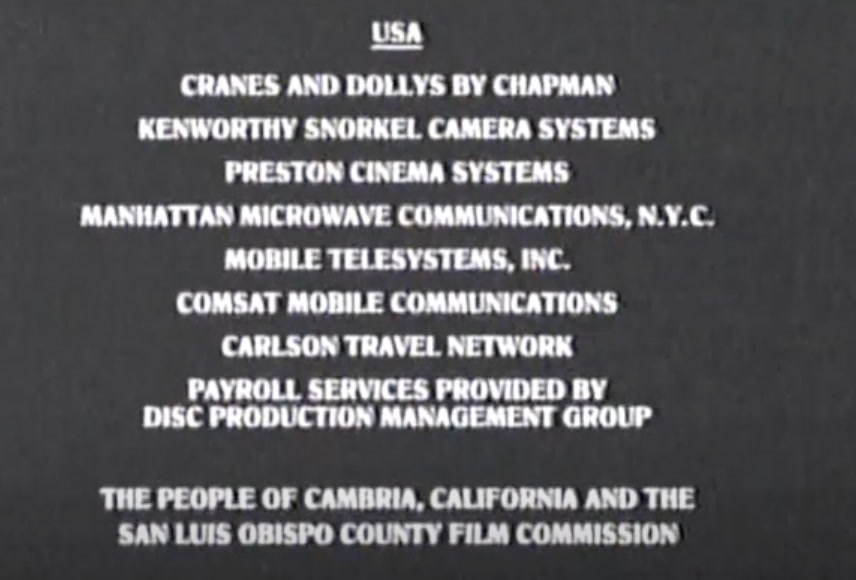
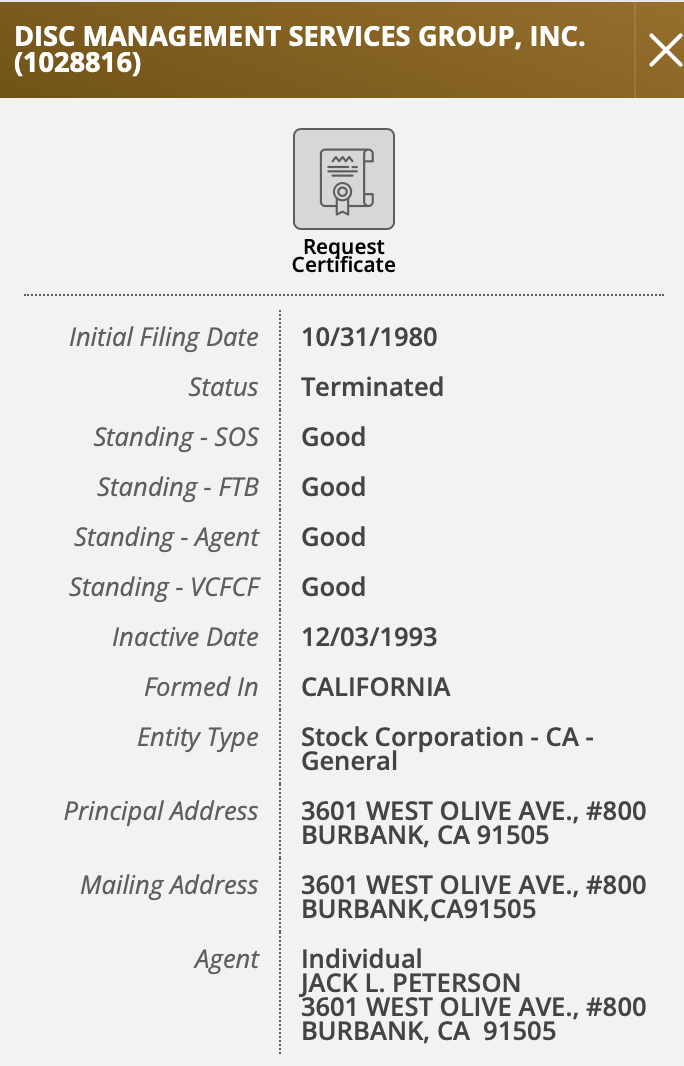
#11. The stumble
During the final shot, Morrow is captured on film stumbling to his knees, just seconds before the helicopter hits the ground. Had he been standing, it’s possible that he could have run for cover.
When Landis took the stand in February 1987 as the first witness for the defence, he spent several days telling his side of the story, from how he got his start in the industry, all the way up to the accident. It was at this point that Landis testified that Morrow’s stumble had in fact been staged, improvised by the two of them about twenty minutes prior to the fatal shot, during the 2:00am technical rehearsal.
“It was planned that Vic should stumble... I think you are having a problem with the fact that what makes this so especially terrible, which is that they are acting, that Vic is acting, and it looks horrendous. Because it’s supposed to look horrendous. And the tragedy makes it that much harder to watch.”
On the one hand, the claim that the stumble had been planned helped substantiate the general claim that the 2:20am shot had been adequately rehearsed.
On the other, it only raised more questions.
DA (D’Agostino): How did you rehearse it then if they [Morrow or his stand-in, Robert Liddle] weren’t carrying the children?
JL: I don’t know how — That is such an odd question. What do you mean? Could you explain?
DA: Mr. Landis, isn’t it true, sir, that you have seen the film and you saw how horrendous, in fact, it did look to have Vic Morrow struggling in the water? And that he did almost, in fact, drop Renee? And that you manufactured this story about how it was all planned for Vic to stumble, because of how terrible it did look on the film? Isn’t that true, sir?
JL: No, it is not true.
DA: And this is the point in time in which you supposedly told Vic Morrow — or you discussed him falling down, right, or tripping, or stumbling?
JL: Soon after that, yes.
DA: Well did you ever tell the grand jury that it was planned for Vic Morrow to stumble or to fall?
JL: No.
DA: Did you tell the NTSB that it was planned for Morrow to stumble or to fall?
JL: I didn’t... I don’t think so.
DA: Did you tell the Camera Operators to be sure and watch for that, because that was going to occur?
JL: Yes. I wouldn’t know which camera now. As we saw the footage, he was in a specific spot that we had discussed for that camera, and I am sorry, I don’t...—
DA: The master camera, Mr. Lydecker?
JL: No, certainly not the master. Whichever one would have been tightest on Vic and the children.
The DA continued to drive at the question of whether Landis had done any rehearsal or preparation for a stumble with regards to the actual children being used. Landis recalled the 9:30 shot.
JL: Yes, I asked if the children could swim. One could and one could not.
DA: Why did you need to know at 9:30 if the children could swim?
But the prosecutor
Was it possible that the two dropped children witnessed by House and Morrow’s stand-in
#12. Beer and liquor runs for the SFX team
The NTSB had found two beer cans in the cabin of the helicopter.
Carl Pittman, one of the special effects drivers:
Mr. Pittman stated that during the afternoon prior to the fatal crash, he had personally consumed a couple of beers that he had purchased and had personally seen Paul Stewart, head of special effects, consume at least one beer. He also observed Paul Stewart’s assistant, named Jerry, drink one beer. He stated that to his recollection, it was approximately 1600 hours on July 22, 1982.
Mr. Pittman stated that although some of these special effects people did consume beer, it was a rule of Paul Stewart’s that when they started handling explosives there would be no consumption of alcohol.
He stated that the 10-ton powder truck was positioned in the area of the Chapman crane and for most of the evening, this is where he spent his time.
He stated that at approximately 2330 hours, he went over to where the special effects pickup truck was parked on a ridge between the village and the dam, to relieve the other driver, named Ted, for lunch. He stated that when he went over to this location, he brought with him a vinyl bucket which contained soda pop and water. He stated that he saw no alcoholic beverages, including beer, consumed by anyone in the village area during this period of time.
He stated that one of the functions that he fulfilled, in addition to being driver, was to make runs to the store for Paul Stewart and his crew. During these runs he would occasionally purchase beer, sodas, tools, and other equipment, as requested by Paul Stewart or members of his crew.
He stated that when he observed Paul Stewart and “Jerry” drinking a beer, they were in the area of the 10-ton truck near the Chapman crane.
Mr. Pittman continued that after he would make purchases, he would give the receipts to Paul Stewart, at which time he would be reimbursed. Mr. Pittman stated that it was not uncommon for people to be drinking beer on the set, that the prop truck had its own cooler which contained sodas and beer. He stated that he saw no bottles of whiskey or vodka; however, these types of alcoholic beverages were usually locked in a cabinet. Mr. Pittman was not specific as to whether there was a cabinet of liquor on this particular set.
He stated that it was the following day when he and members of the special effects crew met at the Burbank Studios and off-loaded material.
Mr. Pittman stated that around the time of the 2330 hour filming, while in the area of the 10-ton powder truck, he smelled the odor of marijuana and stated that although this is not common on most sets, that it is around.
He stated that he had overheard comments that the “powers to be were flying high,” referring to drug usage, but Mr. Pittman was unable to be specific as to who was relating this rumor and to whom they were referring. He stated that in his opinion, he did not believe that anyone that he observed was either drunk or under the influence of drugs.
Theldyanamos Triantafellow, the other special effects driver:
Mr. Triantafellow asked investigators to turn off the tape recorder, with which we complied. At this time he stated that the pilot was holding a red and white can of “Budweiser” beer, and that this was just prior to the crash flight. He stated that Carl was purchasing whiskey, vodka, and beer for the special effects men and was being reimbursed by them. He said that that evening Carl showed him receipts for purchases totalling $150.00, which Carl indicated was for beverage purchases.
He said that after the crash, he left the location, driving the pickup truck, following Carl, who was driving the 10-ton powder truck. He said that Carl was weaving badly all the way back to the Burbank Studios. He said he was alone in the pickup truck and that Carl was alone in the 10-ton truck.
He concluded that, while on the set, he recalled asking ANDY HOUSE what kids were doing on the night set. He said Mr. House told him to mind his own business.
Ishmael Ruiz, Lighting Technician:
Concerning alcohol on the set, he stated there was “booze” all over; the company furnishes beer for the employees after the wrap-up. He stated he could not remember if anyone was drinking beer on the set that night. He concluded that he has seen empty beer cans in the huts that made up the Vietnamese village.
Budds’s initial investigation:
In the area where these body parts were lying, investigators observed several Budweiser beer cans which were still cold to the touch. These cans were open and several still contained a gold foamy-type liquid resembling and smelling like beer. This area was determined to be a “gallery” area for onlookers observing the filming. There were also several empty vodka bottles.
#13. No longer eligible for prosecution
In the immediate aftermath of the accident, Marshall is reported by Chain to have emerged from his point of cover beneath a nearby truck, and joined the many dazed crew members wading towards the wreck looking for survivors. Chain also reports that Marshall was the one to retrieve Renee Chen and carry her back to shore; that he told the 2nd AD, Anderson House, to clear the set and to make sure the film was on the truck; and that he and Folsey led a wailing Mrs. Chen, and a shell-shocked Dr. Le to separate production vehicles headed for the Henry Mayo Newhall Hospital in Valencia.
There was a medic on-set, but no police. The nearest telephone was in a booth at the entrance of the park. (Two crew members said they would have called the labour board, but there was no phone access nearby.) Deputies Sinclair and Strait, from the Santa Clarita Valley Sheriff’s Station, arrived at 2:45am (F&G 145). Budds was dispatched at 4:15am and arrived at 6:10am.
That morning, Landis’s studio-assigned typist
Chain reports that within days of the accident Marshall gave his account of events to Warner Bros.’ attorneys, as documented in a series of interoffice memos (Chain, ch. 25; ch. 27, etc.) possibly shared as a matter of discovery with defendants or suspects who participated in these unofficial depositions (e.g. Elie Cohn) and then circulated among the defendants’ massive legal network.
Farber & Green report that, “Right after the accident, Frank Marshall and Kathleen Kennedy left town to spend two weeks at Marshall’s retreat in Idaho. When they returned, Marshall stayed only a short time in Los Angeles; then left the country with Spielberg to scout locations for Indiana Jones and the Temple of Doom”
On August 2nd, the Chen family filed their lawsuit, naming both Marshall and Spielberg.
By October, according to Chain, Marshall had already been informed by Cal/OSHA that his name was not being passed to the DA’s office for indictment. In the initial confusion after the accident, with the jurisdictional considerations splitting the investigation into three factions, the NTSB interviewed some thirty-one witnesses to the accident, but Marshall was not among them. According to Chain, earlier, Marshall’s attorneys had lobbied the Cal/OSHA investigator, Marilyn Levine, to exclude Marshall from her investigation, emphasizing the distance between Marshall and his people (who operated on the Warner Bros. lot), and Landis’s people (who operated on the Universal Studios lot). Allegedly, Marshall’s counsel misrepresented the number of days their client appeared on set, claiming he had only stopped by three or four times total, when in fact he had been present at least eight days of twelve
And then in late November/December, Spielberg and Kennedy at least were in town: finishing Spielberg’s Twilight Zone segment; hosting a Japanese television crew making a documentary; and having an early-December story bootcamp with Gloria Katz and Willard Huyck establishing the plot for Indiana Jones and the Temple of Doom.
Alpha Campbell also noted that on January 12th, 1983, Frank Marshall returned to John Landis’s office to pick up a few more things.
1:40 PM — Phone Call:
Michael Topher, Spielberg’s producer, called last night. He asked for the call sheet. I told him no one was here. He said he’d come look for it. I told him absolutely not — I shouldn’t let anyone into the office.
Frank Marshall Pickup:
- 24 boxes of trims
- 170 boxes of Twilight Zone film materials
(Picked up from Landis’s office)
January 14, 1983 — Additional Pickup: - Lab roll sheets
- Twilight Zone camera reports
- 1 code book (for Twilight Zone)
- 1 lined script
- 1 folder of miscellaneous Twilight Zone paperwork for editorial
By this time, Budds had been trying to circle back to Marshall for several months, with Marshall’s attorney assuring him Marshall was out of town and unavailable but would cooperate at his earliest possibility. Then Budds heard Marshall was back in town. But Marshall was never at his legal residence. And whenever Budds stopped by the Warner Bros. lot and the booth operator called ahead to the Amblin office, Budds was always informed by Bonne or Mary Radford that Marshall was not on the lot at the moment.
By February 1983, Marshall’s attorney informed Sgt. Budds that his client had decided not to cooperate with investigators willingly. A domestic subpoena was issued for his testimony, but Marshall couldn’t be located at his home or work despite repeated visits by Sgt. Budds, and the case’s lone investigator had bigger fish to fry
Spielberg and Kennedy at least were in L.A. for a disappointing 1983 Oscars, when Spielberg’s E.T. failed to win the big award—the movie’s aura tainted, perhaps, to whatever degree, by its association with the tragedy.
The filming for Temple of Doom took place beginning April 18th, 1983, in Sri Lanka, and continuing through September 8th, 1983, at Elstree Studios in London.
George Folsey, Jr., told me [LaBrecque] that the defendants, too, wanted Marshall to testify, to corroborate Landis’s statements about the decision to hire the children illegally. He said that Landis talked to Spielberg after the preliminary hearing and asked him to intercede with Marshall. “Whether [Spielberg] attempted it, I don’t know. Obviously, Frank went out of the country and avoided the subpoenas,” Folsey said.
Cal/OSHA had decided back in the fall of 1982 that legally speaking Marshall wasn’t culpable for the hiring. But they were mistaken, as discovered by Allingham’s attorney Leonard Levine in 1985, when posing as a film producer and asking DLSE (Division of Labor Standards Enforcement) Chief of the Entertainment Work Permit Unit, Howard Bacon, whether in the case of an accident on-set the crew would be responsible, or the corporation and upper-level management, receiving an unequivocal answer that:
...it was the production company which is deemed the sole employer of the minors, as well as of all other members of the cast, crew, and supporting personnel. If there is more than one production company or executive producer they are each jointly and severally liable as employers of the minors et al. If the production compani(ies) is incorporated its corporate officers are responsible under the Labor Code and the COMM’N’s regulations and guidelines as the employers of the minors.
Marshall was almost certainly a corporate officer at both Twilight Zone Productions, Inc. and DISC Management Services Group, Inc. (the payroll company contracted to oversee the production’s spending).
This, along with Braun’s two letters to the DA in November 1985, alleging that knowledge of the hiring was widespread, led to increased interest in Marshall’s testimony. With the statute of limitations expired, Marshall was no longer eligible for prosecution.
Braun later told Farber & Green:
“Obviously, regardless of what the DA had done, I could have laid a subpoena on Frank Marshall at any time over a three-year period. But Behr [Landis’s personal lawyer] told me, ‘No, we’re not going to do that. It’s too dangerous to the clients’ careers.’ If Spielberg got mad at Landis, Landis could not get a job in this city.”
In June 1986, the DA and the Sheriff’s Department tracked Marshall to London, England, where he was staying at St. James’s Hotel and Club, a luxury boutique hotel, working on Amblin’s Who Framed Roger Rabbit at the famous Elstree Studios. Sgt. Budds was sent overseas to personally serve Marshall a new subpoena, but because of his lack of jurisdiction, Budds had to enlist a young legal attaché from the American Embassy to serve the legal document.
Sgt. Budds listened as she called Marshall from the front desk. Marshall assured her he would be right down. They waited for him for half an hour but he never showed up. A report from Scotland Yard said that Marshall was in Paris, where Spielberg also was at the time, promoting Amblin’s The Money Pit. The report speculated—based on the absence of Marshall’s name from any public flight records—that he had taken a private jet operated by Amblin Entertainment
Given the seriousness of the multiple-homicide trial at issue, Interpol became involved, and Marshall’s name was added to an international “stop and hold” list, along with his longtime girlfriend, Kathleen Kennedy. In fact, Kennedy was intercepted after landing in Barcelona in February 1987, and Marshall on April 7th, 1987, in Madrid
But by this time the prosecution had rested their case and Marshall’s testimony was no longer of any help.
#14. A short scene still to come (the shed)
The helicopter spots them and guns blazing, heads toward the river. As Bill carrying the kids desperately makes his way through the water, the helicopter makes several passes strafing the area. Bill makes it to shore and sees a wooden shed. Making a super-human attempt he manages to get all three of them inside. He stacks the wood inside against the door, then huddles with the kids in the corner.
The shed is now in the pine woods. Dogs barking, torches burning.
The shed scenes are significant for providing plausible deniability to the Location Manager
Vane was able at the grand jury hearing to both (1) admit he was actively participating in the conspiracy at the time of the accident (2:20am); and (2) claim that he, and Frank Marshall—standing beside him—didn’t believe the children were going to be used in the shot. Vane was able to say that he believed the concealment plan was ongoing for the sake of the last scene.
DA (Kesselman): Did you know they would be there in violation of the law?
RV: Yes, I knew that they were going to be there. I did not think that they would be in the explosion scene. There was a scene that was going to follow that in which the kids were in a shelter.
But was it true?
The FSO in question, Jack Tice, told the grand jury that Vane checked on his whereabouts three times in the lead-up to the 2:20am shot specifically.
Did someone have conversations with you on Thursday that in retrospect you now think were somewhat out of the ordinary or order?
“Yes, Richard Vane wanted to know where I was going to be during the filming of the 2:30 scene... he asked me that on three occasions. I think it was unusual. I did not think much of it at the time, but afterwards I thought it was quite unusual. And the reason for it is because the fire deputy had— we had six firemen there, and we were coordinating the fire efforts, representing the county fire department. And it was quite unusual for him to insist on knowing where I was going to be.”
#15. Chain claims
In Fly by Night (2021), journalist Steve Chain claims to have sourced several inter-departmental Warner Bros. memos documenting interviews conducted by their legal team with various Warner Bros. employees, including Marshall, Lucy Fisher (Warner’s head of creative), Vane, Radford, Henderling, Morey, and Cohn.
Although this is an audacious claim, and Chain’s book has no notes, references, or sources, there are several reasons to find it plausible. (1) Chain attended the trial at the time and is recommended by other journalists who attended the trial; (2) Harland Braun, Landis’s pre-trial lawyer, endorses the book with a glowing blurb; (3) If Cohn was questioned by Warner Bros.’ legal counsel in a non-privileged context and without independent representation, and records of that questioning existed, it’s plausible that his later counsel—or other defence attorneys—could have obtained access to those records, making it possible that Chain, through defence cooperation, encountered them; (4) All of Chain’s findings are consistent with established evidence.
#16. Alternate versions
“The Twilight Zone has always meant, more than anything else, those little musical notes that you hear from the other room—like a bugle call that draws you to the television set and grips you for half an hour.” (Spielberg
Joe Dante, the director of the movie’s third segment, “It’s a Good Life,” said that originally the concept was that “all the stories were going to connect.”
“Originally the concept was that characters from one episode would appear in another, so that it wasn’t just a series of freestanding stories. It was all linked together. So it seemed like it was a long piece.”
The second draft of Landis’s script (May 24th) reflects this original continuity, ending with the lines:
“Matheson” is Richard Matheson, the writer of the other three segments. Besides Landis’s prologue and segment, all three were going to be written by Matheson, an original Twilight Zone screenwriter, who also wrote Spielberg’s riveting TV movie Duel (1971), about a malevolent truck pursuing a terribly anxious man. Spielberg was working closely with Matheson on an original segment about a neighbourhood bully who on Halloween becomes prey to supernatural forces.
“There was a lot of talk about [remaking] old episodes,” Dante recently recalled. “I didn’t really want to do an old episode—I thought there [were] so many great stories that hadn’t been done on the Twilight Zone that you could do four new stories. But I think that for whatever reason the studio insisted on doing remakes.
Little is known about Spielberg’s originally planned segment, except that it was substantial and well under way at the time of the accident.
Spielberg described it as follows:
Basically, this is a neighborhood bully, whose costume happens to be the Hunchback of Notre Dame. Trick or treat isn’t enough for him – he runs amok across the streets on Halloween, egging houses, leaving burning bags of dog manure on the front porch; stealing bags from other kids; and single-handedly ruining the holiday for everyone he can – enjoying every minute of his mischief. That is, until... a few strange things commence to happen. It’s been years since I read the script, but I remember a postbox lurching at him; I remember a little girl in a witch’s costume suddenly growing into an ugly, full-sized witch lurching out to seize him. I remember the streets full of ‘REAL’ werewolves and patched-together Frankenstein Monsters and vampires, all stalking him in earnest. I remember a doorknob attempting to BITE his hand when he tries to take refuge in his own house. And ultimately, I remember that when he thinks he is safe in his own home, safe at last from the unexpected horrors which have transformed his neighborhood into a living hell, he catches a glimpse of his reflection in the hall mirror, and he sees Quasimodo – the real thing. His simple makeup and costume are gone. He IS Quasimodo! Horrified, he runs out of the house in total disorientation, and the monsters catch sight of him, and we last see them in close pursuit as he stumbles on his twisted legs across a large vacant lot with the huge October moon in the sky beyond. (Twilight Zone Magazine 1983)
Matheson summarized it as “a bully who’s mistreating all these young trick-or-treating kids, and the supernatural world gets him for it. Creatures—real live monsters—start chasing him around.”
Work on the Spielberg-Matheson project proceeded well into the summer of 1982. During an interview for Starlog magazine, Spielberg said of his upcoming Twilight Zone segment, “[W]e have all these monsters we have to build.”
And then at some point before the accident (according to McBride
All four of the segments in the finished movie are loosely unified by characters caught in schizoid states.
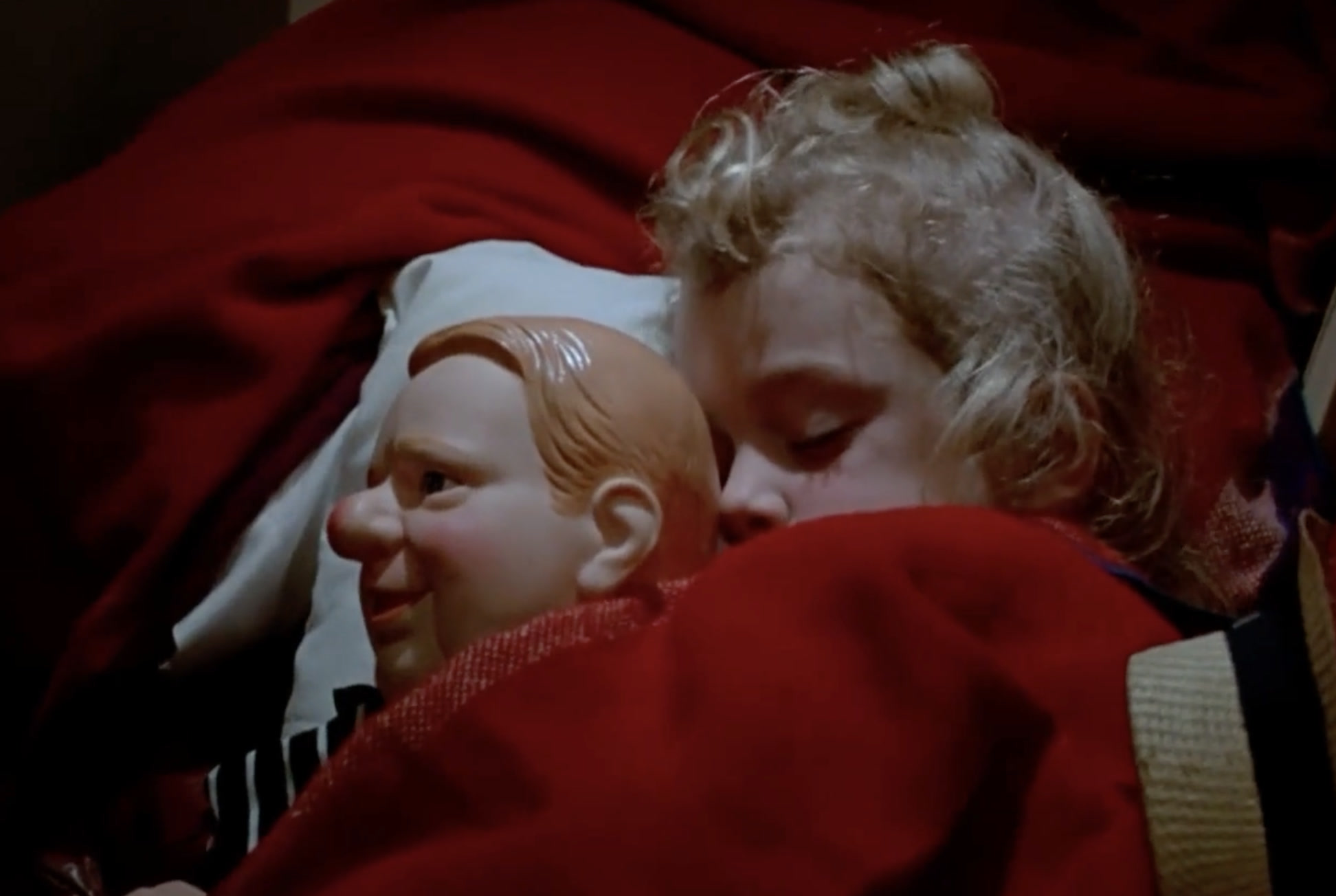
If both “It’s a Good Life” and “Nightmare at 20,000 Feet” passed through Spielberg’s hands, as Dante reports, Twilight Zone would have been Spielberg’s third movie in a row to feature supernatural beings that disrupt suburban life, and a blonde girl with a doll.
i. Twilight Zone—Landis Segment
In “Time Out” I wanted to be true to the spirit of the old TZ show and to inject a lot of Serling’s own politics and morality into that episode... It’s the only political or moral episode in the film, actually. (John Landis, Twilight Zone Magazine, Oct. 1983)
Bill’s dialogue in the bar scene is more significant than it seems. We learn that he has been working at his job for seventeen years (since 1966 or 1967); that the promotion he lost is going to cost him $6,000/year, and that he was “counting on it”; that his house is owned by a Japanese bank; that he was “in the war” and “paid to kill [Asians]”; and that he has to go home early to meet his in-laws. We have a cohesive character sketch of a man using racism as a way of venting his domestic burden; making it someone else’s fault besides his own. He blames the same “Asians” whom, in his estimation, America let off easy in “the war.” He recites religious, racial, and gender stereotypes about Jews, African-Americans, and women. Over the course of his journey, Bill experiences what it really means to be victimized by a powerful other, showing his complaints to be a screen for continued aggression. However, by the end of the story, once it reaches its “root” in his Vietnam reversal, we sense that Bill’s racism and the personal failures it masks are a coping mechanism for guilt he feels over what he did in the war and what it implies about him as a person and the state that paid him. But what exactly Bill did back in the war, if anything, is ambiguous. Did he fail to save two children, out of cowardice? Was he part of the 1st Cavalry Division, associated with the firebombing of villages and shooting at villagers indiscriminately? Was it the Battle of Ia Drang (1965)? Or is the transmission intentionally vague?
The third draft, which introduces the village segment and the two children, brings Landis’s episode into line with the rest of the segments. Spielberg, famously, often incorporates children into his work.
But a change in the fourth draft (6/26/82), the two-line addition of a “MacGuffin” (in storytelling terms, an emotionally charged object of desire) is even more peculiar.
I won’t hurt you baby. I’m just as lost and scared as you are.
(genuinely touched)
Thank you honey. Thank you very much.
This simple prop substantiates the emotional reversal established in the previous revision, giving the audience a clearer point of focus for the projection of their own petty grievances and allowing them to participate in Bill’s spiritual purification.
The second draft of the script (and the second draft only) had a more vivid description of the helicopter attack.
Another small change in the fourth draft is the omission of the line: One after another the buildings blow up in flames as the helicopter systematically destroys the village in its search for Bill.
The third and fourth drafts both also successively tweak the ending. In the third, he’s hit by a truck offscreen, just in time for his friends to see, and “pinned under the rear tire of a truck.” In the fourth revision, his friends call out to him but it’s too late, and he’s “clipped by a car in the street in front of the bar” and “thrown violently to the curb.”
Bill looks at Ray and the Black Patron in wonder. He then looks down at the broken Barbie Doll in his hand.
The Driver of the car comes up to Ray who’s cradling Bill’s head.
Crane up and back as a police car pulls up—pan up to the sky.
The MacGuffin takes on a second significance in this draft, providing the evidence of a final O. Henry moment—maybe it wasn’t bad acid after all; maybe Bill really had been back there again, for a moment, in Vietnam.
Each of the three historical narratives follows Morrow as he flees the dominant social group in a life-threatening manhunt, until he’s finally seized by the police in the Nazi timeline. According to Allingham, the narrative function of the spotlight was to induce a fear of the “police state” in the film.
1941 timeline: “The beam falls on him, pinning him in its harsh spot-light.” (all drafts)
1954/196? timeline transition: “A BLINDING LIGHT comes from the sky accompanied by tremendous winds and a deafening roar. Bill looks up in terror as a HUEY HELICOPTER descends on him.” (2nd draft only)
196? timeline: “The helicopter turns on a powerful spotlight and hovers over the village sweeping it with its beam.” (3rd and 4th drafts)
Is the implication that Bill’s journey was a near-death hallucination after stepping into harm’s way, in the moment before his friends got outside? In this vision, he is instantly cured. His delusions are countered by the reversal, and he is confronted by the emotional denial that is the source of his cycling depression and hyper-reactivity.
There’s also another, hypothetical, ending, which Mrs. Le reported hearing from Folsey on July 16th during the children’s audition. Morrow carries the children across “a stream or river to a shed for safety,” and then “a helicopter was to pick them up”: a rescue, which makes the helicopter something other than the hunter. Whose helicopter, and what exactly the skirmish was, the account doesn’t say. This ending survives only in the DLSE’s summary of its August 2nd interview with the Les; in her shorter NTSB interview with Llorente, Mrs. Le says only that the children were to be carried across to safety.
George Folsey Jr. told Mr. & Mrs. Le that they needed Vietnamese children for the movie; that the two children would be the last two (2) survivors left alone with actor Vic Morrow. Morrow was to pick up the two (2) children, and run across a stream or river to a shed for safety. A helicopter was to pick them up.
But it’s even unclear exactly which version Landis was making, or whether he was revising it as he went. In the movie, for instance, there is no spotlight used in the Nazi-era ledge scene. In the fatal 2:20am footage on July 23rd, the Barbie doll can be identified in Renee’s hands in the final shot. Because of the accident, Landis and Warner Bros. decided not to include the added segment with the children; this effectively reverted Landis’s segment back to its pre-June 13th state.
ii. Kick the Can
Spielberg’s final segment, “Kick the Can,” follows a new resident, Mr. Bloom
In the end, Mr. Conroy tragically finds out that magic is real, but that his bitterness has caused him to miss the miracle of eternal youth.
The next day, Mr. Conroy knocks the can around again himself, feeling lighthearted again for the first time in memory. The itinerant stranger, Mr. Bloom, sees himself off, and on to the next rest home.
“It was a very emotional time for Steven,” Dante recalls. “Steven was very affected by the accident. Then he felt somewhat betrayed by it. He felt he couldn’t understand what happened, and he suddenly became the brunt [of bad publicity]. I think he deeply resented it.”
According to Farber and Green, “the director did not even attend the pre-production meeting on the segment. ‘His heart just wasn’t in it anymore,’ says Patrick Kehoe, the first AD”
“It probably is accurate to say that Mr. Spielberg’s heart wasn’t in the movie after the accident,” stated Spielberg’s then-secretary Kathy Switzer. “[A]t the time, I didn’t know Mr. Spielberg well enough to make a judgment about how he felt emotionally. I do know it was a very sad time.”
Spielberg was so busy preparing detailed sketches for Indiana Jones and the Temple of Doom... that he delegated some of his usual directing duties on Twilight Zone. ...he asked the script supervisor, Kathryn Wooten, and his friend Melissa Mathison (the screenwriter of E.T. and [later] the wife of Harrison Ford) to block out the action with the performers and work with them on their line readings.
The original episode (by George Clayton Johnson) was adapted by Matheson, who removed the scenes in the woods. Then, Spielberg had it reworked by Melissa Mathison (working under the pseudonym Josh Rogan), who gave it a whimsical A Midsummer Night’s Dream gloss.
#17. The four screenwriters of Jurassic Park (1990–1992)
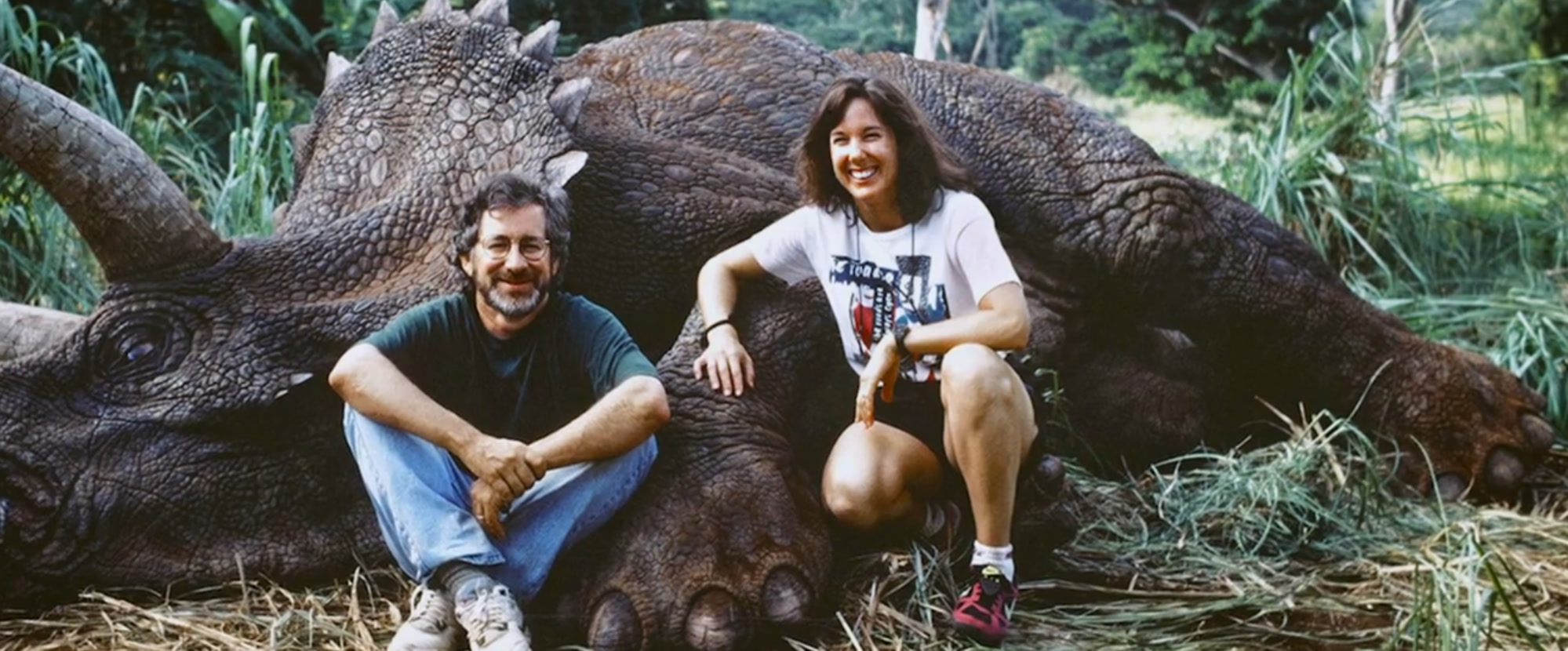
Dr. Grant and Dr. Sattler are paleontologists on a dig, used to brushing fossils by hand. They’re introduced to a seismic camera that takes a ‘shot’ into the dirt, and then they crowd around a set of monitors to watch a computer render an image. The technician tells us that within a few years it’ll make digging unnecessary, to Grant’s dismay.
But he only realizes how radically the world is changing when Hammond arrives and flies them off to his kitschy jungle resort on Isla Nublar
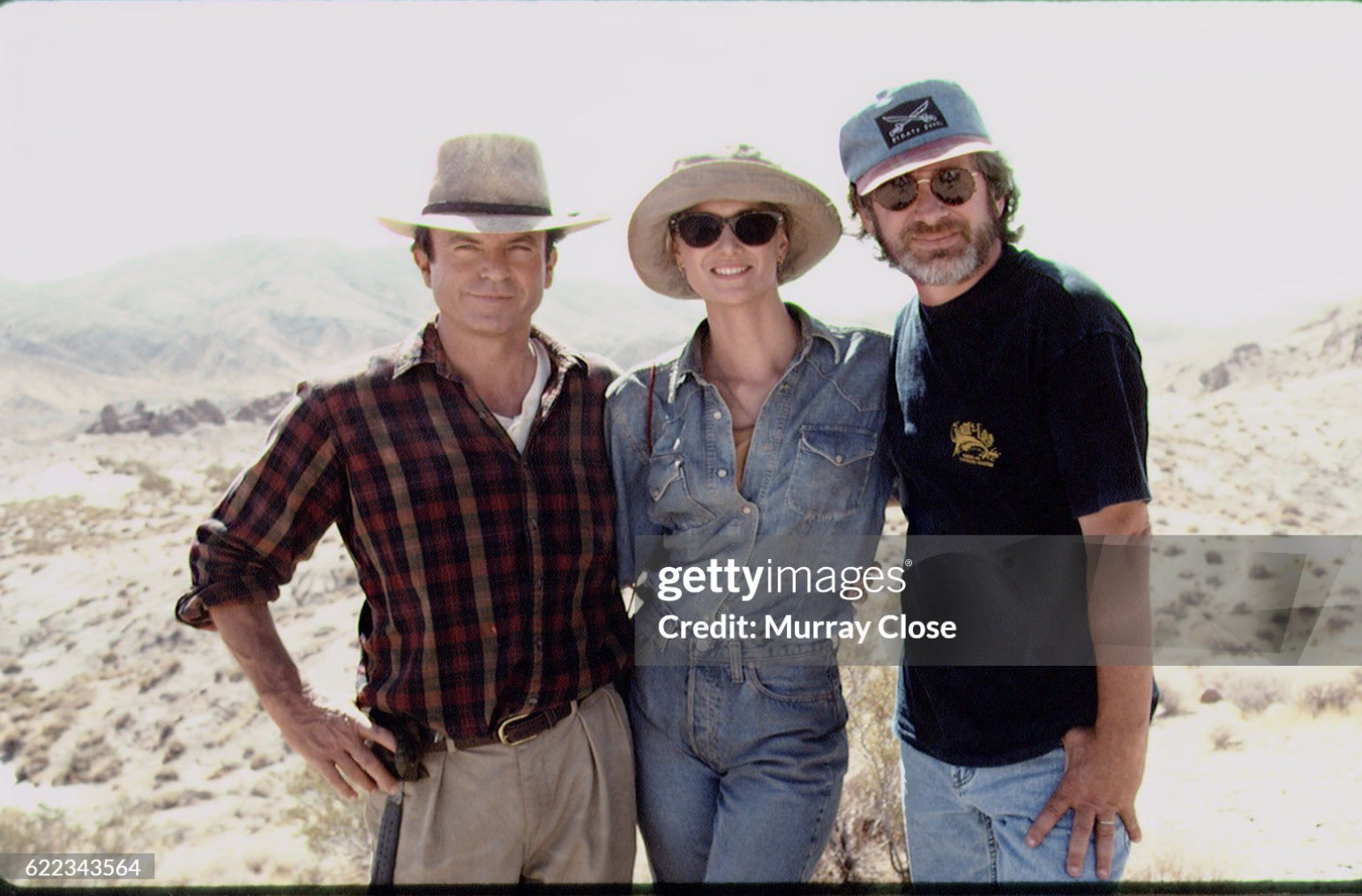
And all of this reimagines the way the real-life filmmakers encountered seamless CGI. One of Jurassic Park’s defining quirks is the way it mythologizes its own unprecedented technological powers. We will see that this repetitive meta-reference functions as a new kind of surface distraction, obscuring deeper dynamics.
Jurassic Park’s dinosaurs were originally going to be achieved using a combination of animatronics, puppeteering, and stop-motion animated models, with CGI only to be used for subtle background work.
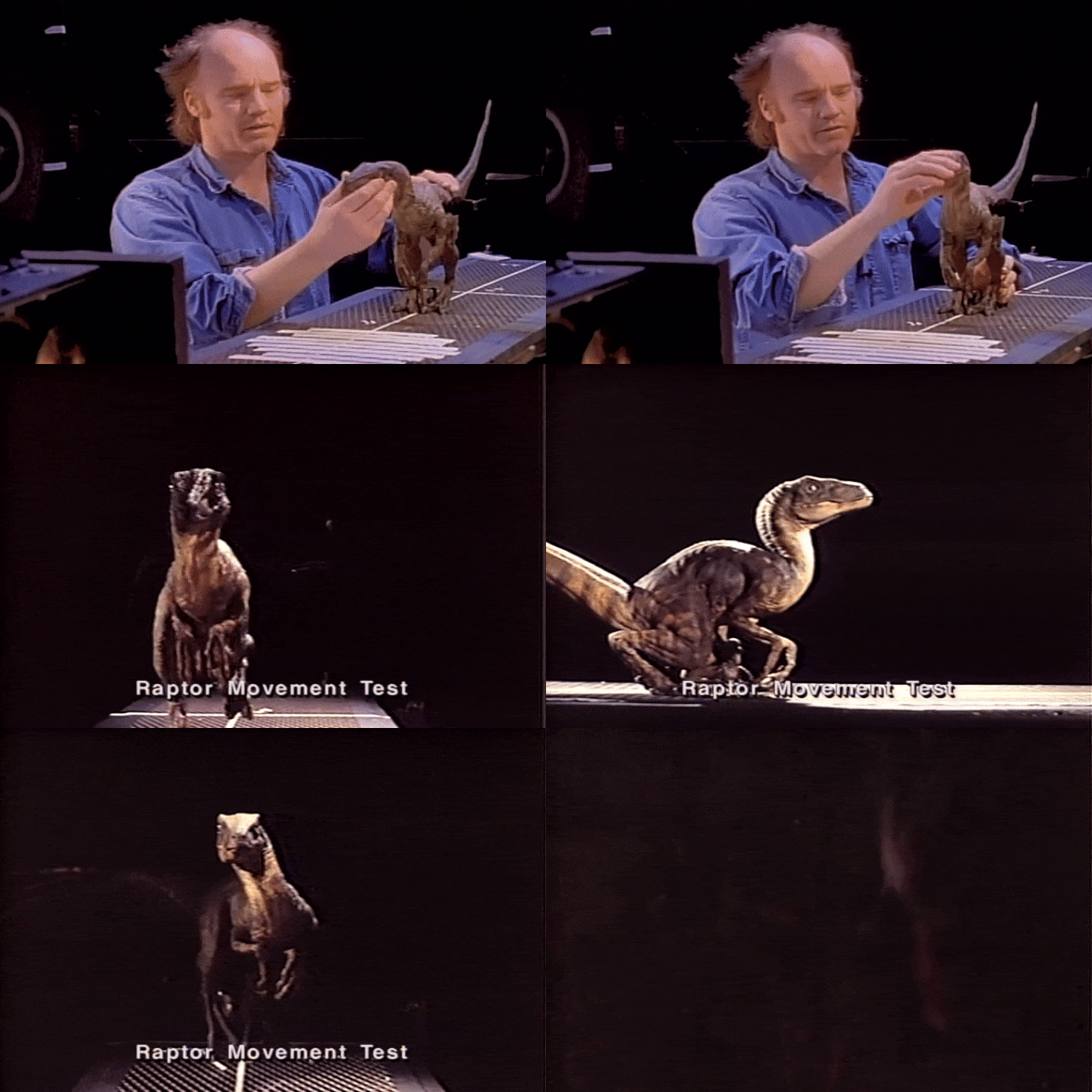

The form of stop-motion they were using was called Go-Motion. Phil Tippett had developed it at George Lucas’s special effects company, Industrial Light and Magic, before starting his own company, Tippett Studio. Go-Motion worked by using a computer to synchronize a camera with motorized puppets, allowing for a motion blur effect that improved realism compared to traditional stop motion. ILM was going to help implement it.
But when ILM received the commission in June ’91 a few of their engineers thought they should be in charge, most notably Steve Williams and Mark A.Z. Dippé, who had been directly responsible for the astonishing but conspicuous CGI work on The Abyss, and Terminator 2, which won ILM two Oscars. Williams and Dippé thought CGI was ready, finally, to become invisible. But Dennis Muren, ILM’s VFX Supervisor, wasn’t so sure. He also didn’t want to venture in the direction of poaching a high-profile contract from a friend and colleague.
Working in secret, Williams built a T-Rex skeleton from scratch—the same method he’d used for the T-1000. By November ’91, he’d given it a walk cycle, in time for an anticipated visit by Amblin producers Kathleen Kennedy and Frank Marshall. He kept it playing on a monitor where they couldn’t help but notice it. To Kennedy, “it was immediately very clear that we were going to get realistic movement to these dinosaurs that was going to be far advanced from what we were doing with stop motion.”
First, ILM delivered a demo of a herd of running Gallimimus skeletons. Spielberg was astonished. The footage reminded him of National Geographic. “I looked at it and I couldn’t speak after watching it. I just couldn’t even catch my breath. I had never seen anything like it. Because even though it was just a skeletal frame of Gallimimus, this herd of Gallimimus was moving just as realistically as if we had taken a camera and filmed them for real.”
But he needed to see a T-Rex walking in broad daylight before he could be sure. The engineers at ILM made 3D scans of the dinosaur models to make matching digital versions. That highly anticipated test was screened for Spielberg, Kennedy, Marshall, Tippett, and Lucas, among others.
Everyone who was there to see it says they felt like they were witnessing the dawn of a new age. A computer-generated entity passing for real.
As Lucas said:
“Everyone had tears in their eyes. It was like one of those moments in history, like the invention of the lightbulb or the first telephone call. A major gap had been crossed and things were never going to be the same.”
As the story goes, Tippett declared himself “extinct,” although he was soon brought back into the fold as the dinosaur motion supervisor.
Spielberg took the frisson of this world-historic moment and fed it back into the story.
We can track this development in the changes that happened to the story between the first draft—developed with Michael Crichton and others through 1990 and 1991, before the decision to use CGI—and the final draft, developed with David Koepp through 1992.
In October ’89, Spielberg was chatting with Michael Crichton in his office about another project, when he found out about Crichton’s latest book, Jurassic Park, which Crichton had just delivered to his publisher. Crichton had written a screenplay about a graduate student cloning a pterodactyl from fossil DNA in 1983, but required several years to work out the kinks. Spielberg asked to read it, and the next day the two agreed they wanted to make it together.
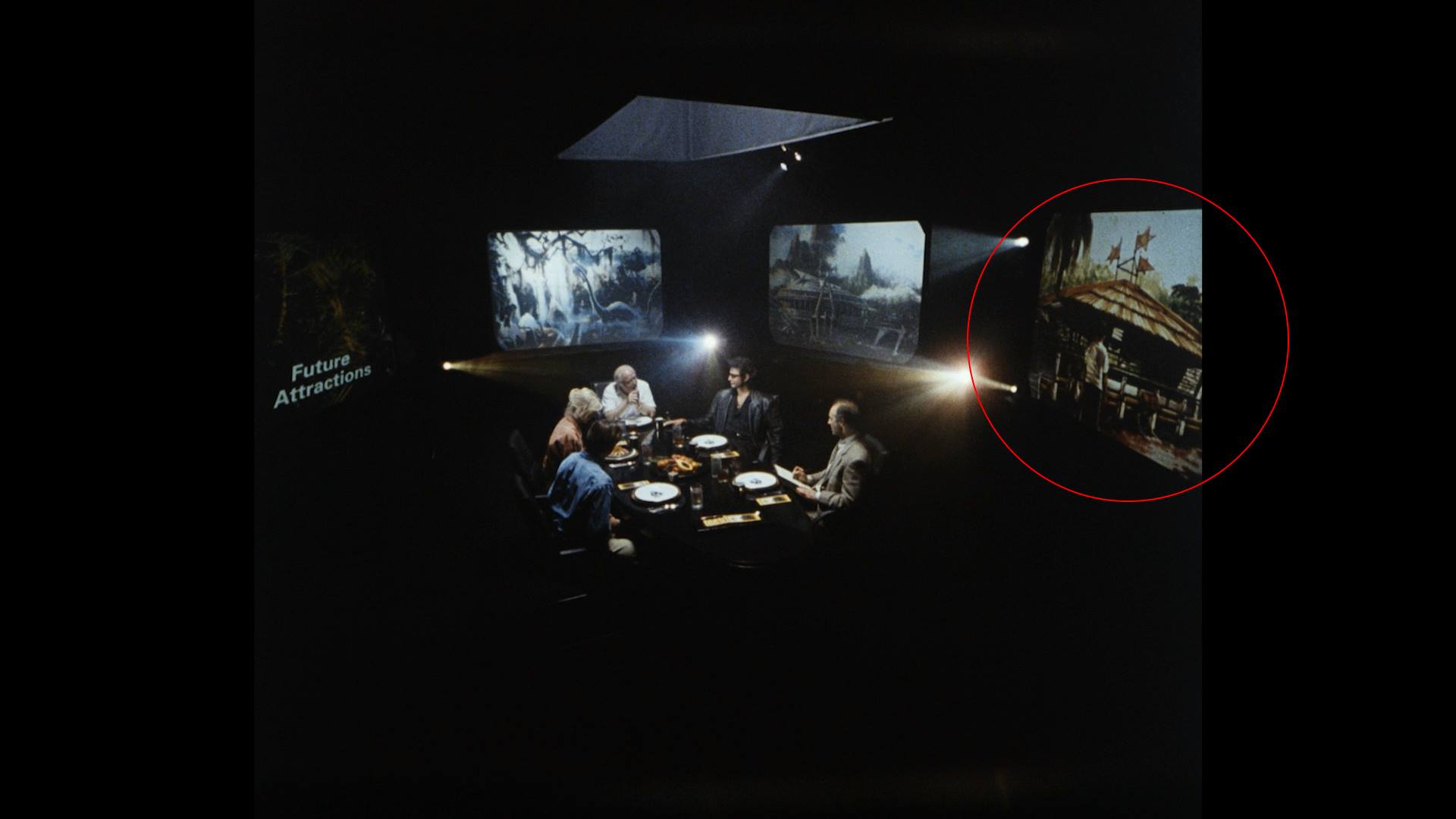

But in May 1990, as the book was getting ready for print, Crichton’s agents started a bidding war. Spielberg went to Universal Studios to secure the funding, emphasizing the property’s franchising and theme park potential. They were especially interested in the T-Rex river chase.

In addition to $1.5 million, Crichton was paid $500,000 to write the first draft of the screenplay. Crichton said he was sick of the dinosaurs and the characters at that point, but Spielberg said they just needed someone who could pare it down fast. Crichton said he’d do it, with the provision that he’d eventually hand it off to someone else for the character polishes. He got started in July 1990, even before the book was released.
Crichton delivered his first draft seven weeks later, on September 7th, 1990. Although this draft has never been published, in 2022, archivist Derrick Davis summarized its contents. By Spielberg’s request, and Crichton’s intention, the first draft is a straightforward adaptation that “has all the big scenes retained and has the logical flow that appears in the much longer and more extended argument.”
It succeeded in establishing the general outline that would be used in the finished movie.
- Grant, at the dig, is approached by Hammond or a representative
- Grant and Sattler meet the kids
- They fly to Isla Nublar
- They encounter the sauropods for the first time
- They get settled and head to the Visitor Centre
- They go to the theatre, then to the genetics lab (the extraction lab, the fertilization lab, the hatchery, and the nursery) and then to the control room. Hammond defends the park against the critics
- There’s a scene at the raptor pen
- The group goes on a guided tour of the park as Hammond watches from the control room
- They stop to inspect a sick dinosaur and Sattler stays behind
- Nedry steps away, turns off the power, and runs off with the DNA
- The T-Rex breaks out of the fence and attacks the stalled cars
- The man riding with the kids runs out and is killed, and Malcolm is injured
- Grant and the children must evade the T-Rex as they make their way back to the Visitor Centre (initially including a river-rafting chase scene) while the rest of the group tries to recover them and debates how to restore the power.
- Once Grant and the kids return,
- Tim and Lex are chased by raptors into the kitchen,
- Ellie and Muldoon distract the raptors outside,
- Someone resets the power
- One of the kids gets the computers back on in the Control Room
- There’s a showdown in the rotunda involving the T-Rex skeleton
- Hammond meets his fate
- They escape by helicopter
Spielberg wasn’t satisfied with it. He said that it “start[ed] too fast.” The next draft included a prologue, and pushed back the scene where the visitors first see the sauropods, delaying the gratification of seeing the “monsters,” like in Jaws. Crichton turned in his final “chunk” on January 19th, 1991, and said he had taken his best shot.
The plot was still rough around the edges. But besides that, Crichton’s draft had flat characters, weak laughs, and lacked inspiration, failing to punctuate its emotional moments.
Spielberg began shooting on Hook on February 19th, 1991, which ran over schedule and budget, occupying his attention until the summer. Soon after starting, Malia Scotch Marmo, who had just successfully reworked the character of Captain Hook, was enlisted to work on Jurassic Park. She found out from her husband that Amblin had optioned Crichton’s novel; she got a copy and was reading it outside the studio one day, when Kennedy noticed, started a conversation, and invited Marmo to try a rewrite. Marmo and Spielberg talked a lot about the story while shooting the movie, but Marmo only officially started her draft in October, and only finished it on March 14th, 1992.
Although Marmo read Crichton’s draft, she decided to start fresh and work from the novel. She said her principal contribution was to make Sattler and the children more assertive. Crichton had prioritized scientific verisimilitude, as he had in the book, but Spielberg said that “effects are only as good as the audience’s feeling for the characters.”
Marmo also brought out the romantic comedy and “mating ritual” between Grant and Sattler, who’d already been married in Carter’s version. Jurassic Park gained much of its colour during her tenure. But overall her take was too juvenile. Spielberg said, simply, “I’ve read it twice, and I think it’s a miss.”
At this point, Koepp was brought on from Robert Zemeckis’s Death Becomes Her (1992), and quickly pulled the script into shape in time for the production’s August start date. Koepp said he never even read the previous drafts.
So goes the surface history of Jurassic Park. But a closer look, aided by other materials unearthed by Davis, including early storyboards, story memos, and a lost draft by Production Designer Rick Carter (Back to the Future Part II), suggests a far more continuous development largely governed by Spielberg himself
Months before his first script meeting with Crichton in July ’90, Spielberg was already working out the story. He’d pored through his copy of the book, highlighting his favourite passages and scribbling notes in the margins. Spielberg said, “What I wanted to do was boil the book down and choose my seven or eight favorite scenes and base the script around those. So we crunched the book.”
Carter was the first creative professional brought onto the project, within weeks of acquiring the property. They hired seven artists to help conceptualize the story: five primarily doing storyboards (Marty Kline, Ed Varreaux, Tom Cranham, David Lowery, John Bell) and two primarily doing paintings (Dave Negron and Craig Mullins).
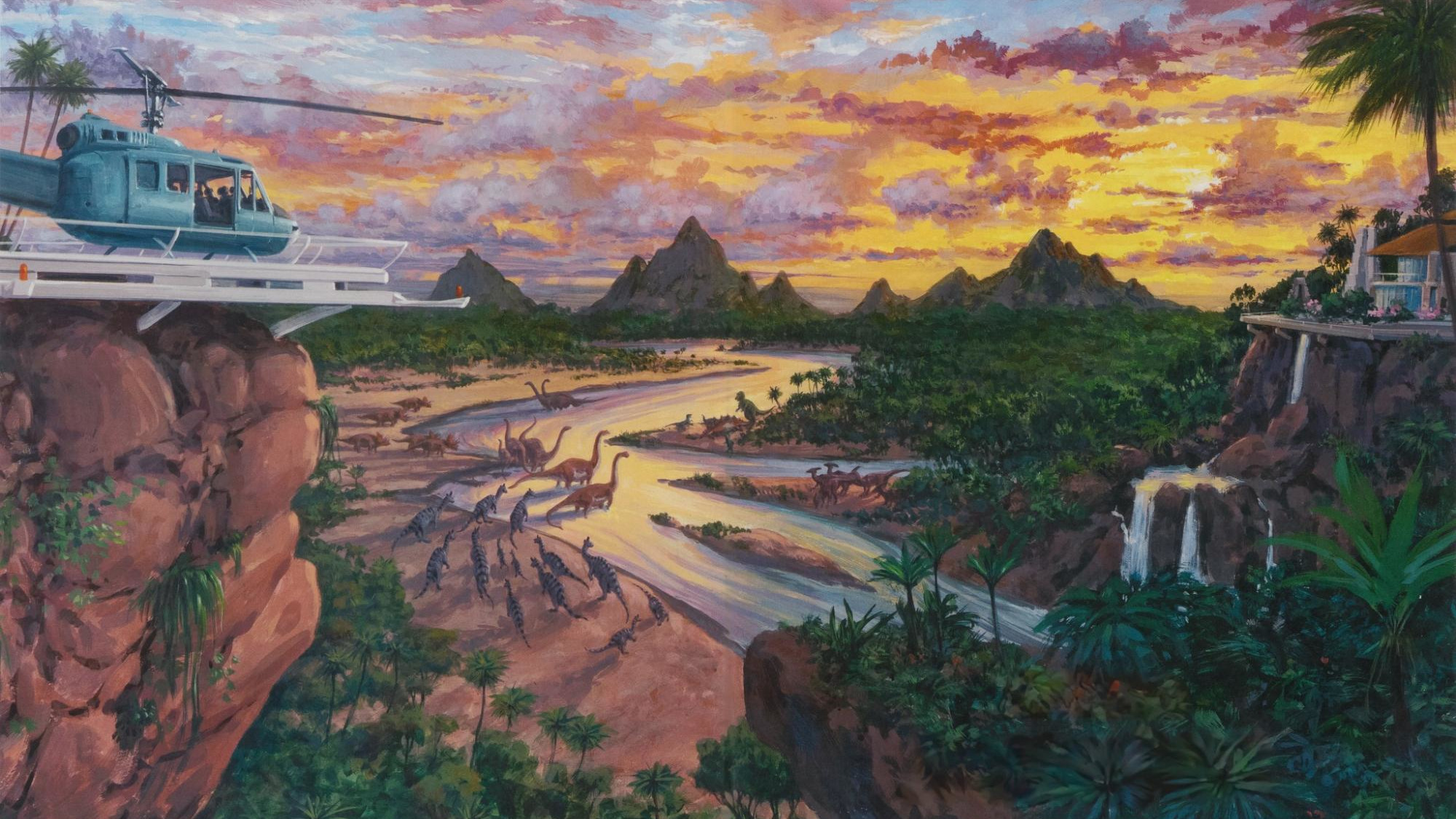
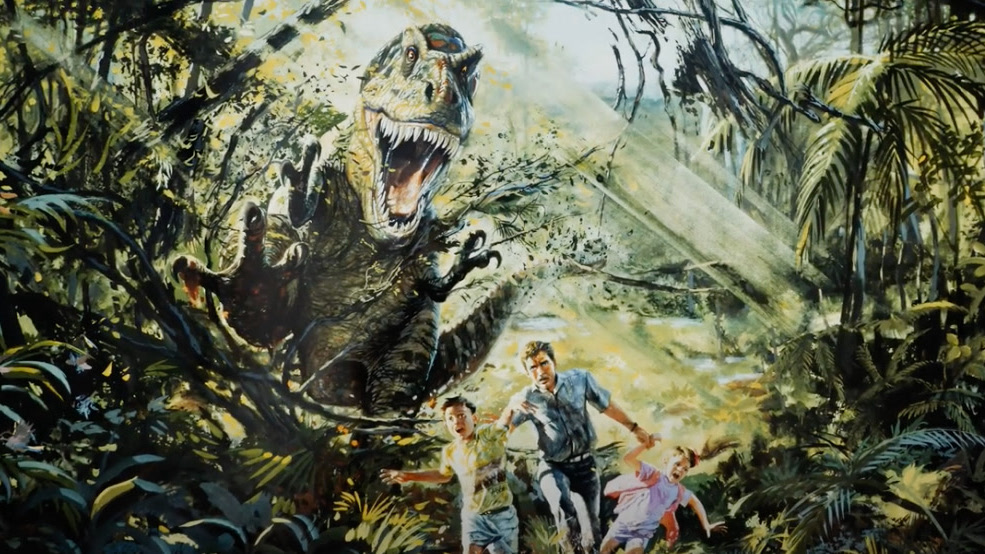
After they crunched the book and established its major set pieces, Spielberg started to dig in.
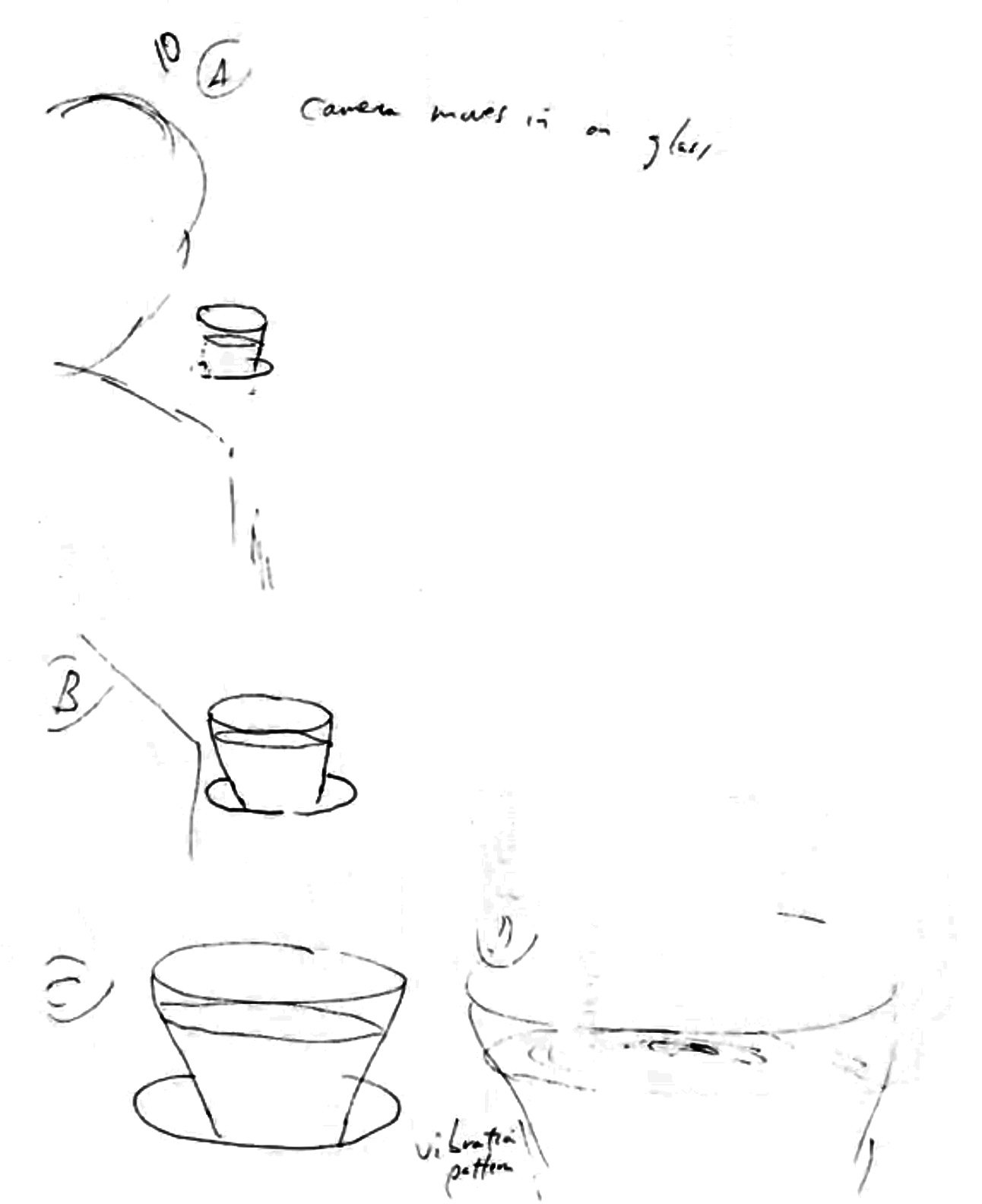
Carter observed that Spielberg begins by envisioning a physical layout: “once he knows what the space is—that’s very important, to know where things are—he’ll just start playing a projector in his head. He’s open to contributions and he’ll talk it through, but he’ll actually draw these funny little frames which are incredibly detailed if you know how to look at them.”
Koepp would later say he found the storyboards “enormously helpful. It was like having a large portion of the movie just handed to you, to be able to walk around and soak up the feel of what the movie was supposed to look like.”
Some of the recently published storyboards appear to have been produced prior to Crichton’s first draft.
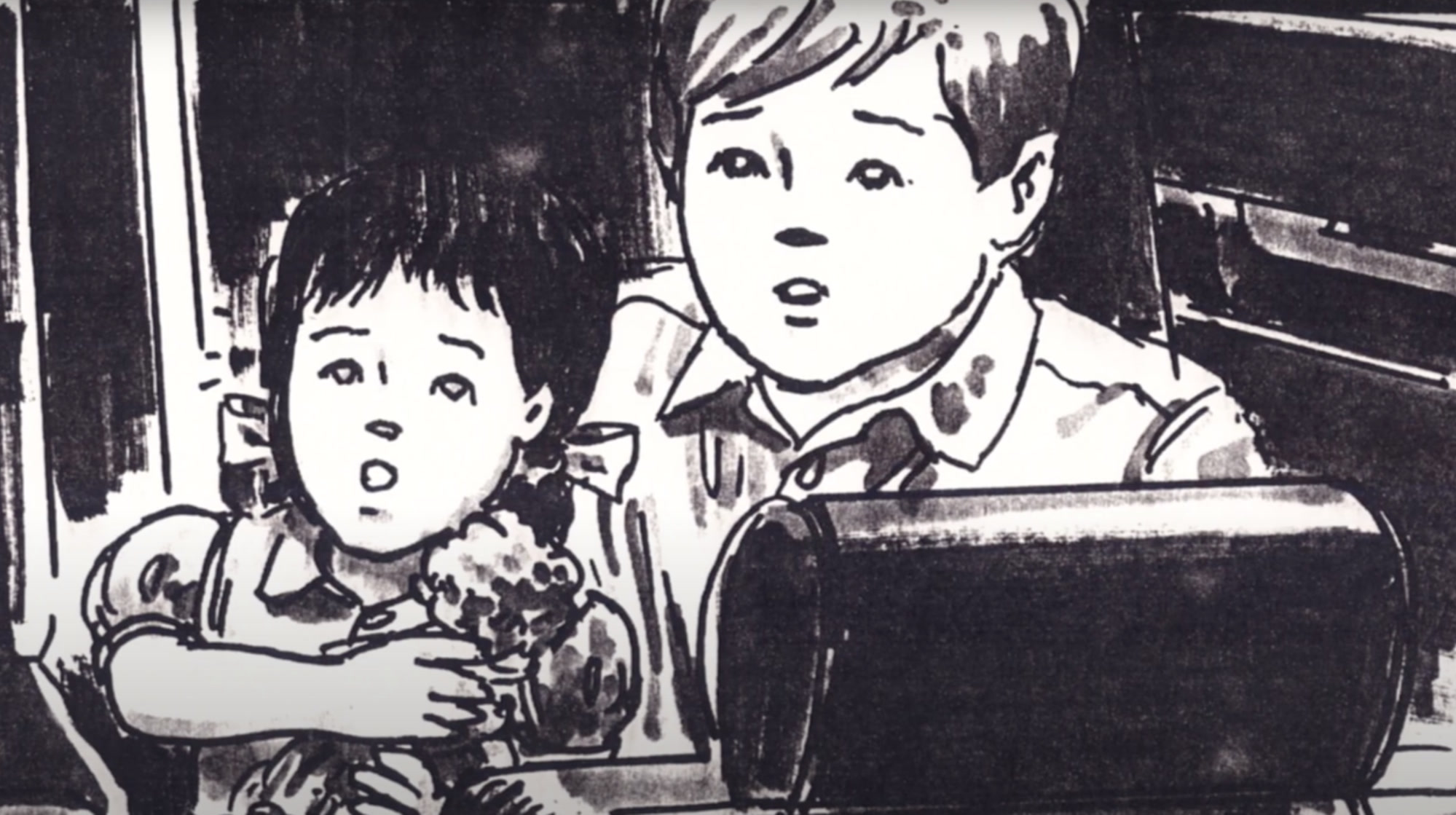
In this frame, for example, we see an older Tim (11) and a younger Lex (7 or 8). These were their ages in the novel, and they were only reversed with Koepp’s draft, since Spielberg wanted Joseph Mazzello as a younger Tim, and “realized that if I cast Lex younger than Tim, she would look about five years old—which was much too young to put in jeopardy with these dinosaurs. It would have turned the audience against us completely.”
But here Lex is drawn with dark hair, while in Crichton’s novel (earlier) and his drafts (later) she’s described as a blonde. She’s also holding a doll, rather than the baseball mitt she has in Crichton’s novel and both of his drafts. No accessory is mentioned in Carter’s version, and by Marmo’s it’s a flashlight instead.
In Crichton’s first draft, the kids are described as being protected from the invading T-Rex by a plastic bubble that “falls over them like a shield.”
Afterwards, the T-Rex lifts the car into her jaws, attempting to eat the children alive. Lex falls out of the car into the mud, still holding her doll. Unlike in the book, however, she lands just underfoot of the T-Rex.
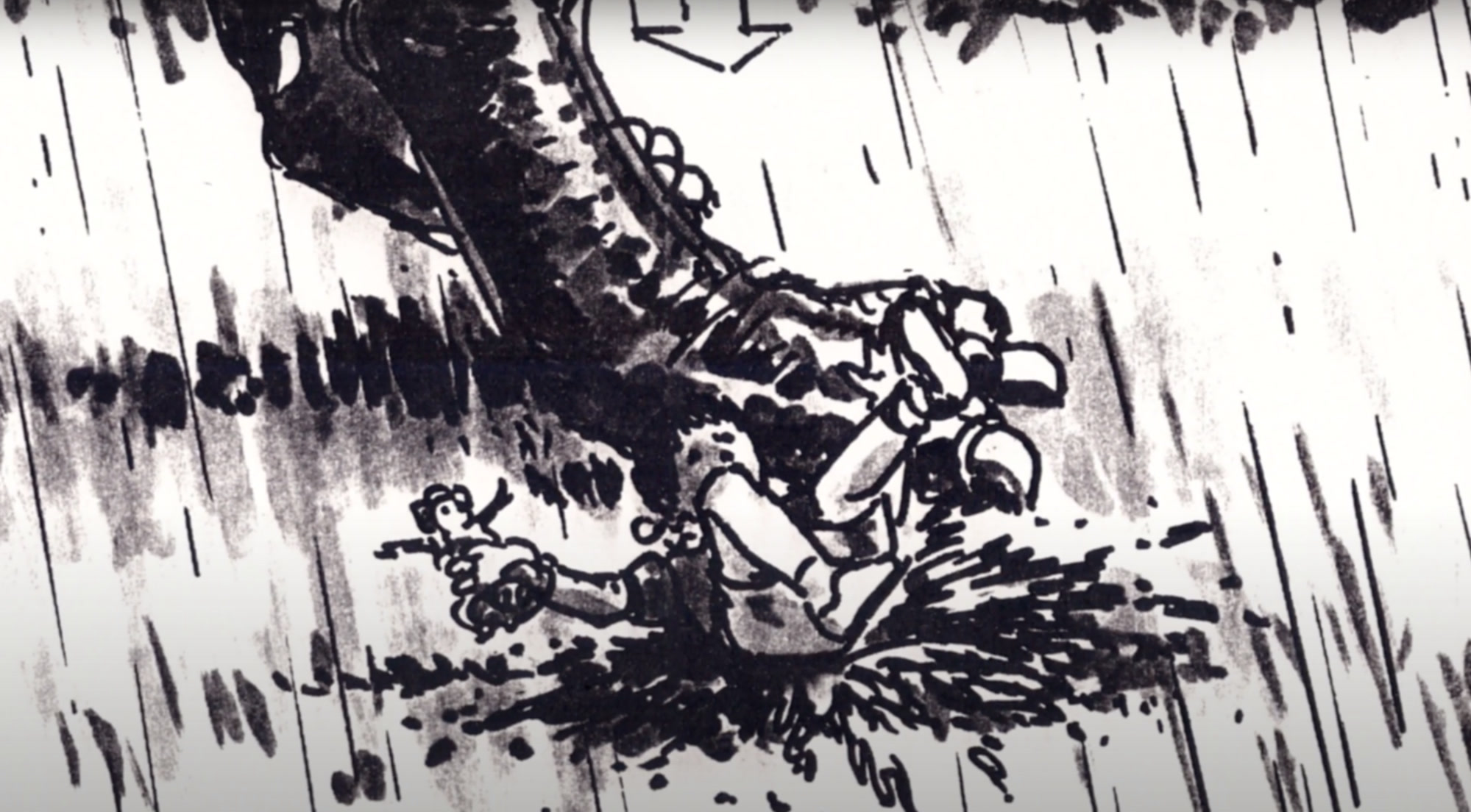
Crichton’s first draft introduces more mutilation than exists in the corresponding scenes in the book. In the first draft, and only the first draft, the T-Rex is described as chomping down on Malcolm’s legs, and then pinning Ed Regis (a deleted tour guide character) into the mud with her claws. Then, according to Davis’s summary: “The rex grabs him in his jaws, and lifts him above the limbs of the tree. We don’t see what happens. Body parts seem to fall, but it’s hard to tell in darkness.”
In Crichton’s second draft, Nedry’s body is discovered ripped into parts.
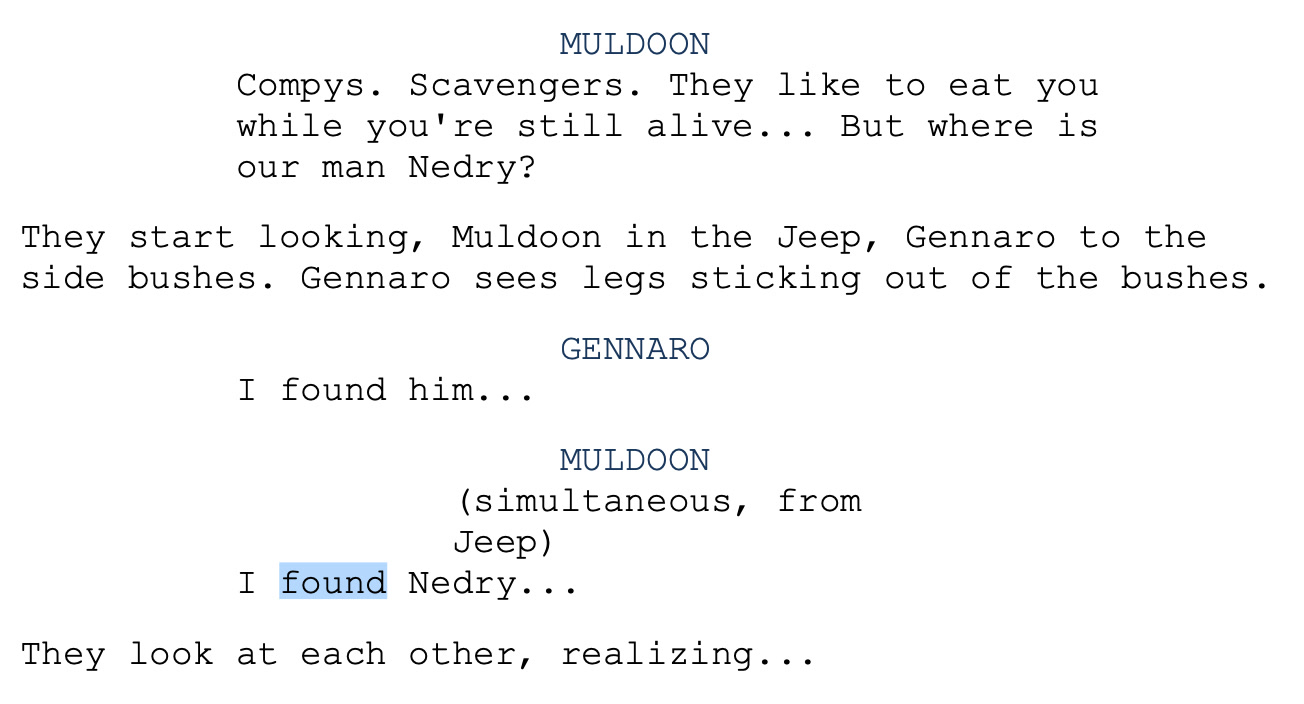
In Marmo’s, the dismemberment is expressed as comic relief.
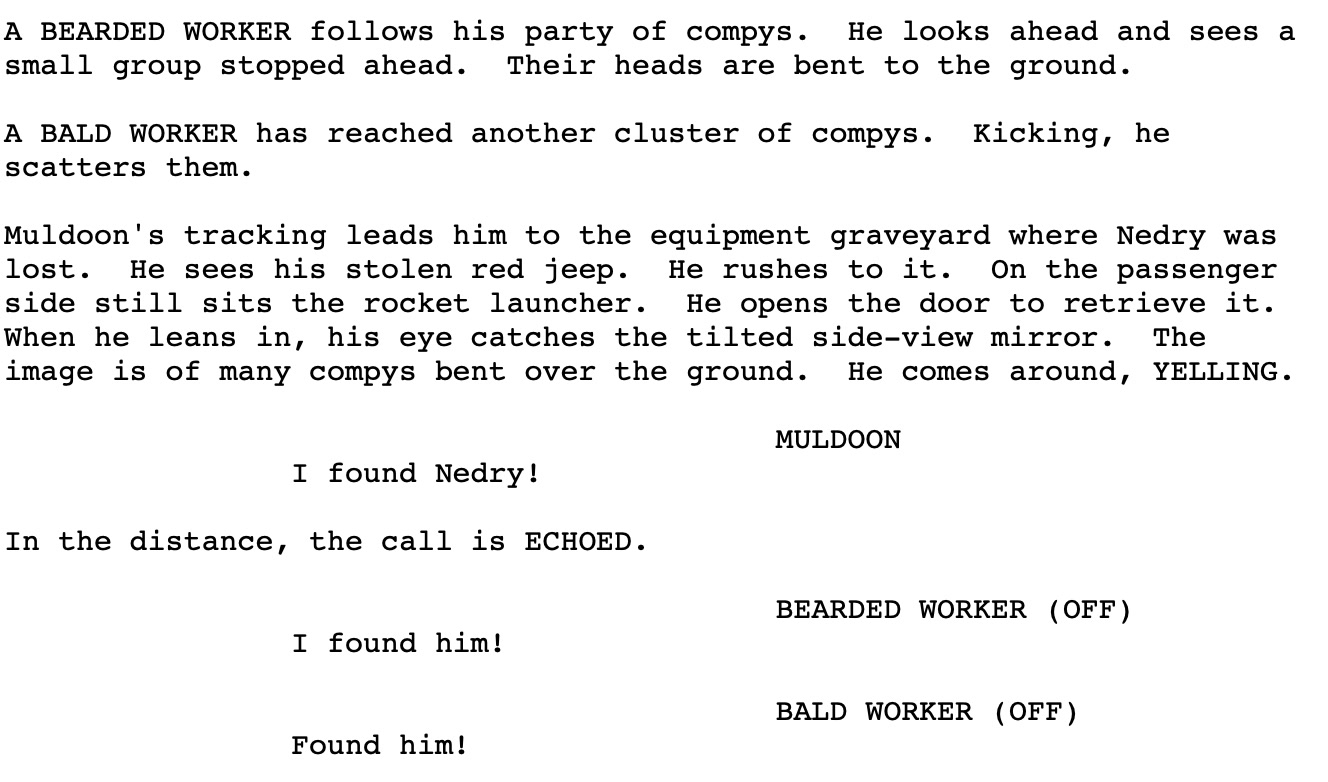
Even before finishing his first draft, Crichton was told to drop the pterodactyl scene that had made the initial crunch. It was eventually used in Jurassic Park III.
Finally, Crichton’s first draft contains a new ending. In the book, Hammond stumbles into a ravine, and is eaten alive by ‘compys’, small dinosaurs with narcotic venom.
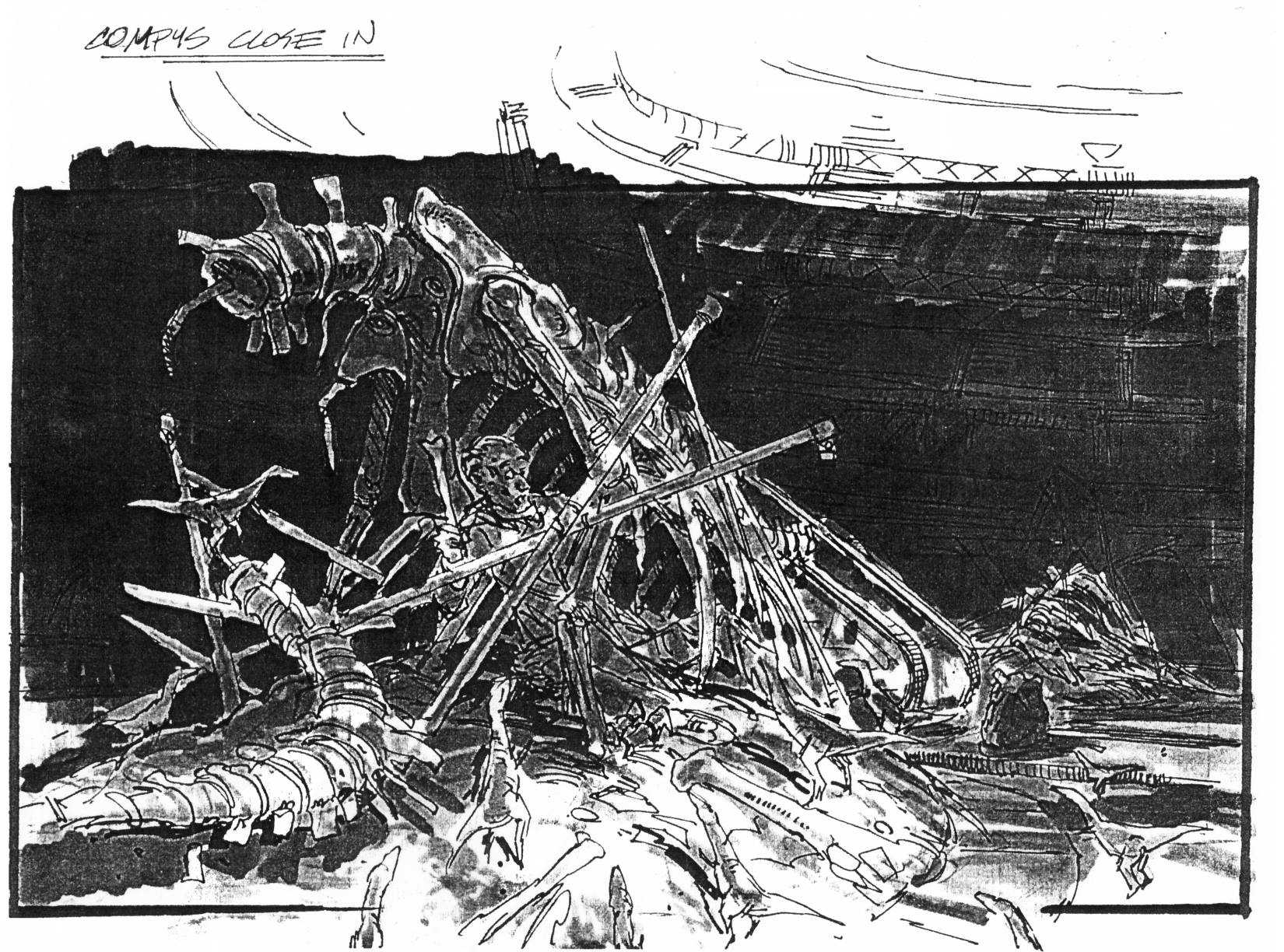
In Crichton’s first draft, this happens instead in the rotunda, after the hanging dinosaur skeleton and scaffolding crash down onto him, pinning him to the ground.
Crichton turned in his second draft on January 19th, ’91. Three days later, Spielberg, Carter, and Steve Starkey met to discuss the script with an eye to reducing the budget. And six weeks later, Carter turned in a draft of his own.
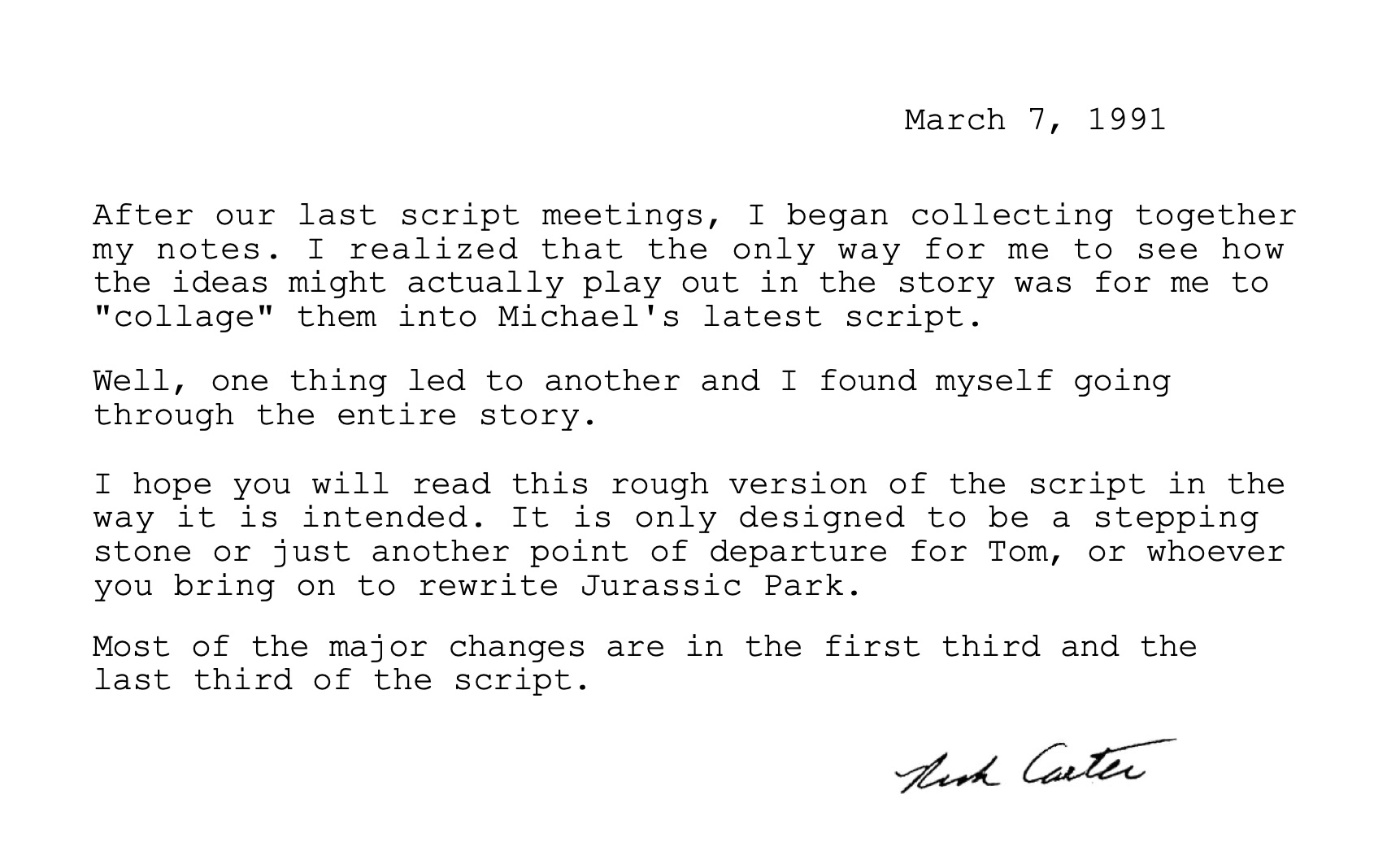
While each of Spielberg’s writers attests to his close involvement, his exact influence is obscured by their product. Carter’s draft—a “collage” of notes and storyboards that claims mostly to reflect the state of the story pre-Hook—suggests a more transparent view into Spielberg’s vision for Jurassic Park as it existed after Crichton and before Marmo.
Carter’s version is the only one bookended by helicopter scenes, beginning with the InGen helicopter, and ending with a military helicopter.

Carter’s opening adapts the prologue from the book, in which some of Hammond’s men deliver an injured worker to a jungle clinic. Ed Regis tells the doctor that the worker was injured in a construction accident and mentions a “backhoe” but she suspects that he was mauled. In a line not in the book, she conveys her doubt by remarking that “it looks like he was eaten by a bulldozer.” The patient moans “lo sa raptor” before dying and then Carter cuts from the bite marks to the raptor jaws Grant is uncovering. The association between industrial machines and dinosaurs is echoed later on in a description that says that a trail deforested by dinosaurs looks like a “giant bulldozer went berserk.”
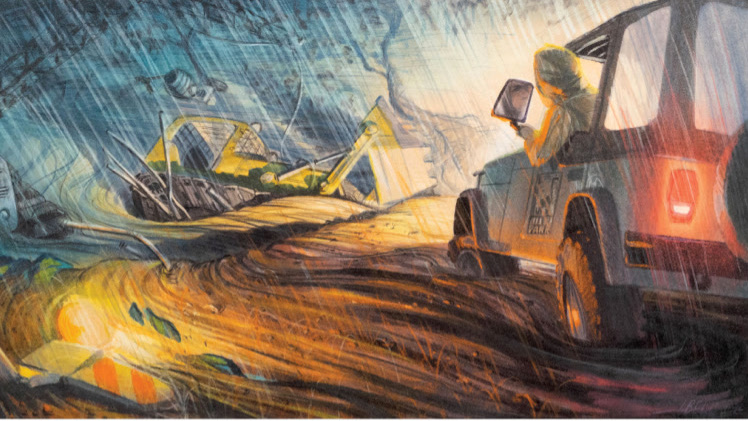
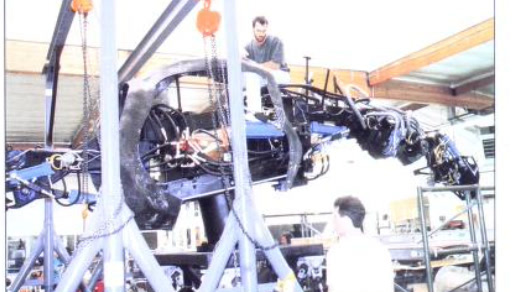
Marmo’s draft introduces a similar analogy, this time between the helicopter and the dinosaurs, during the Nublar landing scene.
In Koepp’s first draft (the only other version to contain the helicopter opening)—as in the book—the doctor looks up the definition of “raptor” and learns that it means “bird of prey.” Then, in Koepp’s early versions of the dig scene, the ROAR of the arriving helicopter is described as sounding “like some giant beast descending on the camp.” But Koepp also retains the bulldozer; he opens with a newly imagined scene that shows the accident itself, when a bulldozer, which also ROARS, attempts to push a crate into a holding pen, and an attending worker is slashed by whatever’s inside.
In Crichton’s second draft, the lawyer who approaches from the helicopter is told that he’s standing on top of the skeleton. In Carter’s version, the helicopter lands “right on top of the dig site.” In Koepp’s early versions, the helicopter arrives at night. Grant “looks up at the helicopter and shouts, shaking his fist.”
In Carter’s version (only), during the Nublar helicopter descent, when the pilot loses control, Ellie asks Hammond if they’re going to crash. In Crichton’s second draft (only), it’s Lex who asks. In Marmo’s version (only) the helicopter is twice described as shaking violently.
Carter’s draft closes by introducing the new “T-rex finale” that “came from Spielberg’s fertile mind” during the January 22nd ’91 story meeting. In previous versions, the park had either been blown up by an army helicopter in a series of fiery explosions (Crichton’s first version) or destroyed by a genetically engineered lysine deficiency akin to a plague (Crichton’s second).
The T-Rex leaps up and grabs the helicopter by the skids, causing the pilot to lose control.
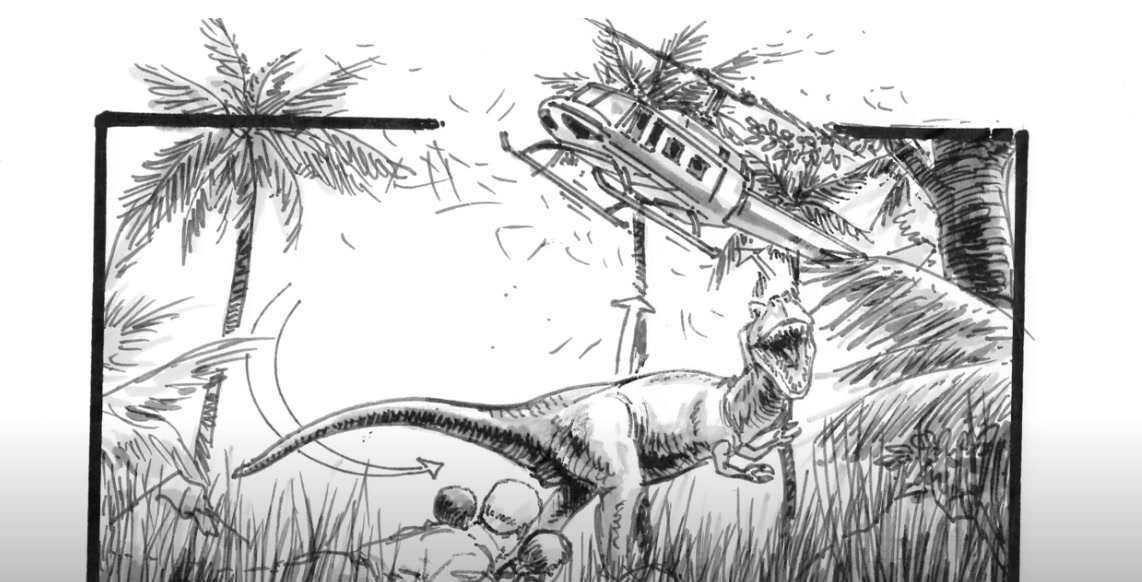


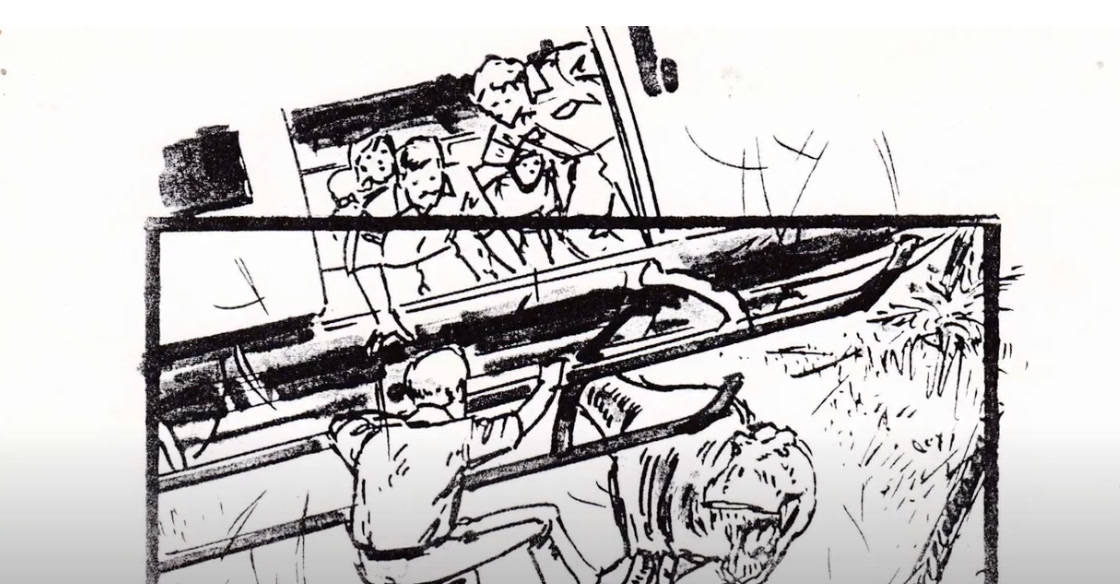
This version lasts through Marmo’s draft (in which it becomes an “army helicopter”), but is gone by Koepp’s: “I was not privy to that one. Steven must have moved on from that one before I got there.”
On Marmo’s request, Spielberg lent her his personal copy of the galleys, with highlights and margin notes. She also stayed in touch with Crichton. Her version includes a description of a bearded Grant, and storyboards from this era feature Grant with glasses, an Asian Ellie
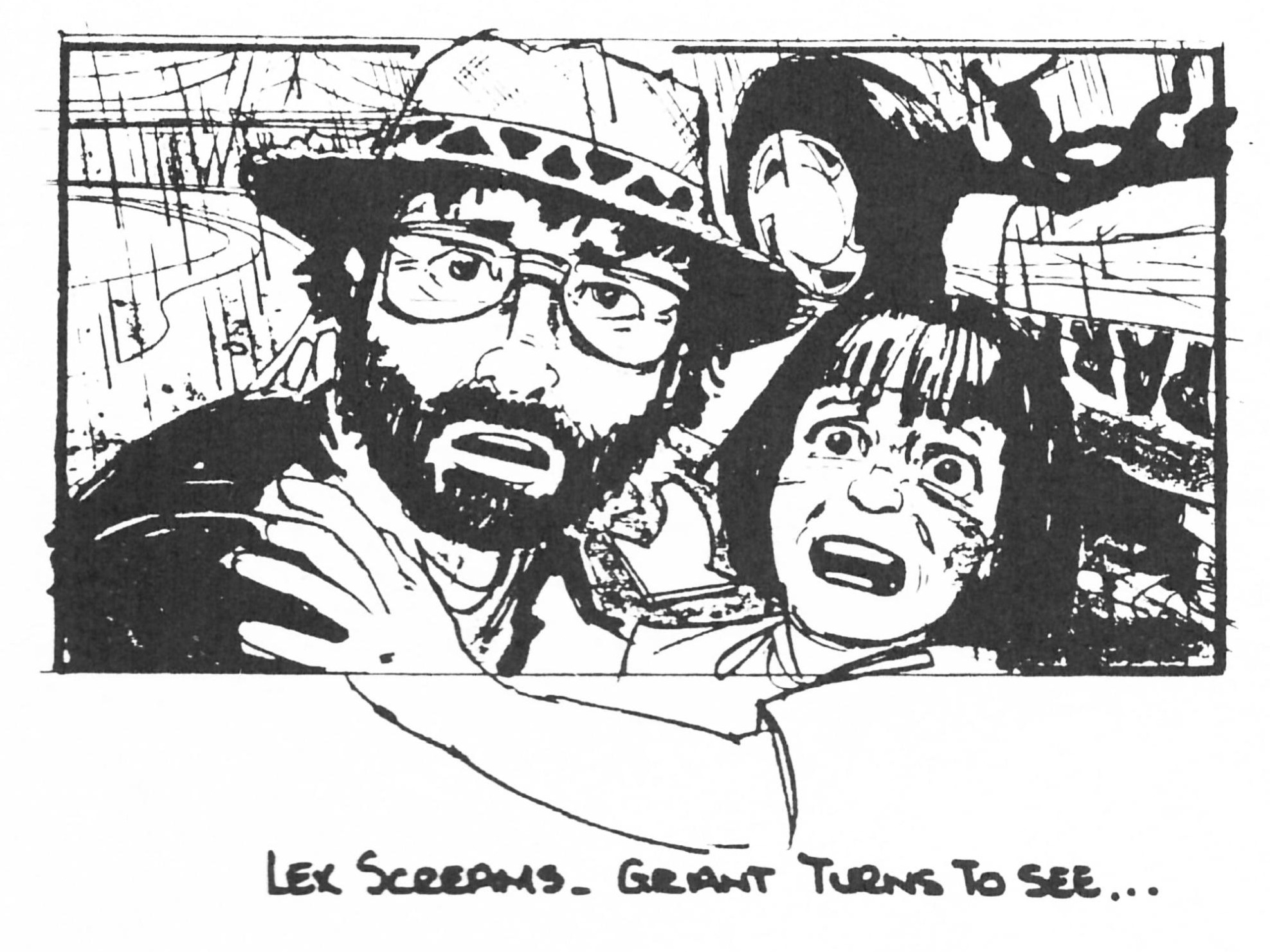
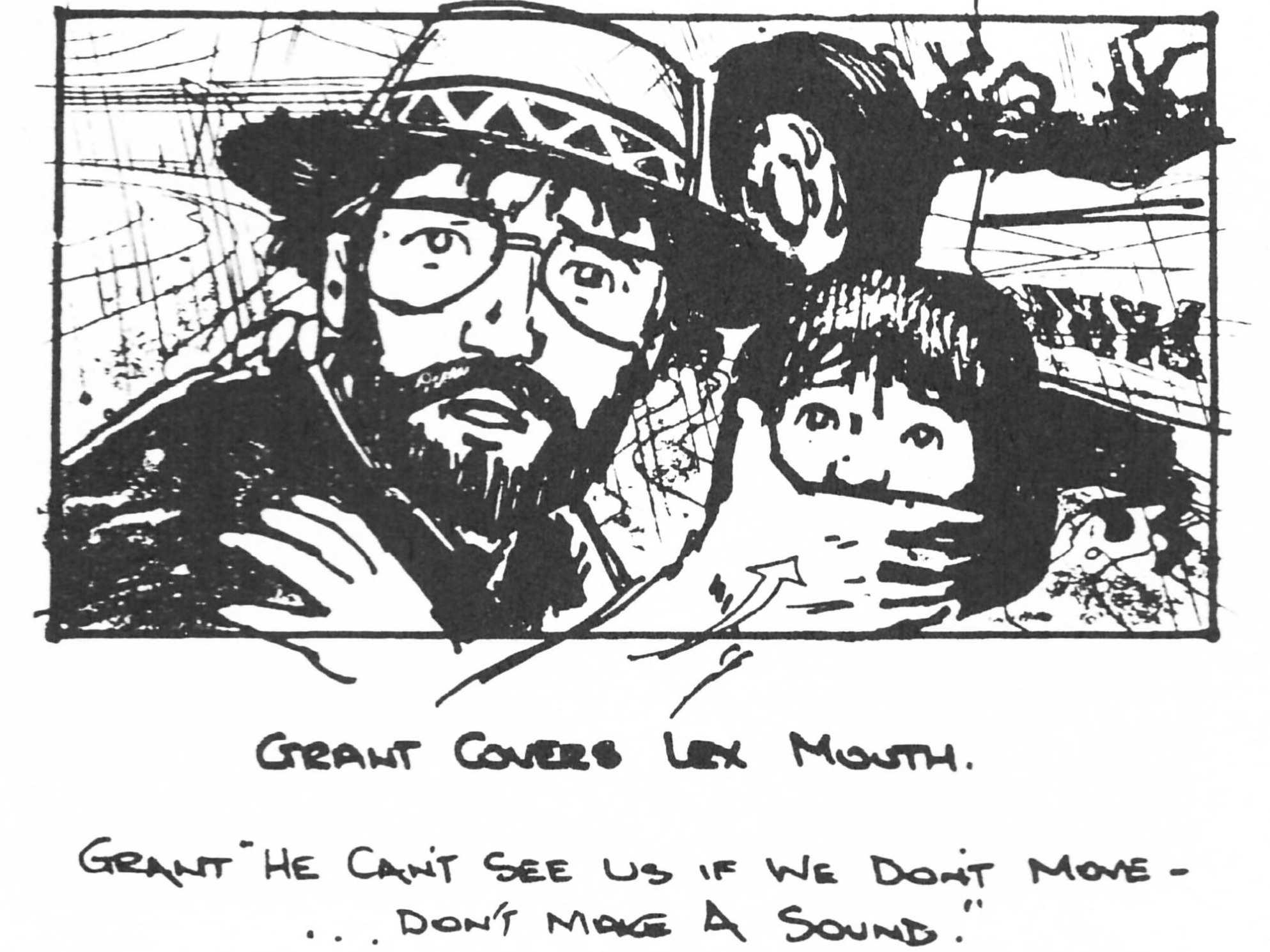
Marmo’s version introduces the electric fence as an ominous new obstacle, and the roadside wall-drop sequence.
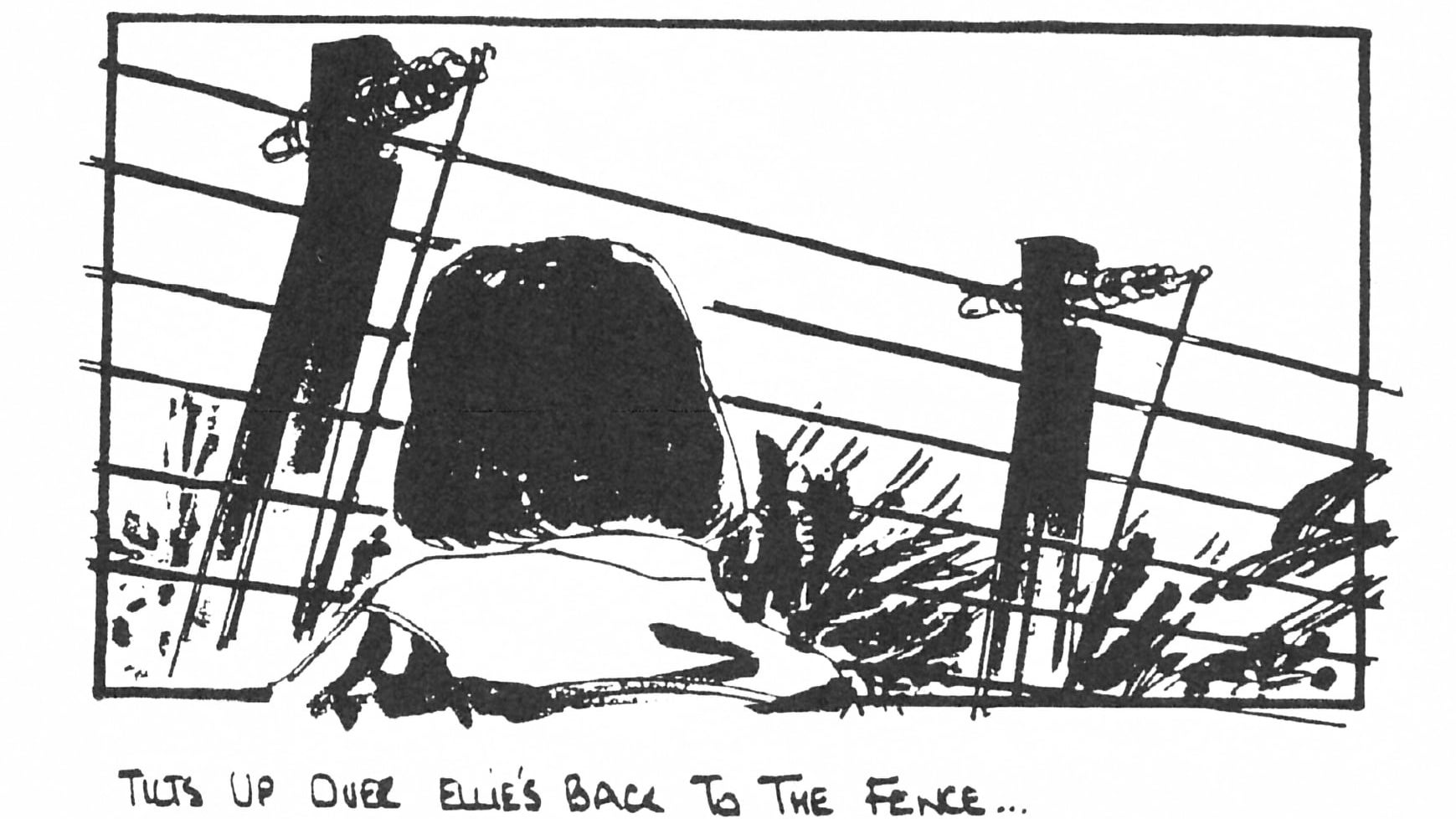
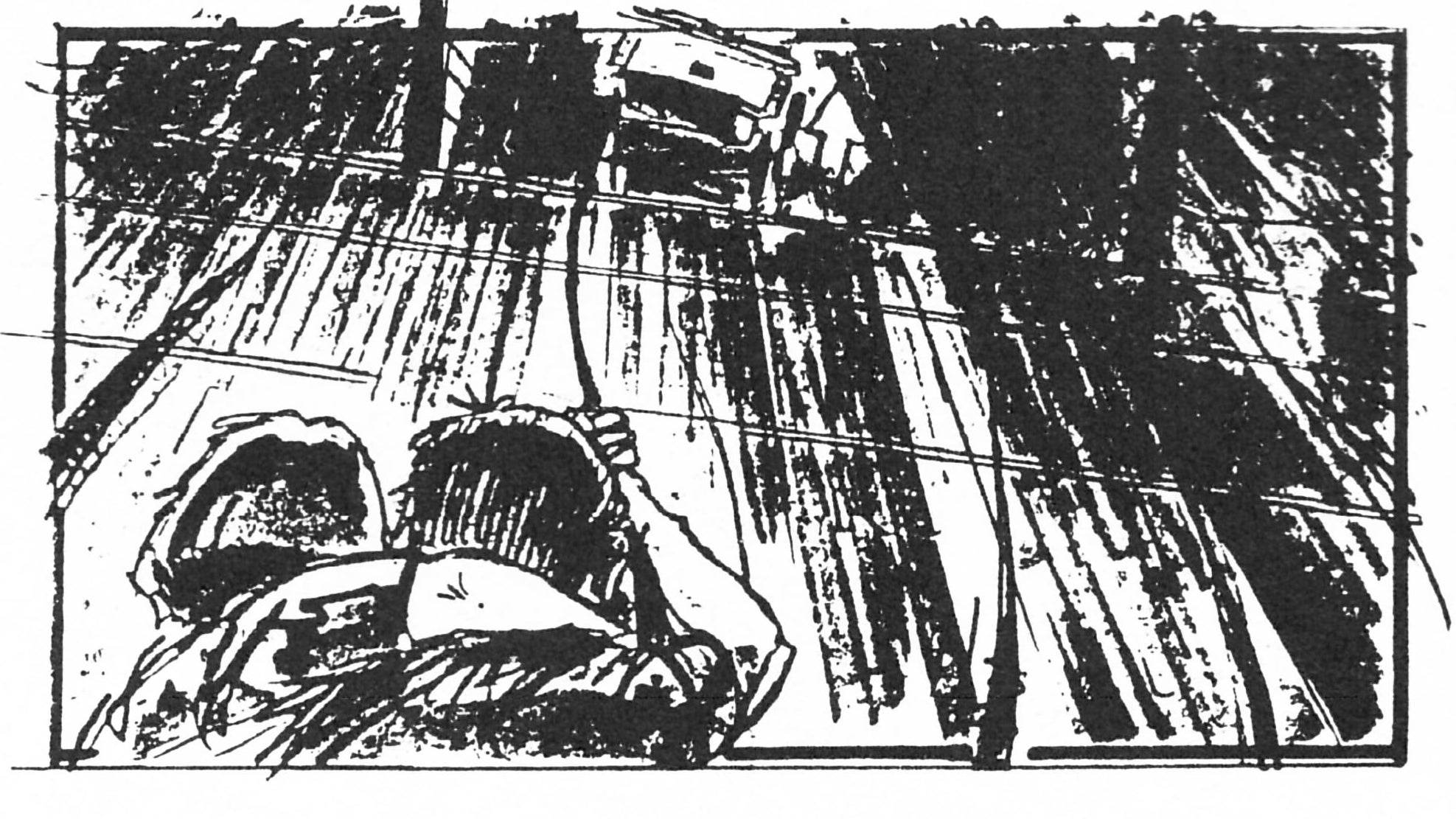
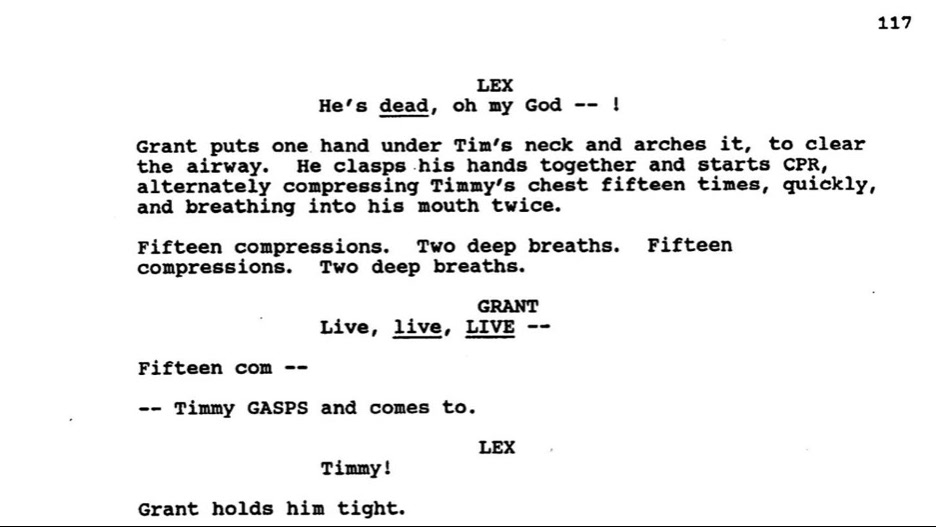
But it’s only with Koepp’s version that Tim is electrocuted by the fence and stops breathing, before Grant resuscitates him.
By the time Marmo finished her script, Koepp had already been given his assignment and Spielberg’s full attention. He decided to start fresh from the novel rather than modifying earlier drafts. But he worked from the copious storyboards and ideas generated by the creative team in conjunction with the previous screenwriters and Spielberg. As well, during the writing, he received story notes from Marmo, and ongoing input from Spielberg, whom he found to have “wonderful suggestions for action scenes.”
Spielberg had emphasized to Marmo that each scene should be “weighty with narrative ingenuity,” and Koepp continued the process of compressing the story. He refined the movie’s pairs of opposites, such as chaos–order, nature–artifice, man–woman, parent–child, science–religion, carnivore–herbivore, creator–creation, etc.
The kids were kind of a challenge, because we didn’t want it to seem like they were there just to have kids in the movie. Steven, in particular, is vulnerable to criticism like that, because he likes to work with kids. He works with kids awfully well, so it’s not entirely fair, but the perception is there nonetheless. So our challenge was to find out why these kids were essential to the movie. (Koepp
Koepp turned in an early working draft sometime between April 23rd and May 1st, 1992; a draft on May 26th, of which only ten pages have been released; an update on June 30th (full script); followed by numerous revisions during principal photography, with a Final Shooting Script dated November 11th and a Final Draft dated December 11th, 1992.
Koepp’s version, like all previous versions but Marmo’s, expands on a moment of criminal negligence from Crichton’s novel. The novel includes three separate dinosaur incidents on mainland Costa Rica: (1) the arrival by helicopter of a young (“no older than 18”) injured worker to a jungle clinic; (2) the attack of a young girl by compys (later used in The Lost World); and (3) a fatal attack on an infant by compys while a nanny is distracted. Eventually word of the strange lizards is funnelled to Columbia University, where it’s redirected to Dr. Grant for his expert opinion. This coincides with the arrival of Grant’s research funder, Hammond, whom Grant has been informed has been buying up amber. Later in the movie, Grant spies baby velociraptors stowing away on the supply ship. Besides Crichton’s second draft, which includes the second incident (a scene discarded within days), the drafts focus on the first incident.
Koepp’s first draft drops the idea of the raptors already having made it to the mainland, but opens for the first time with the “bulldozer accident.” He then reintroduces Carter’s jungle clinic scene, including Crichton’s beat of the doctor learning that a “raptor” is a “bird of prey.” And he continues with a scene at an amber mine, first conceived in Marmo’s draft, but now with Hammond learning that the injured worker is suing them for $2 million. In every subsequent version this is adjusted to $20 million. By the May version, Koepp and Spielberg realized that the jungle clinic beat was just a rehash of Jaws’ “This was no boat accident!” They omitted it, but allowed the original accident to remain as a catalyst for the investors to pressure Hammond, who must then court Grant’s approval to smooth over the disturbance.
Koepp’s crucial tweak was making Dr. Grant hostile towards children, creating a dramatic tension that doesn’t exist in the novel or previous versions. Grant uses his prop claw (introduced in Crichton’s second draft) to slash at and terrorize a child—already re-enacting the opening scene. Critic Henry Sheehan finds this moment to be echoed again in the main road T-Rex attack, in which Grant interrupts his own “barely suppressed murder fantasy” by snapping out of a trancelike moment of indecision.
Koepp finally removed the raft sequence, which he found “rather redundant.” The Jurassic Park River Adventure at Universal Studios had been in development since at least May 1990. Spielberg called it “a three-dimensional chance to live the movie,” although he admitted he would be stepping out before the steep drop at the end, being, himself, afraid of heights.
Koepp also continued to develop the ending. Each draft since Crichton’s first develops a scene involving the collapse of the T-Rex skeleton in the rotunda (not in the book). In Crichton’s first draft, we recall, it collapsed onto Hammond. In his second, it collapses as Grant climbs it, and serves as a distraction. In Carter’s, Tim and Lex try to escape the raptors by climbing into the T-Rex’s rib cage, to no avail; Grant arrives at the last minute, presses some control buttons, which causes the skeleton to collapse, with the T-Rex skull crushing one of the raptors. Marmo’s version is similar. Koepp’s refines the concept further, introducing a “Condor” crane that Grant manoeuvres to knock down the skeleton, ripping it from the ceiling and sending cables and bolts down like bullets, and with the skull decapitating the raptor—beheading the raptor with a beheaded head.
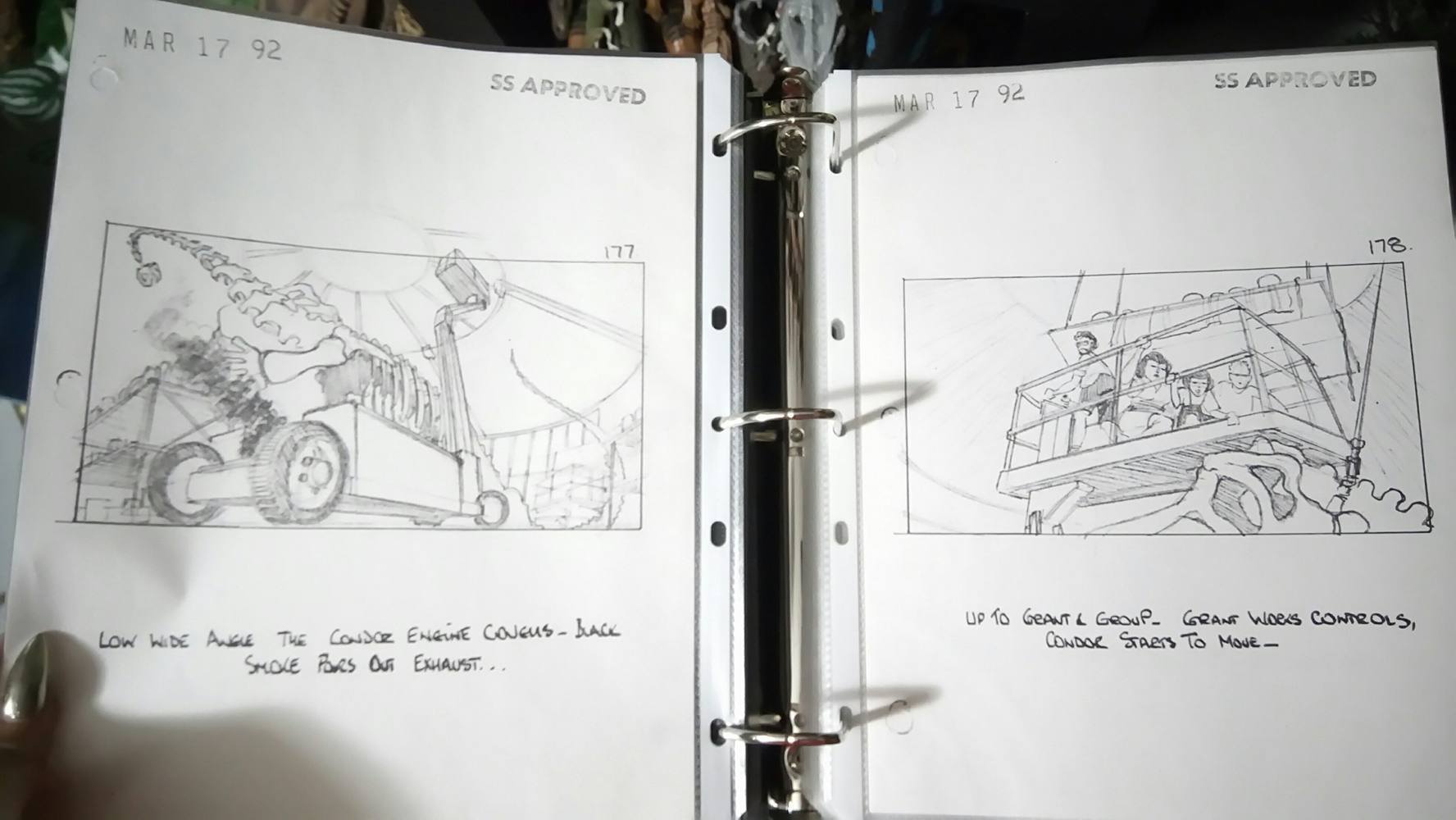
In the final draft (the change was only made on-set) the skeleton collapses on top of Tim—marking the third time that a chassis has done so, a conspicuous repetition.
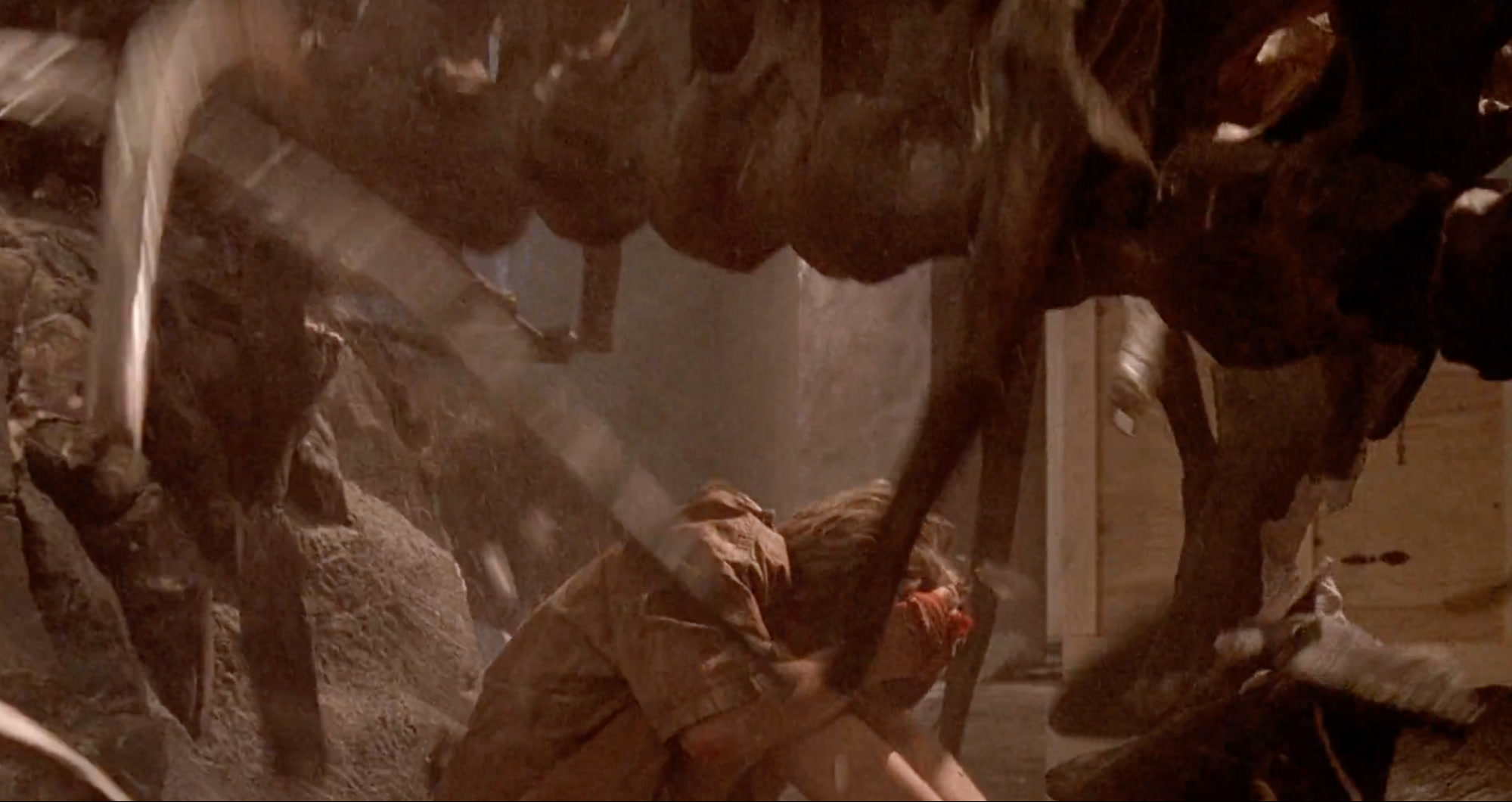
Koepp also completes the rehabilitation of John Hammond. After Hammond was crushed in Crichton’s first draft, he distracts the raptors in the second, sacrificing himself in a final act of redemption to save the kids.
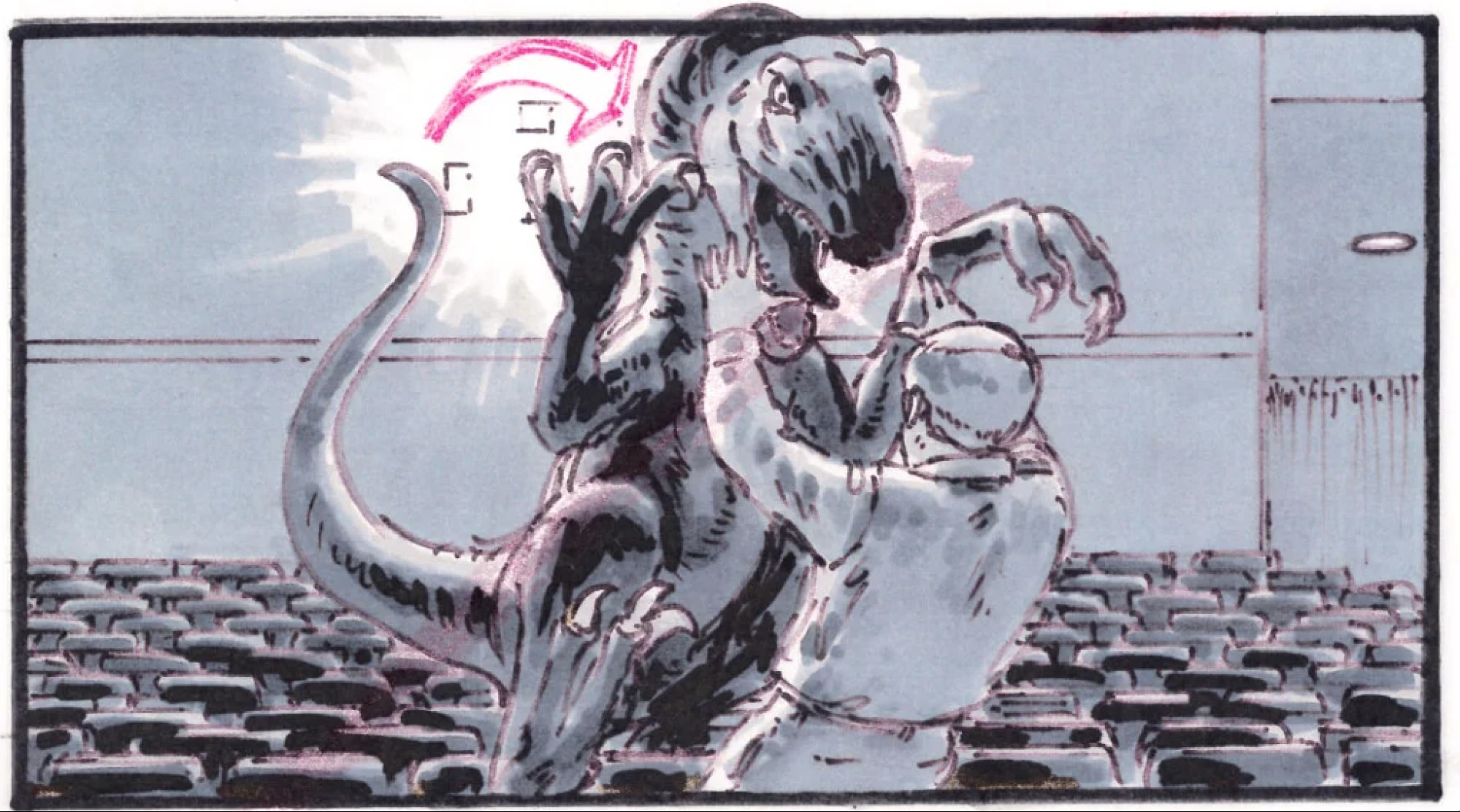
Carter’s version is similar, except that Hammond admits to knowing the DNA was unstable and that the park was never tenable. In Marmo, he admits it but blames it on his employees, and is left behind and dies. In Koepp’s first draft, he admits he knew, but blames it on himself, and stays behind but we don’t see him die. By Koepp’s June 30th ’92 draft, the DNA isn’t inherently unstable, Hammond’s culpability for the park and bringing the kids there is unclear, and he is brought along on the helicopter. Koepp speaks to the softening of Hammond directly: “Steven identified with him, whether consciously or not.”
Marmo said, “I thought [Hammond] was insane because he made a park that had raptors and T. rexes in it and still he brought his grandchildren to it before it had a real safety check. He took his own grandchildren to a potentially lethal park to use them as pawns.” But, “Steven wanted a sunnier captain of the Jurassic ship; he was clear about that.”
By the final draft, the question of culpability for the story’s concrete acts of negligence—the young worker mauled by a raptor whose family is suing Hammond for $2 million or $20 million; the boy and girl repeatedly threatened with violent death—is overshadowed by Hammond’s idealism and the ultimate rescue of the children.
But Koepp’s versions also enact a more fundamental reframing. In the book, Dr. Wu compares DNA to photography: “The DNA of the dinosaurs was like old photographs that had been retouched, basically the same as the original but in some places repaired and clarified...”
Reconstituting the components of the miracle at ILM, Koepp’s first draft restores the early brachiosaurus scene from Crichton’s first draft and sequences it next to the movie theatre/computer lab/genetic nursery, amalgamated into a single rotating theme park ride.
“I’d love to take credit for it, but I think it was Steven’s idea. It was brilliant. We could pop in for a few seconds here and there, put up some essential bits of information, and then get out. ... and it would make sense because it’s all part of the amusement park environment.”
This conscious, ironic meta-reference became the finishing layer of Jurassic Park’s aesthetic.
Spielberg was dreaming himself into his movies—as he always did—but had intuited a strange new hook. It was a dream about discovering a new power for making dreams come true—just as, in reality, he was.
As a celebration of the historical turning point and their new ability to create seamless CGI, they showcased it.
Throughout the story, they remind the spectator of their newly harnessed powers for capturing the imagination. As critic Nigel Morris puts it:
Jurassic Park inflects knowledge, always present in spectatorship, that what is experienced is not real—though the experience is real and what is experienced may be realistic—by heightened awareness of the stimuli’s synthetic nature.
This shifting was both cause and effect, a mesmerizing feedback loop that bounded the spectator’s sense of being both safely protected behind a screen and completely enveloped in the story.
This allowed a new transparent dimension that could be saturated with advertising that didn’t feel like advertising. By pretending it was criticizing itself, it disarmed the spectator, whose criticisms they heard addressed, and neutralized.
It obscured the apparent absolution fantasy of a grown man haunted by the death of two children in an unforeseeable industrial accident.
#18. The Fabelmans (2022) is about the limits of honesty
Spielberg’s most comprehensive biography to date is Joseph McBride’s Steven Spielberg: A Biography, first published in 1997. But it was “unauthorized.” Spielberg has always discouraged potential biographers, telling them that he was planning to write his autobiography at some time in the future.
McBride notes Spielberg’s desire to “control the telling of his own life story.” He writes:
I am constantly surprised by how many people, including some in the literary world, react with automatic suspicion when they hear the phrase “unauthorized biography,” as if there were something inherently dubious about a book not having the subject’s seal of approval. On the contrary, what should arouse the reader’s suspicions are the inevitable constraints placed on an author’s integrity by the decision to allow his subject to authorize and thereby to control the writing of the book. By talking endlessly about his life in press and television interviews to promote his movies, Spielberg already has given us an autobiography of sorts, albeit a scattered, fragmentary, and sometimes misleading one; what largely has been missing from the picture is an independent examination of his character, seen not simply through his eyes alone but also through the perspectives of the people who have known and worked with him throughout his lifetime.
McBride details some of these “misleads” in his work. Spielberg has a habit of telling “fibs.” Most famously over the years, for example, he’s told various more-or-less elaborate versions of how he got his break at Universal Studios. The template is that he sneaks off a tour, hides in the bathroom, and then occupies an office and gradually insinuates himself into the studio. The truth (which is no less impressive) is that his father’s colleague contacted the Universal Studios librarian, Chuck Silvers, who got Spielberg a day-pass and offered to show him around. Spielberg made a strong impression on him, and Silvers offered him a summer internship, but couldn’t get him a pass, and so Spielberg had to find his own way onto the lot.
It may seem trifling to address such imprecisions, but many of these fibs sustain a weird purchase in reality. Once he began making inroads in Hollywood, Spielberg subtracted a year from his age, an adjustment he maintained in the media and on documents like his driver’s licence until 1995 (past the time of Jurassic Park), when a lawsuit finally prompted his representatives to acknowledge that he was born in 1946. In 1975, according to the suit, his adjusted age allowed him to claim that an unfavourable contract, signed in 1968 with Denis Hoffman, the producer of Amblin’, was unenforceable, on the basis that he’d signed it as a minor, before he was twenty-one; in 1977, Hoffman accepted a $30,000 buyout. It was only in 1994, when McBride, researching his biography, mentioned Spielberg’s real age in an interview with Hoffman, that the counter-party obtained the birth certificate and pressed the claim, leading to an exchange of lawsuits in October 1995.
Spielberg started making good on his promise of an autobiography as early as 2002, with Catch Me If You Can. Of course, as we have seen, Spielberg’s work generally has a strong autobiographical tendency. But Catch Me If You Can signalled a “more literal” reflection of his own family trauma.
Despite his frequently told anecdote suggesting his lack of susceptibility to Freudian analysis, he also began to admit the opposite. In conversation with Scorsese about the film at the time of its release, Spielberg noted that:
The older I get, the more I go back to the early memories to get me to commit to a movie. It takes sometimes something very Freudian to get me to say, ‘Well, this is interesting; I better read beyond page fifty.’
In 2017, HBO produced Spielberg’s first authorized documentary: Spielberg (2017). Spielberg’s mother, Leah Adler, encouraged him to turn his family’s story into a movie.
Spielberg has always been fascinated by coming-of-age stories, but in 2022, with The Fabelmans he finally turns the lens onto himself—still displacing his story onto fictional characters but to a minimal degree. And it’s precisely by undermining this apparent transparency that he begins to reveal the distortions that characterize his technique.
In an interview with director Paul Thomas Anderson, Spielberg once again describes his working relationship with screenwriter Tony Kushner as a sort of therapy session, acknowledging his first (but not his second) therapy experience.
The Fabelmans begins like Bergman’s Scenes from a Marriage—a 1973 six-part TV series about the disintegration of a marriage—before finding its shape or “splitting” as Paul Thomas Anderson puts it.
Spielberg has previously used Scenes from a Marriage as a shorthand for the difference between him (and George Lucas) and Scorsese (and the rest of New Hollywood). One style, he says, is introspective, and “concentric” while the other is a “complete thought” and “more linear.”
The story unfolds in the vein of Malick’s The Tree of Life or Tarkovsky’s Mirror. Spielberg mythologizes his own biography as a genesis of myth-making, turning the particulars of his life—like having three younger sisters, being a Jew among Christians, and the child of an unstable marriage—into elements of a paradigmatic creation myth populated by the gods and goddesses of cinema.
The movie opens with one of Spielberg’s earliest memories: his mother and father taking him to the movies.
His parents are emblems of the Greatest Generation; his mother is a creative spirit playing the role of a housewife, and his father is an engineer laying the foundations of the personal computer.
When describing the memory elsewhere, Spielberg emphasizes two impressions: feeling overwhelmed and feeling deceived.
So the curtain is open and I expect to see the elephants and there’s nothing but a flat piece of white cardboard, a canvas. And I look at the canvas and suddenly a movie comes on and it’s The Greatest Show on Earth. At first I was so disappointed, I was angry at my father, he told me he was taking me to a circus and it’s just this flat piece of color.
But in The Fabelmans this moment is played for awe. It’s superimposed over another, more primal memory, which he described to Time magazine in 1985: being wheeled down the aisle of a synagogue towards the red light of the Ark of the Torah, while elders on each side chanted prayers in rhythm and handed him crackers. And when asked in 1991 to choose a “master image” that recurs throughout his work, Spielberg chose that of Barry, the toddler from Close Encounters, approaching “that beautiful but awful light, just like fire.” Spielberg’s first memory is also his “master image,” and here he layers it under the later memory, rendering the cinematic image as the ultimate expression of the divine fire.
These two memories give way to a third: inspired by the train crash in the middle of The Greatest Show on Earth, Spielberg begins to crash his own trains together by flashlight.
His mother reflects on the artistic fulfillment she feels while playing Bach, especially when she descends into the lower octave of one of his laments, describing it as “making a world you can be safe and happy in,” and infers from this that crashing trains is her son’s way of gaining a sense of control over his life. His father isn’t conscious of it, but he takes just as much pleasure in tinkering with his machines.
The subsequent scene plays like Freudian pornography. And later, when the family goes camping just after he turns sixteen, his mother dances in a nightgown as the men of the family gaze on. His father’s best friend tells Sammy that he should be filming this, and turns on the headlights of the car behind her, making her gown transparent. Once again the illuminated moving image is infused with ambivalence. The embarrassed elder daughter tries to block her, but Sammy urges her to sit down, which the father doesn’t overrule.
Later, while editing the dancing footage on his father’s request, he notices evidence of his mother having an affair with the friend. This is the moment that gives the movie its “shape,” echoing the earlier “secret,” and splitting Sammy from the rest of his family.
Sammy and his mother, as co-conspirators, play out an emotional affair in parallel to her actual affair, which eventually results in the parents’ divorce. Spielberg had been accused of making Disney movies about incest before, with The Color Purple and Back to the Future, and now the veil is even further lifted.
As Jocasta says to Oedipus in Sophocles’ tragedy, “many a man has slept with his own mother in a dream.”
But even when the movie’s psychosexual elements are made explicit, they hardly register until they become so loud that they’re hard to ignore. Once Sammy reaches senior year in Saratoga, his power to control reality becomes activated, not only within the story, but conspicuously in its telling.
After being bullied by two blonde antisemites, Sammy later finds himself in a private, playful moment in the library with one of their girlfriends and her friend. When the girlfriend points out that he’s Jewish, he replies, in close-up, “I mean, yeah, since the day I was circumcised.” The friend becomes attracted to him, associating him with Jesus (who was also Jewish, and circumcised), and invites him over to her room, covered in posters of Jesus and Elvis, so that Sammy might let Jesus “come inside him,” the first of many such double entendres.
Eventually Sammy gets his revenge on the bullies by screening a movie of the senior beach day that he’s edited to show the smaller Aryan as a thieving loser, and the bigger one as an Olympic god, including a close-up of his lower body while running. The bewildered pair turn against each other, and after Sammy admits his exact motives are unclear even to himself, he promises never to tell of the humiliation, “unless I make a movie about it.”
The autobiography is too Freudian to take at face value. Spielberg is playing with us the same way he says he played with his first therapist. The meta-implication is that Spielberg is showing us what it means to have a power to manipulate reality to make it safer for himself. It was in Saratoga that he realized that his movie camera could be used not only as his vehicle to social acceptance but as a “defensive weapon.”
Spielberg’s making conspicuous of his power for shaping reality is his way of telling us that there are some things he still can’t talk about, even at the sunset of his career.
#19. And, as a corollary, all artworks
Steven Spielberg’s Jurassic Park (1993) recently celebrated its 30th anniversary. In the years since its release, its intellectual property has grown into a “cottage industry,” encompassing theme-park rides, toys, apparel, video games, product placement, and six sequels, the latest of which, Jurassic World Rebirth (2025), began a new “Jurassic era.” While Spielberg had already directed other movies that were hugely profitable, some, like Jaws (1975), Close Encounters (1977), and E.T. (1982), weren’t “toyetic,” as Kenner’s Bernard Loomis told Spielberg of Close Encounters in 1977
(Jones 258) ; and the other, Indiana Jones, belonged to George Lucas. Jurassic Park was the first, and last, enduring merchandising empire that Spielberg could call his own.At the time, Jurassic Park represented a breakthrough in cinema technology, marking the first time that a blockbuster depended on CGI that looked and moved realistically. It became the herald for the coming digital revolution, which Spielberg talked about with a mixture of excitement, melancholy, and trepidation.
(Rufus Sears, “Making Jurassic Park,” Empire, no. 50, August 1993) The filmmakers integrated this energy into Jurassic Park’s brand identity. At the same time as Jurassic Park movies operate at the cutting edge of creative technology, their stories are about the perennial danger of cutting-edge creative technologies, adding a new meta-referential gloss to the classic technology-critical story archetype (e.g., Prometheus, Golem, Frankenstein, Godzilla).
But Jurassic Park also had a more personal significance. By 1992, Spielberg was in his mid-40s and onto his second marriage, with Kate Capshaw, who had just converted to Judaism, renewing Spielberg’s faith in the process. They had one child each from their previous marriages, one adopted son, and two children of their own. But he was still facing a transition to adulthood: both in his upcoming responsibilities of running a major Hollywood studio, DreamWorks SKG; and in the seriousness required by Schindler’s List (1993), which was being treated by Sid Sheinberg, Spielberg’s mentor at Universal Studios, as Spielberg’s arrival into his own identity as a mature filmmaker. It was his cinematic bar mitzvah and an emotional breakthrough.
According to biographer Joseph McBride, Spielberg’s movies of the late ’80s and early ’90s reflected the filmmaker working through several of his well-publicized neuroses: his resentments towards his father (Indiana Jones and the Last Crusade); his divorce from his first wife, Amy Irving (Always); and his own Peter Pan complex (Hook). It was around this time that Spielberg had been trying some psychotherapy.
All my friends went to therapy and I thought that maybe I would learn something about myself, so I went for a year. But I can’t say that I found the discoveries conclusive. Everything I learned about myself I knew already or I’d guessed for myself.
(qtd. in McBride, ch. 15) Spielberg was reportedly in talks with celebrity self-help author John Bradshaw, a guru specializing in healing the inner child, by imaginatively regressing his subject(s) back to their early childhood. According to Bradshaw, Spielberg was deeply impressed by his work. Los Angeles magazine reported that in February of 1992, they met at Spielberg’s house to discuss a TV show Spielberg had been convincing him to do. Bradshaw says, “Steven looked at me on the set of Hook and said, ‘This could be the most powerful television program of all time.’”
(qtd. in Sally Ogle Davis, “Oh, Pablum!,” Los Angeles, April 1992) Spielberg must have valued something about Bradshaw’s analysis, as he hired him as an on-set consultant for Hook, and cast his daughter in the movie.In this context, Jurassic Park always seemed like one last summer vacation. Sheinberg had insisted Spielberg get Jurassic Park done before Schindler’s List: “he knew that once I had directed Schindler, I wouldn’t be able to do Jurassic Park.”
(Spielberg, qtd. in McBride, ch. 16) Critic Kim Newman summed it up as follows:
The paring-down of a monster best-seller into a suspense machine (Jaws); the tackling of a popular-science childhood sense of wonder perennial with state-of-the-art effects that re-imagine 1950s B-science fiction (Close Encounters of the Third Kind); the all-action jungle adventure littered with incredible perils and gruesome deaths (Raiders of the Lost Ark); and big-eyed creatures who range from beatifically benevolent to toothily murderous (Gremlins, E.T.
, qtd. in Morris, Empire of Light, 256. ).But what if Jurassic Park wasn’t a break from Spielberg’s therapeutic phase, but its most pivotal moment?
“But Richard was great for the part because Richard is every person. If I want to put myself in one of my own movies I sort of go to Richard. I feel that I was the ichthyologist in Jaws and Richard played me in that; I felt that I was Neary in Close Encounters and Richard played me in that; and I felt I was the character in Always and Richard played me in that also.” Close Encounters was produced by Julia Phillips and Michael Phillips for Columbia Pictures.
Spielberg had been developing the premise for a while, but Paul Schrader was originally hired to write the screenplay. Spielberg outlined the premise and key images for Schrader, who interpreted it as a retelling of the conversion of St. Paul: an unbeliever has a spiritual encounter that changes the direction of his life. Spielberg hated Schrader’s script (“Kingdom Come”), which he called “one of the most embarrassing screenplays ever professionally turned in to a major studio or director... a terribly guilt-ridden story... not about UFOs at all.”
(qtd. in McBride, ch. 11) Schrader said, “The only thing I deserve a credit for... is changing Steve’s mind about doing the film as a UFO Watergate. I thought it ought to be about a spiritual encounter. That idea stayed and germinated.”
(qtd. in McBride, ch. 11) After another rewrite or two, Spielberg decided to write the screenplay himself. Spielberg and Phillips honed the idea of a climactic moment of transcendence they referred to as “The Experience.” These pockets of spiritual denouement would become a characteristic feature of Spielberg’s work.
Kael found Close Encounters to be a “kids’ movie in the best sense.” It was joyous and optimistic. But while she was dazzled by its mixture of the transcendent and the infantile, she was beginning to see Spielberg less in Dreyfuss’s “man looking for answers” and more in the toddler Barry, a “light-worshipper who sees the sky as a giant toy shop.”
In the wake of Star Wars’ transformation of the cinematic landscape, and the rise of SNL, Spielberg became more assured in dispensing with the pretensions of his New Hollywood milieu and exploring his comedic sensibilities. He was fostering two younger filmmakers, Bob Gale and Robert Zemeckis, who specialized in screwball comedies steeped in Americana. He had recommended them to the most conservative of his New Hollywood cohort, John Milius, whose A-Team Productions hired them to develop the script that would become Spielberg’s next movie, 1941 (1979).
The foursome began hanging out together, skeet shooting and then going out for chili-burgers and doing bigfoot impressions while Spielberg filmed it all on his Super-8 camera. “Great howling mad evenings... out of which came 1941,” said Milius.
1941 was the third time in a row that Spielberg had gone over time and budget, but this time it was a bomb. Spielberg soon disavowed the movie, the first of three times that he would do so
(Temple of Doom (1984) and Hook (1991) being the other two) .Spielberg said, “I plunged into [1941] with such wild abandon that I didn’t really focus on the story I was telling, to know whether it was funny or simply stupid or whether the film was getting too overblown... On about the hundred and forty-fifth day of shooting, I realized that the film was directing me, I wasn’t directing it.”
(qtd. in McBride, ch. 12) At the time, he blamed his writers, telling the New York Times that they “caught me at a weak moment. I’ll spend the rest of my life disowning this movie,” although he apologized to them shortly after
(qtd. in McBride, ch. 12) .Indiana Jones was first suggested to Spielberg by George Lucas in 1977. Spielberg would direct and Lucas would produce. Lucas negotiated a sweet deal with Paramount (allowing him to keep the rights to the franchise) that was highly contingent on Spielberg being able to deliver the movie on time and on budget.
He accomplished this with a renewed production regimen, involving an expanded storyboarding practice, newly capable and reliable producers, in Kathleen Kennedy and Frank Marshall, and a willingness to shoot to get the job done.
Spielberg and Lucas jointly worked out the story in a series of meetings with writer Lawrence Kasdan, in which they wrestled over whether the character should be more Cary Grant or Humphrey Bogart.
Both Spielberg and Lucas saw themselves—and each other—in Indiana Jones. Lucas said that “If I could be a dream figure, I’d be Indy,” and Spielberg later poked fun at Lucas being “a kind of dweeby Indiana Jones.”
He loved Melissa Mathison’s draft (“E.T. and Me”), and they rushed it to production. He had been planning to do Poltergeist next, based on a script called Night Skies, a sort-of sequel to Close Encounters based on an account that came up in his research about a farmhouse family terrorized by malevolent aliens.
At some point he’d hired John Sayles (Piranha (1978) Eventually he wrote it himself, incorporating several of his childhood memories., dir. Joe Dante ) to turn it into a screenplay.At the same time, he’d been wanting to do a movie about children. Spielberg reported that Truffaut had told him: “You must make a movie about keeds. You must stop all this big stuff and make a movie about keeds! If it’s the last thing you do!”
(qtd. in McBride) Spielberg had tasked Gale and Zemeckis with writing the project, but didn’t give them much guidance except that it should be about kids. The three of them worked briefly on a script called After School, but Spielberg’s agent advised him against making it—the comedy was too juvenile.In Night Skies, one of the aliens, a benevolent one named Buddy, befriends an autistic boy. This side-plot provided the axis for Spielberg’s movie about kids, E.T., while Poltergeist remained the “hostile” successor to Close Encounters.
- An Unresolved Syllogism in Freud?
The patient would lie down on a sofa, while Freud sat behind him. The patient agreed to “say whatever came into his head, while ceasing to give any conscious direction to his thoughts.”
(Freud, An Autobiographical Study) The purpose of free association was the same as that of its predecessor (therapeutic hypnosis): to isolate maladaptive tendencies in the patient’s unconscious mental processes and resolve them. But it had been modified for a very specific purpose: to isolate a subtle form of what Freud called “transference.”
In the early 1880s, Freud was an early-career medical scientist. Rather in the way that Aristotle makes an analogy of a bent stick—i.e., the displaced, faint, quivering reflection of a stick—for an image
(cf. Aristotle, On Dreams 3, 461a) , Freud studied, not delusions, per se (the quivering reflections), but their underlying physical causes.One day, his friend, a medical doctor named Josef Breuer, told him about a woman he was treating who suffered from “clouded” mental states. Breuer had figured out—after she once fell into one of these states in his presence—that he could engage her while she was in it, and even talk through it so that her waking condition would improve.
Freud speculated that these memories were ordinarily clouded because considering them directly would be so shameful by the patient’s own standards that some part of their mind was somehow, actively, keeping it at bay, unbeknownst to the patient. The patients felt guilt in the form of displaced anxiety. If they could just be brought back to the original incident, and urged through it “with a free expression of emotion,” the pent-up energy would be released (“catharsis”) and their condition resolved.
But Freud suspected that some of his patients’ traumatic recountings were embellished. And one day, one of his female patients, as she was waking up from her trance, tried to kiss him. The same thing had happened to Breuer.
Freud realized that he’d failed to account for a key variable. His patients were responding to his analysis in exaggeration of what was reasonable, which either took the form of intensified positive feelings (compliance, love), or of intensified negative ones (criticism, anger). Either way, this exaggerated “transference,” since it was woven into the therapeutic relationship, was difficult to detect, and even harder to prove to the patient. He realized that he’d only ever been part of his patients’ own distorted re-tellings. And indeed, although the patients had seemed to improve, over the short-term, their symptoms soon returned.
Considering this problem, he reframed his method. Instead, he would ask his patients to talk about their dreams. To the contemporary skeptics, then (and there were many)—who believed that the so-called realm of the unconscious was nothing but random epiphenomena—this provided a perfectly random sample. It was nonsense material, given meaning only in the patient’s interpretation.
But if they agreed with Freud’s speculation—that dreams must provide the closest interface between the waking world and the “clouded” self—then all the better.
And now, when the inevitable moment of transference occurred, the practitioner would be better positioned to see it for what it was, and explain it using the patient’s own associative links, which could be traced all the way back to early childhood experiences.
Freud, reflecting later, observed that, by way of logical corollary, he’d also discovered several other sciences at the same time. If psychoanalysis was a science, he realized, for example, then so was dream analysis. In other words, both could trace an apparent, “manifest” narrative back to its underlying, evolutionary “motive.”
Freud, by analyzing his own dreams, outlined the basic ways the dream’s real purpose concealed itself. It expressed itself through an ongoing narrative, with multiple people from life being “condensed” into singular dream figures, and the actual functions of the dream “displaced” onto seemingly minor details. It was then finished with a “deceptive secondary revision,” with the relatively conscious side of the mind doing a bit of extra polishing. It was only as the analyst paid attention to the patient’s associative patterns, rather than their interpretations, that the underlying story became visible.
And if dreams were basically stories, you see, then this implied two more sciences: art criticism, and consumer psychology.
Poetry, like dreams, could be decoded as the imaginary gratification of the artist’s unconscious wishes. The analyst just needed to factor out their conscious orientation towards an audience: poems were “calculated to arouse interest in other people and were able to evoke and to gratify the same unconscious wishes in them too.”
(Freud, An Autobiographical Study) But did Freud’s bilateral syllogism really hold together the way Freud said it did?
Isn’t the real story the underlying ahistorical assumption that the basic evolutionary drives are human beings’ primary motivators? And—willfully or not—coming to see everything through that “lens”?
#20. Pauline Kael: Musing on the problem for years
Many years ago, Pauline Kael gave me a really great review on Sugarland Express, but she said whatever’s on the surface might be all that’s there; there may be nothing behind that. And she was absolutely right. I hadn’t grown up yet through the movies. And that was going to come in time. (Spielberg, Spielberg, 2017)
This section collects Kael’s mainline reflections (mostly in the New Yorker) on Spielberg’s (and Lucas’s) influence on the American cinematic mainstream, 1974–1985.
🔗 Sugarland and Badlands (March 18th, 1974)
“The Sugarland Express” is like some of the entertaining studio-factory films of the past (it’s as commercial and shallow and impersonal), yet it has so much eagerness and flash and talent that it just about transforms its scrubby ingredients.
The director, Steven Spielberg, is twenty-six; I can’t tell if he has any mind, or even a strong personality, but then a lot of good moviemakers have got by without being profound. He isn’t saying anything special in “The Sugarland Express,” but he has a knack for bringing out young actors, and a sense of composition and movement that almost any director might envy. Composition seems to come naturally to him, as it does to some of the young Italians; Spielberg uses his gift in a very free-and-easy, American way—for humor, and for a physical response to action. He could be that rarity among directors[—]a born entertainer—perhaps a new generation’s Howard Hawks. In terms of the pleasure that technical assurance gives an audience, this film is one of the most phenomenal debut films in the history of movies. If there is such a thing as a movie sense—and I think there is (I know fruit vendors and cabdrivers who have it and some movie critics who don’t)—Spielberg really has it. But he may be so full of it that he doesn’t have much else. There’s no sign of the emergence of a new film artist (such as Martin Scorsese) in “The Sugarland Express,” but it marks the debut of a new-style, new-generation Hollywood hand.Maybe Spielberg loves action and comedy and speed so much that he really doesn’t care if a movie has anything else in it. But he doesn’t copy old stuff. He isn’t deep, but he isn’t derivative, either.
The scriptwriters are living off the past. I think it’s likely that being part of the TV-and-young-moviemaker generation affects a director—changes his perceptions—much more basically than it affects writers. It may turn writers on so that they want to work in movies, but they tend to draw upon old movies for their ideas, and this is particularly true of the film-school and American Film Institute troops (which Barwood and Robbins belong to), whose education has been sitting around and looking at movies, and who are now selling scripts to the major studios. They’re not really writers, any more than most of the other Hollywood writers are. They’re synthesizers of other people’s ideas, even when they write an “original” like “The Sugarland Express.”
Spielberg is a bit leaden with some of the older actors, and can’t always redeem the low-comedy effects—the sort of squalls and antic outrage that got laughs in “The Russians Are Coming, The Russians Are Coming.” There are hero-worshipful views of Ben Johnson, who plays the captain who leads the pursuit; the camera regards him as if he were a diva and his face the big aria. The captain’s excesses (breaking the weapons of a pair of right-wing nuts, shooting the tires of a TV-crew truck) are in a too cute old-movie style. I’m not a great fan of Ben Johnson’s acting in general; he holds positions like a pointer—imparting an air of deliberation and importance to every move he makes. Some of the comic touches that pull down Spielberg’s style are probably the result of the editors’ leaving a nudging extra beat; their work is mostly split-second right, but they leave a beat on an art effect, too—on the Teddy bear in the road near the end of the picture (the shot featured in the ad campaign). Spielberg can’t redeem it all, but he gets away with it; he’s one of those wizard directors who can make trash entertaining. That’s what “The Sting,” for example, tries to do, and though I may be lonely in this, I think it fails. Spielberg savors film, and you respond to that. “The Sugarland Express” has life to it. Not the kind of life that informs a young film like “Mean Streets”—probably the best American movie of 1973—but the vitality that a director with great instincts can bring to commercial entertainment.🔗 Notes on Evolving Heroes, Morals, Audiences (November 8th, 1976)
In “Jaws,” which may be the most cheerfully perverse scare movie ever made, the disasters don’t come on schedule the way they do in most disaster pictures, and your guts never settle down to a timetable. Even while you’re convulsed with laughter, you’re still apprehensive, because the editing rhythms are very tricky, and the shock images loom up huge, right on top of you.
There are parts of “Jaws” that suggest what Eisenstein might have done if he hadn’t intellectualized himself out of reach— if he’d given in to the bourgeois child in himself. While having a drink with an older Hollywood director, I said that I’d been amazed by the assurance with which Steven Spielberg, the young director of “Jaws,” had toyed with the film frame. The older director said, “He must never have seen a play; he’s the first one of us who doesn’t think in terms of the proscenium arch. With him, there’s nothing but the camera lens.” It’s not only the visual technique of “Jaws” that’s different. The other big disaster movies are essentially the same as the pre-Vietnam films, but “Jaws” isn’t. It belongs to the pulpiest sci-fi monster-movie tradition, yet it stands some of the old conventions on their head. Though “Jaws” has more zest than a Woody Allen picture, and a lot more electricity, it’s funny in a Woody Allen way. When the three protagonists are in their tiny boat, you feel that Robert Shaw, the malevolent old shark hunter, is so manly that he wants to get them all killed; he’s so manly he’s homicidal. It’s not sharks who are his enemies; it’s other men. When he begins showing off his wounds, the bookish ichthyologist, Richard Dreyfuss, strings along with him at first, and matches him scar for scar. But when the ichthyologist is outclassed in the number of scars he can exhibit, he opens his shirt, looks down at his hairy chest, and with a put-on artist’s grin says, “You see that? Right there? That was Mary Ellen Moffat—she broke my heart.” When Shaw squeezes an empty beer can flat, Dreyfuss satirizes him by crumpling a Styrofoam cup. The director, identifying with the Dreyfuss character, sets up bare-chested heroism as a joke and scores off it all through the movie. The third protagonist, acted by Roy Scheider, is a former New York City policeman who has just escaped the city dangers and found a haven as chief of police in a resort community on an island. There, feeling totally inadequate in his new situation, he confronts primal terror. But the fool on board the little boat isn’t the chief of police who doesn’t know one end of a boat from the other, or the bookman, either. It’s Shaw, the obsessively masculine fisherman, who thinks he’s got to prove himself by fighting the shark practically single-handed. Shaw personalizes the shark, turns him into a fourth character—his enemy. This fisherman is such a macho pain that it’s harrowingly funny when he’s gobbled up; a flamboyant actor like Robert Shaw, who wears a proscenium arch around him, has to be kidded.
The high point of the film’s humor is our seeing Shaw get it; this nut Ahab, with his hyper-masculine basso-profundo speeches, stands in for all the men who have to show they’re tougher than anybody. The shark’s cavernous jaws demonstrate how little his toughness finally adds up to. If one imagines George C. Scott or Anthony Quinn in the Robert Shaw role, these anti-macho jokes expand into a satire of movie heroism.
🔗 Contrasts (September 26th, 1977)
The loudness, the smash-and-grab editing, the relentless pacing drive every idea from your head; for young audiences “Star Wars” is like getting a box of Cracker Jack which is all prizes. This is the writer-director George Lucas’s own film, subject to no business interference, yet it’s a film that’s totally uninterested in anything that doesn’t connect with the mass audience.
There’s no breather in the picture, no lyricism; the only attempt at beauty is in the double sunset. It’s enjoyable on its own terms, but it’s exhausting, too: like taking a pack of kids to the circus. An hour into it, children say that they’re ready to see it all over again; that’s because it’s an assemblage of spare parts—it has no emotional grip. “Star Wars” may be the only movie in which the first time around the surprises are reassuring. (Going a second time would be like trying to read “Catch-22” twice.) Even if you’ve been entertained, you may feel cheated of some dimension—a sense of wonder, perhaps. It’s an epic without a dream. But it’s probably the absence of wonder that accounts for the film’s special, huge success. The excitement of those who call it the film of the year goes way past nostalgia to the feeling that now is the time to return to childhood.🔗 The Greening of the Solar System (November 28th, 1977)
“Close Encounters of the Third Kind” is the most innocent of all technological-marvel movies, and one of the most satisfying. This film has retained some of the wonder and bafflement we feel when we first go into a planetarium: we ooh and aah at the vastness, and at the beauty of the mystery. The film doesn’t overawe us, though, because it has a child’s playfulness and love of surprises.
[...] This vision would be too warm and soul-satisfying if it weren’t for the writer-director Steven Spielberg’s skeptical, let’s-try-it-on spirit. He’s an entertainer—a magician in the age of movies. Is Spielberg an artist? Not exactly—or not yet. He’s a prodigy—a flimflam wizard-technician. The immense charm of “Close Encounters” comes from the fact that, for all its scale and expense (nineteen million dollars), this is a young man’s movie—Spielberg is still under thirty—and there’s not a sour thought in it. (The title is from a book by the astronomer Dr. J. Allen Hynek—close encounters of the first kind are sightings, the second kind are physical evidence, and the third involve actual contact. Sightings aren’t necessarily close and they’re not encounters, and physical evidence isn’t an encounter, either, but the title sounds good, anyway.)“Close Encounters,” too, is a kids’ movie in the best sense. You can feel the pleasure the young director took in making it. With his gift for investing machines with personality, Spielberg is the right director for science fantasy.
He made a malevolent character of a truck in “Duel,” his famous made-for-TV movie. In his first theatrical feature, “The Sugarland Express,” he had cars dancing, feuding, bonding. In his second film, “Jaws,” he turned a computer-operated shark into a personal enemy. And now he’s got his biggest mechanical toys: the mother ship and the flying-saucer herald angels—whirring through the skies, flashing their lights. Some are intergalactic Pucks teasing earthlings and leading them on fools’ chases; some are stately geometric forms spinning languorously. Each is like a musical divertimento, a delight unto itself. “Jaws” was a nightmare movie; this is a dream. In “Jaws,” the harrowing terror kept building; here the mystical good humor builds—the story envelops you. [...]Roberts Blossom has the look of a true believer. That’s what Dreyfuss lacks. Spielberg is far more successful with Barry, the three-year-old, whose pure lust for otherworldly entertainment is delicately funny. Barry, the toddling light-worshipper who sees the sky as a giant toy shop, is closer to the heart of Spielberg’s vision than Roy, whose “looking for answers” Dreyfuss strains to represent.
“Close Encounters” shows an excess of kindness—an inability (or, perhaps, unwillingness) to perceive the streak of cowardice and ignorance and confusion in the actions of the authorities who balk the efforts of the visionaries to reach their goal.
Having devised a plot in which the government systematically covers up information about U.F.O. sightings, Spielberg is much too casual about how this is done and imprecise about why. He has a paranoid plot, but he hasn’t dramatized the enemy. The obstacles here are just Air Force and Army men doing their duty, and these authorities are shrugged off by the cranks, or humbly accepted. Roy and the others don’t have the incapacitating hatred of smooth-talking authority which would make us respond to their frustrations—would make us feel what was unhinging them. Impersonality doesn’t enrage Spielberg, because he hasn’t got at the personality hidden in it. Stock villainy isn’t what’s needed—something deeper is. He had similar trouble with the corrupt local merchants and politicians in “Jaws;” their corruption was tired, ritualized—it was necessary for the plot, that was all. In “Close Encounters,” there is nothing behind what the military men do except bureaucratic indifference. But that means they don’t know what they’re doing—and to be so totally blind is tragic, crazy emptiness. Spielberg has a genuine affection for harmless aberrants, but he doesn’t fathom the dangerous aberrance of authority—particularly an authority that in its own eyes is being completely reasonable.“Close Encounters” is a beautiful, big, enjoyable film that sends you out happy. It might be even better if there weren’t so many people at the end looking upward with transfigured faces.
🔗 Whipped (June 15th, 1981)
The marketing executives are the new high priests of the movie business. It’s natural.
They’re handling important sums of money. And they dispense the money dramatically, in big campaigns that flood out over the country. It’s not unusual for more to be spent on marketing a picture than on making it, and this could become commonplace. (Everybody takes it for granted that more is spent selling soap than manufacturing it.) Right now, the easier a project looks to market, the easier it is to finance. And the scope of what these priests think they can sell becomes narrower all the time.These marketing divisions are a relatively new development. (In earlier years, there were two much smaller departments—advertising and sales.) Their growing power isn’t in any special effectiveness in selling pictures; it’s in their ability to keep pictures that don’t lend themselves to an eye-popping thirty-second commercial from being made or, if they’re made, from being heard of. In the new Hollywood wisdom, anything to do with people’s lives belongs on TV. (As a result, television now makes contact with us in ways that movies no longer do.)
Like poor relations, the print media are the residual legatees of the huge marketing campaigns for pictures.
This month, God knows how many publications are featuring “Raiders of the Lost Ark,” a collaboration between George Lucas and Steven Spielberg—both still very young (Lucas is thirty-seven, Spielberg only thirty-three), and each responsible for some of the very top box-office successes in the history of movies. If anybody has a chance to turn movies around, it would seem to be these two (or Coppola).
But “Raiders” is a machine-tooled adventure in the pulp-esoterica spirit of Edgar Rice Burroughs; it appears that Lucas and Spielberg think just like the marketing division. According to modern movie legend, Lucas, who had watched the serials of the thirties and forties on television in the fifties, has long cherished the idea of a hocus-pocus series “following the exploits of an adventurer/archeologist, Indiana Jones,” but he got more interested in his other idea—“Star Wars”—and put “Raiders” aside, for later. Over the years, he worked up the story idea with Philip Kaufman—the first picture was to be set in 1936, in order to take advantage of Hitler’s well-known interest in the occult—and in 1977 he offered it to Spielberg to direct. Spielberg, who was then finishing “Close Encounters” and was committed to making “1941,” agreed to do it after that, and Lawrence Kasdan, who had done the rewrite on “The Empire Strikes Back,” prepared the screenplay.But “Raiders” is so professional and so anxious to keep moving that it steps on its own jokes. You can almost feel Lucas and Spielberg whipping the editor to clip things sharper—to move ahead.
(I say the two, rather than just Spielberg, because this picture gets dangerously close to cancelling itself out, in a way that recalls “More American Graffiti,” which Lucas also produced.) The effect of the obsessive pace is that the picture seems locked in. Our eyes never have a second just to linger on a face or on an image of planes coming out of the clouds. The frames fit into each other, dovetailing so tight that sometimes it seems as if the sheer technology had taken over. It’s all smart zap—a moviemaker’s self-reflexive feat.Despite its daring surface, “Raiders” is timid moviemaking: the film seems terrified of not giving audiences enough thrills to keep them happy.
It’s an amalgam of Lucas’s follies—plot for its own sake, dissociated from character or drama; the affectless heroine, who’s a tougher version of Carrie Fisher’s spunky Princess Leia in “Star Wars”—and effects that Spielberg the youthful magician has already dazzled us with. I kept wondering if it was the drubbing that the press had given Spielberg on “1941” (where he was trying new things) that made him so cautious. He seems to have accepted the Lucas pulp-repulped format as a safety net. It’s not right for him. The movie comes alive in the kinetic comedy: in the lowdown, rowdy slapstick, when the Nazi sadist Toht, played by Ronald Lacey, picks the medallion up out of the fire, drops it from his blistering hand, and runs out screaming; and in the balletic slapstick, when Marion is the prisoner of the Nazis and Toht arrives and takes out a metal apparatus that Marion—and we—think is an instrument of torture but turns out to be a coat hanger. But Spielberg fumbles a lot of his action sequences, such as the ones on a tramp steamer and a U-boat, and even the early chase, in which Marion disappears. And some of the episodes are simply tired: a fight between Indy and a huge, sadistic German wrestler; a sequence with Indy jumping on a moving Nazi truck that’s full of soldiers, chucking them off one by one, and ramming other cars in the convoy, to the accompaniment of soul-grinding music. Seeing “Raiders” is like being put through a Cuisinart—something has been done to us, but not to our benefit.
It’s a shocker when the big-time directors provide a rationale for the marketing division—when they say, as Spielberg does, that “the real movie-lovers are still children.” And there’s no doubt he means that in a congratulatory sense. The whole collapsing industry is being inspired by old Saturday-afternoon serials, and the three biggest American moviemakers are hooked on technological playthings and techniques.
Behind “Raiders” is the soft-spoken George Lucas, who says things like “I’m really doing it so I can enjoy it. Because I just want to see this movie.” I believe him. I wish I didn’t. I wish I thought he talked that way just as a come-on for “Raiders,” because if Lucas, who is considered one of the most honorable people who have ever headed a production company, weren’t hooked on the crap of his childhood—if he brought his resources to bear on some projects with human beings in them—there’s no imagining the result. (There might be miracles.) I don’t think the deterrent to his producing movies with human characters is just financial risk. Lucas, who keeps a tight rein on budgets, probably wouldn’t stand to lose too much of his own or other people’s money. The bigger deterrent may be Lucas’s temperament and tastes. It’s not surprising that he takes pride in the fine toys that “Star Wars” generated, and controls their manufacture carefully; essentially, George Lucas is in the toy business.
🔗 The Pure and the Impure (June 14th, 1982)
[...] If the film seems a continuation of “Close Encounters,” that’s partly because it has the sensibility we came to know in that picture, and partly because E.T. himself is like a more corporeal version of the celestial visitors at the end of it.
Like “Close Encounters,” “E.T.” is bathed in warmth, and it seems to clear all the bad thoughts out of your head. It reminds you of the goofiest dreams you had as a kid, and rehabilitates them. Spielberg is right there in his films; you can feel his presence and his love of surprises. This phenomenal master craftsman plays high-tech games, but his presence is youthful—it has a just-emerged quality.[...] Elliott (his name begins with an “E” and ends with a “T”) is a dutiful, too sober boy who never takes off his invisible thinking cap; the telepathic communication he develops with E.T. eases his cautious, locked-up worries, and he begins to act on his impulses.
When E.T. has his first beer and loses his inhibitions, Elliott, at school, gets tipsy, and in biology class when each student is required to chloroform a frog and then dissect it he perceives his frog’s resemblance to E.T. and sets it free. (His classmates follow suit.) The means by which Elliott manages to kiss a pretty girl who towers over him by at least a head is a perfectly executed piece of slapstick.[...] As [if] to offer positive proof of how confounding people can be, Spielberg has also made an anything-for-a-scare movie—“Poltergeist,” a suburban gothic in which the children’s paradise turns into a children’s hell.
Although the writing credits are shared, he wrote the initial story and rewrote the other writers’ work on the script, and he produced the picture and supervised the final edit. And although he picked Tobe Hooper to direct, he storyboarded the shots and, it appears, also took over, in considerable part, on the set. Whatever the credits say, he was certainly the guiding intelligence of “Poltergeist”—which isn’t a high compliment.[...] At first, Spielberg’s skill may get your hopes up—you think everything will come together in some wonderful sneaky-clever way.
When you realize that it won’t, your whole relationship to the movie changes. You’ve become the director’s target: you’re being subjected to thrills, bombarded by them, as you were in “Raiders.” And so, since the director puts you in the position of being a connoisseur of special effects, you sit back and turn bitchy—at least, I do. It doesn’t take long for the principle of diminishing returns to set in: after a while your anticipation of a grisly new horror is more fun than what is delivered—ectoplasmic manifestations, spinning rooms and flying objects, gooey stuff that extrudes around closed doors, ambulatory cadavers, and angry, roiling skies and a mean tornado. The spectral effects are so varied that the film turns into a showcase for fancy opticals. And when we get into that jaded mood any effects that actually carry an emotional charge—such as the little boy in the family having nighttime terrors of a gnarled old tree with clawlike moving branches that’s outside his bedroom window, or the boy’s anxiety about a ghastly stuffed clown doll (its eyes seem to light up)—may be irritants. These effects don’t have any clearer connection to the poltergeists than the others do, but they bother some of us because we associate them with our own childhood fears, and so we respond to them on another level than connoisseurship—and it seems almost callous for the movie to toss them in with skeletons popping up and other “Boo!” effects.🔗 Hysterics (July 25th, 1983)
When stories like the ones that were told on the Rod Serling TV show “The Twilight Zone” grow up, they become Borges fables—metaphysical hoodwinks.
I didn’t expect (or want) “Twilight Zone—The Movie” to be Borgesian, but I did rather hope that John Landis, Steven Spielberg, Joe Dante, and George Miller—the four young directors who are paying homage to the TV series—would tease us with more artful macabre games than the ones on the old shows. It’s a naive (and dubious) sort of tribute that sets out to do essentially the same thing with the implicit expectation of doing it better; what they’ve given us is simply a remake.Written and directed by John Landis, this prologue is a beauty, but the happy rush of fright we get from it has to sustain us for a long stretch, because the first two episodes are embarrassments.
The first, which was suggested by some of the old shows (rather than adapted from them, like the three others), is a painfully blunt sermon on the evils of racism and prejudice. The central character, a loudmouthed bigot, is played by Vic Morrow, who, along with two Vietnamese-American children, was killed in a helicopter accident during the filming; that may be why we don’t get the turnaround that we expect—when this bigot, after experiencing the terrifying plight of being a Jew trapped by the Nazis in occupied Paris, and a black chased by a lynch mob in the South, and a Vietnamese gunned down by G.I.s in a paddy, would metamorphose into a decent person. I assume that the moviemakers considered the possibility of dropping this segment, but that its writer-director, Landis, who was co-producer (with Spielberg) of the whole film, probably felt that it would be a memorial to Vic Morrow—that he wouldn’t have wanted his last performance to be scrapped. It is, after all, a starring role in one-fourth of an A-budget movie. And there’s nothing the matter with his scowling bad-guy performance, except there’s no shading in it—that would probably have come with the twist.In some ways, the lump of ironclad whimsy directed by Spielberg, which follows, is a worse embarrassment.
[...] With the gloppy rich music, and what might be (laughingly) described as the ensemble acting, the tone here is sentimental-comic, and horribly slick. It’s as if Steven Spielberg had sat down and thought out what he could do that would make his detractors happiest.🔗 A Breeze, A Bawd, A Bounty (June 11th, 1984)
“Temple of Doom” probably has to be called a pre-sequel, or prequel, to “Raiders of the Lost Ark,” which was in 1936, but it isn’t pulpy in the way that “Raiders” was. It doesn’t have the serious undercurrents that “Raiders” had; it’s less “sincere”— and that’s what is so good about it.
The two films have the same adventurer-archeologist hero, Dr. Indiana Jones(Harrison Ford) , who wears a brown fedora and carries specs and a bullwhip. Indy seems more assured now, and more formidable physically—he’s a professor with the chest of a horse. The plot is minimal this time: the action starts in Shanghai, at the Obi Wan night club, where the lusty blond Willie(Kate Capshaw) , in a line of tap-dancing chorus girls, belts out the film’s keynote song, “Anything Goes,” in English and Chinese. After a scramble at the club that features a diamond, a dose of poison, a vial of antidote, a lazy Susan, a pack of Oriental gangsters, and a rickshaw, and turns into a full-blown masterpiece of cheerful slapstick, Willie and Indy and his tiny, daredevil sidekick, the Chinese orphan Short Round(Ke Huy Quan) , make a fast getaway by plane and drop off (literally) in India.The subject of a movie can be momentum. It has often been the true—even if not fully acknowledged— subject of movies. In “Indiana Jones and the Temple of Doom,” it’s not merely acknowledged, it’s gloried in. The picture has an exuberant, hurtling-along spirit. Spielberg tried kinetic comic-strip routines in his “1941” and couldn’t quite make them work; here comparable routines come off just about perfectly. Spielberg uses old wheezes like the lazy Susan and you’re charmed by it, remembering how, as a kid, you were nuts about these spinning discs. “Indiana Jones” is the kind of comedy in which the hero, in the middle of terrifying circumstances, and with his foot smoking, yells for water, and a deluge comes at him. The film sets the comic-book context for the hyperbolic perils that the three central characters get into, and keeps us laughing at the very fact that they don’t get a chance to catch their breath. The whole movie is designed as a shoot-the-chutes, and toward the end, when the heroic trio, having found the sacred stone and freed the stolen children from the maharajah’s mines, are trying to escape in a tiny mine car, and a shift in camera angles places us with them on a literal roller-coaster ride, the audience laughs in recognition that that’s what we’ve been on all along.
Spielberg and his team come up with sequences that have an elusive mixture of comedy and wonder.
At night in the jungle, the three travellers pause on the way to the palace; Indy and Short Round sit on the ground playing cards, squabbling amicably, and ignoring Willie, who has thus far been nothing but a shrill, complaining nuisance to them. It’s like a nostalgic American campfire scene or picnic on a Saturday Evening Post cover, but Willie, in the background, is being attacked by vampire bats and menaced by baboons, iguanas, snakes, and even an owl. She rushes around shrieking; the man and the boy are oblivious. This gag may have seemed terrific even on paper, but the look of it—the American small-town-boys’-world images it recalls—is inspired. Kate Capshaw’s Willie is the clown on the team; she has routines right out of burlesque. There’s a classic cockeyed-comedy bit involving her and her elephant, who treats her as derisively as the others do—the elephant likes to come up behind her, nudge her, and spray her with water. Willie gets so fed up that she grabs at what she thinks is its trunk, and throws a python at Indy. (She’s too exhausted to marvel at how she managed to detach it.) And there are sequences that are like what children dream up when they’re having a gross-out and trying to top each other: the three hungry travellers sit down to a banquet, with the boy maharajah at the head of the huge table and the high-ranking members of his court in evening dress, and the servants bring platters of delicacies—slippery, squirming baby eels, baked beetles, eyeball soup, and, for dessert, chilled monkeys’ brains to be scooped out of the skulls.🔗 Passion of a Critic: Kael on Mediocrity, Risk and American Movies (December 18th, 1985)
Pauline Kael: In the beginning of the review of Raiders of the Lost Ark, I did a piece on the management people taking over the decisions about which movies should be made. That was four or five years ago, but it’s still the most recent and awful development I’ve covered. The only new wrinkle is that the young moviemakers who really are in a powerful enough position to do something have gone in the direction of making old-fashioned movies for kids. It’s certainly true for Lucas and what he’s produced, but it’s also become urgently true for Spielberg, that the movies he sponsors rip off his own work. And he doesn’t seem to realize that he’s cheapening his own imagination that way.
Michael Sragow: Have you seen Amazing Stories?
PK: Yes, I have. There was a comedy, one I quite liked, called “Mummy, Daddy.” I also watched that hour-long one that Spielberg directed about two months ago, “The Mission.” It was like a World War II movie. I thought of A Guy Named Joe and all those awful World War II movies that Spielberg has gotten hooked on. And it was absolutely brilliant technically. It’s very funny—I stood in front of the set staring at it, because I knew if I sat down I wouldn’t be able to sustain any interest in it because it was so stupid. But standing right in front of the set, it was technically so brilliant that I just looked at it shot by shot. Also, the kid was so much like Richard Dreyfuss in Close Encounters. It’s as if Spielberg wants this slightly stocky, infantile kid image, that he’s in love with that image, and he sees something noble and saintly in it.
MS: [...] like a lot of Spielberg and Lucas movies. But when I was trying to think of when movies hit this awful plateau, I came up with 1977—the year Star Wars came out.
PK: I had hoped with The Goonies that audiences would really start falling off to the point where those two guys would be forced to grow up. But it’s still the dominant thing in American movies, and it’s so convictionless, so empty. You see One Magic Christmas, and it’s imitating some flop movies of the ’50s, and it has nothing fresh, nothing that pertains to this period.
🔗 Pauline Kael: “And you can quote that...” (December 22nd, 1985)
Why are movies so bad? One hates to say it comes down to the success of Steven Spielberg, but... It’s not so much what Spielberg has done as what he has encouraged. Everyone else has imitated his fantasies, and the result is an infantilization of the culture. Spielberg, with his TV series (“Amazing Stories”), now rips off his own things. I can’t think of any other director who’s started paying homage to himself so early.
#21. Jaws, Close Encounters, Raiders, Poltergeist, E.T.: Stunts, danger, and negligence on Amblin movies (1974–1981)
“Amblin” here covers both of Spielberg’s production companies: his loan-out company, Amblin’ Productions, Inc. (1970), and Amblin’ Entertainment, Inc. (1980), which was trading in 1982 as Amblin Productions. Cases are dated by shooting year.
Spielberg first saw the galleys for Peter Benchley’s novel, Jaws, on his Universal Studios producer Dick Zanuck’s desk in 1973. He begged to make it, and it was only after Universal won the rights that Spielberg realized how difficult it would be to shoot. Because of its technical challenges, Jaws went several times over its originally planned shooting schedule and budget at Martha’s Vineyard. Although Benchley wrote the first draft, it was quickly discarded. A second draft by Howard Sackler was more successful at reducing the story to its elements. The final pages were written by Carl Gottlieb with Spielberg every night after dinner at Spielberg’s cabin, with the extended schedule affording them time to workshop scenes with the leads
...As much as Pauline Kael liked Jaws, there was something about it that nagged at her. It was what she called “the hidden confusion of historical fact and sadistic fantasy.” It was about Quint’s monologue.
He tells the ultimate shark horror story—it’s worse, even, than anything that we see in the movie. The story he tells concerns the men of the Indianapolis, a heavy cruiser that was torpedoed after delivering key elements of the atomic bombs to be dropped on Japan. As Shaw, in drunken, sepulchral tones, describes the events, the survivors were attacked by sharks, which returned day after day, using the ever-smaller group of survivors as a feeding ground. Actually, it is not known how many of the Indianapolis crew died because of sharks, or how many died from exposure, or from injuries sustained when the ship was hit. The monologue, conceived by Howard Sackler, embellished to a length of nine pages by John Milius, and then trimmed by Spielberg and Shaw to a feasible length, could easily have dealt with a fictitious ship, but using the correct name gave it an extra plausibility. In the rest of Jaws, we’re worked over right in the open, but in this Indianapolis episode we’re fooled by a hidden confusion of historical fact and sadistic fantasy. The writers probably didn’t consider—or were simply indifferent to the nightmarish pain that their gothic embroidery would give to the relatives of the men who died in those waters.
But Kael didn’t know the half of it.
- 1974 (Jaws)—Susan Backlinie
- 1974 (Jaws)—Jeffrey Voorhees
- 1974 (Jaws)—Carl Rizzo
- 1980 (Raiders of the Lost Ark)—Karen Allen
- 1981 (Poltergeist)—JoBeth Williams
- 1981 (E.T.)—Rachel Brown
“Nobody from the press asks us at all about their leaders. They really want to know about Robert Redford and Jane Fonda, and how Steven got the girl in the beginning of Jaws to go this way and that so violently in the water. (Fearless stuntwoman, ten men, ten harnesses, pushpullpushpull, lacerations and bruises for years to come, don’t ask.)” (Julia Phillips, You’ll Never Eat Lunch in This Town Again p319)
Backlinie was a professional stuntwoman who played Jaws’ first victim.
BACKLINIE: “The first jerk-down, Steven did. He had a cable that went to the front of my stomach, and went to an anchor that was laying at the bottom of the ocean. And he wanted that pulled he would just pull. He wanted to use an electric wench [sic], and I wanted to have more control, so we used manpower. So I put cut-off Levis on, and had cables running from me out to the side to two pilings and all the way out to the beach. We put marks on the beach and put 5 or 6 guys on each line and they would run back and forth from mark to mark. So I didn’t have the hard work to do, I just sat there and got pulled around. The guys were running back and forth on the beach.” (The Making of Jaws, 1995)
SPIELBERG: “She’s praying, then she comes into a close up, then she’s gasping for air, and then she’s pulled down, and I was on the rope for that last tug.”
DREYFUSS (albeit in jest): “Susan and Steven were looping the screams. And he had her tilt her head back and he poured water down her throat while she screamed. Which is now known as waterboarding.” (ibid)
Backlinie, for her part, happily participated in the stunt and dubbing session, and later in the ensuing fandom circuit.
Voorhees was an “extra” recruited from the local community to play Jaws’ next kill. However, because Voorhees kept coming up for air too soon, divers were sent to hold him under water. Without rehearsal, this easily constitutes a drowning hazard.
JV: “...when it blows up, go under water and stay there as long as you can... So, I’m 12-years-old, I’m lying on this... it’s full of blood, they’re saying it’s going to blow up. I’m lying there and this thing blows up and there’s blood going all over your face and I went under water, and I heard ‘cut.’ ... The first time my arm was showing. Finally I think after 4 tries they said we have a man in a wetsuit under water he’s going to grab ahold of you and lift you up and down a couple times and pull you under water.”
Voorhees, as well, participated gladly in the stunt, and in the ensuing Jaws fandom circuit.
Rizzo was an adult, “little person” stunt performer who appears in Jaws 2nd Unit footage taken in Australia in February 1974.
The issue for the production was getting a shot of a human diver (Hooper, in the story) in the water for a diving scene. In the book and script mid-production, Dreyfuss’s character, Dr. Hooper, is meant to be fatally attacked by Jaws during a dive. The production needed second-unit footage for this scene. Spielberg was fascinated by the work of husband and wife Ron and Valerie Taylor, who’d been featured in an acclaimed Great White Shark documentary (Blue Water, White Death, 1971). The Taylors were sure to get first-rate footage; but a great white off the coast of Australia might be only 10 to 15 feet long, while the book’s shark was 25 feet.
Zanuck came up with an Old Hollywood solution: by shooting with smaller-sized stunt people they could make the sharks look larger by comparison.
They found a very short stuntperson (4′11″) to perform the job, named Carl Rizzo
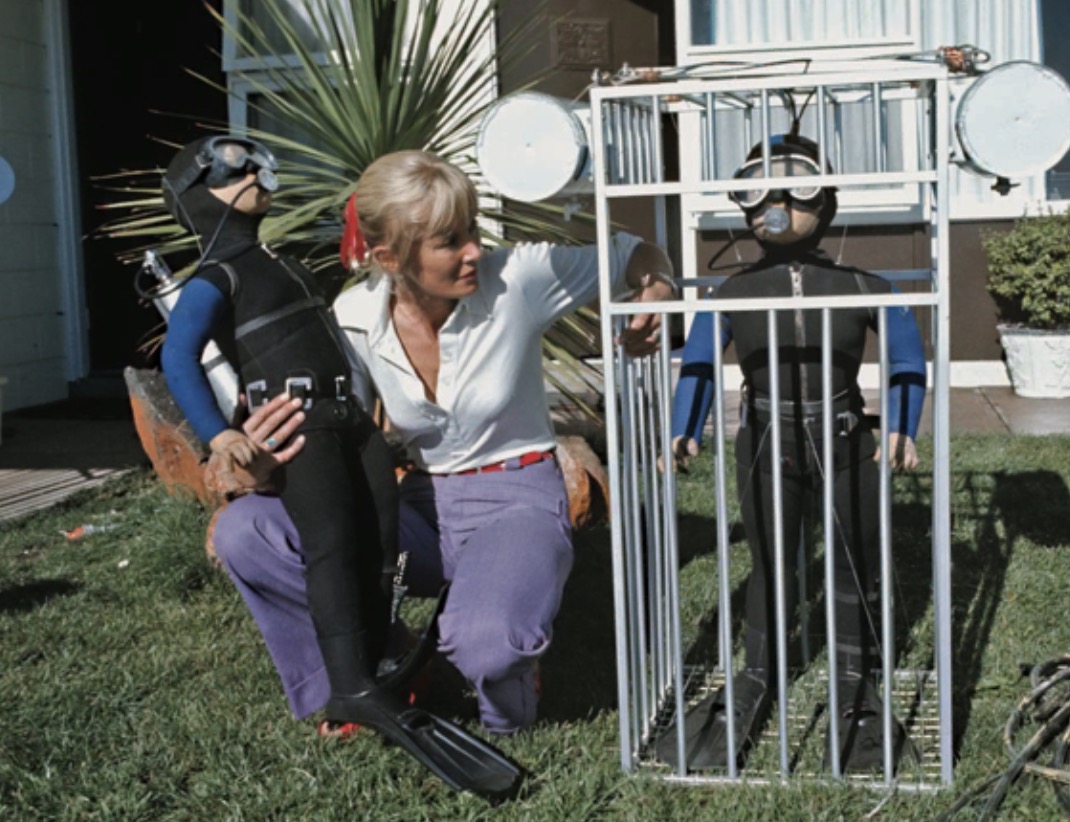
Rizzo had misrepresented his scuba training when auditioning for Spielberg. The production sent him down in a miniaturized cage with miniaturized tanks, holding a correspondingly small supply of air. On an early dive, with a great white rushing the cage, he lost his regulator and was trapped underwater while the small boat struggled to winch the heavy cage up
Jaws co-screenwriter Carl Gottlieb tells the story in The Jaws Log (ch. 4): ...
“By this time—it was January 1974—and although the final shooting script was nowhere near completion, it was certain that crucial action sequences would remain in whatever script was finally approved. Specifically, the encounter between Hooper, the young ichthyologist in the book, and the great white shark—the climactic struggle between men and shark that the book is all about—would be in the film. Since chances are we would not be so lucky as to cast an actor to play Hooper who was also a shark expert and an accomplished scuba diver, it looked like a job for second unit. And then we began to see some real creative planning. The villain in the book, the monster shark, is described as being twenty-five feet long. Now, there are few great whites that size. They have been reported that big, but rarely. The chances of the second unit getting onto a boat and finding one were nil. Great whites of ten to fifteen feet were relatively commonplace in Australian waters, but how were we to make them look twice their size? Well, if the sharks aren’t going to be big, let’s make the actors small...
And so Carl Rizzo got a free trip to Australia and almost didn’t come back. Carl Rizzo is an ex-jockey, a rugged little guy about 4′9″ who used to ride second string to Johnny Longden and raced horses for the likes of Harry James and Betty Grable, for a trainer named William Molter. He got onto a picture as a technical advisor for some horse-racing jockey sequences back in the Fifties, and stayed in, doubling children and young Indians, doing horse falls and other physical stuff too dangerous to risk principals on. He is still an active guy, and hopes someday to own and train and run his own horses out at Del Mar and Santa Anita and Hollywood Park. In the meantime, he’s got more than twelve years of stunt work and is working toward a motion picture pension, trying to work the required number of days each year. He was the guy in the diving helmet in the underwater scenes in Mame, and when he was asked if he had any diving experience, he naturally answered “Yes.” (Actors and others have long ago learned to say “Yes” to any question involved with casting, figuring they can get a few quick lessons in between the time they get the job and the time they actually have to dive, or ride, or fence, or do whatever it is they’re going to be asked to do.)
Movie schedules being what they are, Carl Rizzo and a Universal production man left two weeks earlier than expected, and after seventeen hours in a trans-Pacific flight, they shlepped out to Port Lincoln, Australia, and got on a boat to shoot man-eating great white sharks.
It’s safe to assume that it’s more than Carl Rizzo bargained for, but a job’s a job, and he’s a pro. On the end of one of the reels of film sent back by the second unit from Australia, there’s a cute little home-movie kind of shot, panning from the portico of the Port Lincoln Motel, down to Ron and Valerie Taylor, and a couple of shark cages that were doubles of the one finally used in the film. One of the cages is about 5/8 scale, and another is less than 1/2 scale. The 5/8-size one is for Carl; the little one is loaded with a three-foot doll wearing a perfect little wet suit and teensy air tank, carrying the cutest little spear gun. Carl had his own matching wet suit, with undersize air tanks and miniaturized scuba gear specially made by the Universal Studios special effects shop.
The first week they were lucky, with good weather and plenty of marauding sharks. They lowered the littlest cage, with the doll, and shot a lot of footage of great white sharks biting dead horse hindquarters in half, nosing around the cage, and behaving in a properly threatening manner. Carl is sick from his vaccinations and jet lag, and has had maybe two or three scuba lessons when it’s his turn in the cage. The cage is made of tough steel, carefully welded and braced, and it is heavy. Carl gets in, they lower away, and so far everything is fine. Ron and Valerie are in position, in another cage of their own design, with their underwater cameras turning, and here comes a great white, rushing the cage like it’s a free lunch. Carl chokes up a little, loses his regulator (the device that controls the flow of air from his tanks), forgets how to clear the water from a filled breathing mouthpiece, and is trapped in this cage surrounded by about 1,200 pounds of hungry shark snapping away. Panic sets in, he pulls his safety line, frantically signaling “Take me up,” and they begin to winch him in. Unfortunately for Carl, the cage is so heavy that the little auxiliary powerboat responsible for him is having a hard time getting the cage out of the water, which is too bad for Carl, since as long as he’s in the cage, he’s safe from the shark, but he’s not safe from being underwater without air. Eventually, they distract the shark, get the cage up, and Carl is a little shaken up but not incapacitated. Fortunately, they’ve run out of blood and dead horse, so it’s time to head back for Port Lincoln to stock up on bait.
Now they’re out again, but the weather’s a little rougher than before and it’s getting hard to find the sharks. Carl makes a few dives, getting used to the scuba gear and learning how to clear his mask and regulator. But there’s no usable film, so it’s heigh-ho, back to port, then out again. This time, they’re filming off an underwater area known worldwide as Dangerous Reef. Appropriate, no? Carl is feeling pretty good, Ron and Valerie Taylor and their crew are happy, but there’s some trouble with local abalone divers, who are grumpy about shark bait getting loose and into the fishing grounds. (Keep in mind the national sport in Australia is punching people, so some surly abalone divers off Port Lincoln and Dangerous Reef are probably a little hairier than they are off Carmel, California.)
But movies must be made, and eventually a big mean great white appears, really hungry for some week-old dead livestock and fish heads. Well, as soon as he’s sighted, out comes Carl’s 5/8-scale cage, and his cute little air tanks and scuba gear and ineffectual little spear gun, and it’s over the side for the chap. Only the shark is not waiting for anyone to say “Action.” He’s got two or three million years of evolution saying “Lunchtime!” and pointing at the commotion on the surface, where Carl is trying to enter the cage from the top so they can fasten it down and send him under. Then the shark goes for Carl and the cage and gives the whole arrangement a mighty gnashing of teeth and a great lashing of tail, and Carl is bashed out of the cage onto the boat. The shark gets tangled in the lines, half in and half out of the water, and begins to tear things up. A 1,500-pound great white can bite through oak planking, flatten things with his tail, and generally create more fuss than an army of beer-crazed Australian abalone divers. He can also kill you quicker than you can bite a cocktail frank, and in much the same way. In the second-unit footage shot with the surface camera, you can see the folks in the auxiliary launch scrambling to avoid the mighty tail, with taut nylon lines popping like thread and scraps of aluminum and steel and wood flying through the air. The steel cage sinks to the bottom, with no one sure if Carl is in it or not. If he’s under it, he’s got to stay there for fear of being gobbled. If he’s under out of it, he’s a goner. If he’s under in it, he’s also in deep trouble because his little 5/8-scale air tanks only hold a little 5/8-scale air supply, assuming he’s remembered to clear his mask and keep his regulator straight. Fortunately, the shark breaks free without killing anyone, although the solid steel cage is totaled by the action and brought up from the bottom in pieces.
Carl is intact, but here’s where stories differ. According to Carl, he was shaken up pretty bad, but he realized it was like getting thrown off a horse or going through the rail—you’ve got to get back on. So he went down a few times after that. According to anonymous reports, the next time Carl was scheduled to dive, he was nowhere to be found, which is no mean trick on a thirty-five-foot fishing boat. It makes a better story to say he was located cowering in the forward chain lockers with the anchor, developing a drinking problem and going home vowing to never dive again, or even eat seafood. But when I talked to him in a neat little Hollywood apartment, he related simply that they went back to port because of bad weather and to repair their damaged equipment, and went out again without incident a week later.”
Spielberg: I guess the scariest part of making the movie was a sequence where Harrison Ford and Karen Allen are thrown into a chamber with 7,000 live snakes.
Cavett: Yes, I thought that was a press agent’s invention when I read about that, but, ah… And how did they decide on 7,000, rather than 6,000, or 6,500?
Spielberg: Well, first we budgeted 2,000 snakes, but the problem was when you put the 2,000 live snakes on the floor they all huddled into a corner, and it looked like just a little dust swept under the rug. We realized to cover the floor of the rather large set we would need about 7,000 snakes
Cavett: Who has those available in the yellow pages? How do you get them?
Spielberg: It was the British yellow pages. And they came from all over the place. They came from Scandinavia. They came from France. They came from Germany.
Spielberg: A lot of them were garter snakes, but a lot of them were deadly snakes. The cobras we got from India. And we got the boa constrictors I’m-not-sure-from-where. And the pythons came in.
Cavett: Is there a snake wrangler?
Spielberg: There were many snake wranglers. We had four of them. They were always being bitten by everything, but cobras of course, because that’s deadly. But the pythons were going after everybody.
Spielberg: And in the movie when something bites, and snaps, and takes hold of the character, those are real teeth, and that’s a real actor going, “Why am I here? And why did I make this movie?” That’s really happening. That’s not fake.
Cavett: ... In one scene I saw— I mean, it was an outtake, documentary style. It looks like something bit her on the leg, but did she get bitten at all?
Spielberg: She wasn’t bitten. She was terrified all through the movie because of the snakes. She hated snakes, as did everybody else—most everybody else. And when she got involved in the movie, she couldn’t scream loud enough, because sometimes when you’re terrified, you [go to] scream [and no] noise [comes] out. It’s very real; it’s real, and nothing [comes] up. So I thought I needed something to get [it]. So once [she] least suspected, I dropped a snake from the scaffold over[head]; [it] came around her neck and she let out a scream that I was able to use all [through] the movie. I made eleven copies of the scream and kept cutting it in. That’s a good scream. That last [scream]—you’ll never beat that one. And, uh, it was a terrible, cruel trick to play on her. But ever since then, she never— When she didn’t see me around the side, she would always look up when I wasn’t around. [Unclear.] Yeah. Yes. It’s sort of a method—method acting, method directing.
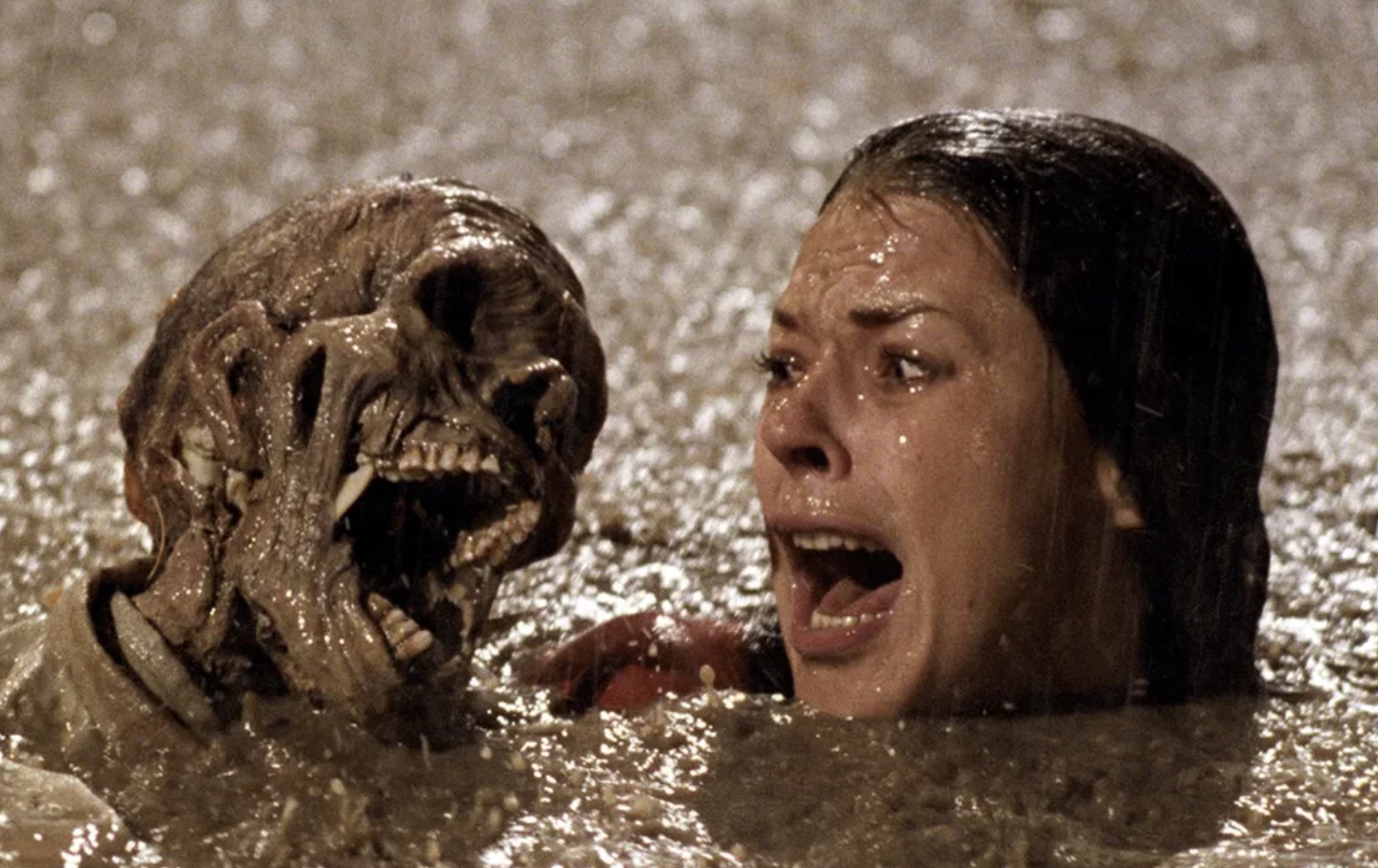
A 2022 Vanity Fair article, What Really Happened During the Making of Poltergeist revealed that during the 1981 making of Poltergeist, JoBeth Williams was placed in a muddy swimming pool with what she only discovered later were real cadavers.
The same article revealed the physical brutality Williams suffered during the filming of the “rotating room” practical effects shot, for which she says Spielberg was in full participation.
“I had to be on a 360-degree turning set, which I had never even heard of. And when they said, ‘You’re going to just ride this thing and slide along the ceiling,’ I went, ‘Okay, I see.’ What they didn’t say was that I’d be doing 50 takes of it and by the end, my elbows and knees were bleeding,” she recalls.
The scene happens at a point when her character is most relaxed, and most vulnerable. She has just taken a soothing bath, and is wearing little more than a baggy sleeping T-shirt. So, there was no way to hide padding.
“And the poor cameraman who had to ride the thing like a Ferris wheel...” she adds. “He was strapped in, and several times, he had to get off and go throw up because it was literally making him physically sick, but he carried on. And when I got off after a few takes, I said, ‘Steven, I’m bleeding. My elbows and knees are bleeding!’ And he said, ‘That’s all right. We can just wipe the blood off. It’ll never show.’ And I said, ‘Oh, I feel much better now. Thank you.’ I had to laugh.”
In this clip, E.T. co-Producer Kathleen Kennedy discusses (albeit in jest) compelling a highly resistant 4-year-old girl into the foam latex E.T. costume (presumably a suffocating hazard) for the sake of getting a video of the costume in motion for Spielberg.
“But we did get to a point where I finally just kind of threw up my hands and I said I just don’t know how this is going to work. I don’t know how in the world we’re ever going to get E.T. to move in a way that you’d believe without putting somebody in a suit. So I called up Steven’s lawyer’s partner, Harold Brown, and he had a four-year-old daughter, at the time, she’s now I think graduated from Harvard, or something. I said, “Look, I just want to test this, I feel that if I can put somebody in a suit, and I can video it, and I can show Steven, and it works on some level, we certainly don’t need to rely on it, but he’s never going to go for this unless we can show him. Would you be willing to bring Rachel to Carlos’s shop and we’ll put her inside the suit? So Harold says okay. So by the time he arrives, this four-year-old is completely hysterically crying, and is not into doing this at all. And Harold comes over to me and he goes I don’t know, I don’t know if it’s going to work, I’ve tried to bribe her with two McDonalds, and it’s not working. I told her we go to McDonalds after she does this, she can have two burgers, she can have any milkshake she wanted, and she still doesn’t want to do it. So I go over and I try to talk to Rachel. She gets a little bit calmed down. She gets the suit on. By the time we get the head on, she is completely hysterical again. And she’s jumping up and down and screaming and crying again. So Harold just says “roll camera!” “...and he bought it. He said, I agree, this may be the way we have to go.” Kathleen Kennedy, The Making of E.T.
Just a year before the accident, during a long-form interview on the Dick Cavett Show in 1981, Spielberg demonstrates a strong awareness of the prospect of stunt danger in the film industry:
Cavett: Do you know situations—obviously without naming names and so on—where the stuntmen have been unnecessarily endangered, and in fact, maimed and killed? I know one lost both legs. Is it Yvonne de Carlos’ [sic] husband...—
Spielberg: Do you mean the helicopter accident?
Cavett: This is two trains.
Spielberg: There’s a famous helicopter accident where... it wasn’t a stuntman. He was a cameraman with a special Tyler mount out the back of a jet ranger, the side of a jet ranger. He went too close to another helicopter below him and he lost his legs. ...
I mean, it’s not just stuntmen. The tragedy last week where we lost Boris Sagal. Very, very excellent and wonderful director and human being who walked into the back rotor blade of a propeller. ...
There’s something that happens when you’re making a film, especially with directors and cameras. And that is when your eye is to the camera, you are taken away to a Never-Never land, a kind of reality Oz. And suddenly, with the eye glued to the camera, nothing can happen to you. You could be on the edge of a train, looking through a viewfinder, heading towards a tunnel with no clearance. And as far as you’re concerned, it’s only a movie until everything goes black, and then white. And I think, I think it’s, it’s, it’s almost the sirens that are calling you.
IJPAUC: DOSSIER: CREATION
| # | Title | Description |
|---|---|---|
| 1 | Lunch | The arguments structuring the rest of the story. |
| 2 | Footnotes to “Lunch” | Footnotes to Jurassic Park’s “Lunch” scene. |
| 3 | The Making of Star Wars | Lucas, Graffiti, merchandising, and the Force. |
| 4 | Flat Like a Hieroglyphic | What is the Ur-technology? |
| 5 | UNIX System | New frontiers in data systems management. |
#22a. Lunch
You stood on the shoulders of geniuses to accomplish something as fast as you could, and before you knew what you had, you patented it, packaged it, slapped it on a plastic lunchbox, and now you want to sell it.
Malcolm argues that Hammond has inherited powerful knowledge, and delivered it over to commercial interests.
Hammond replies that, by that logic, any technology would have to be considered problematic, even those which are uncontroversial goods, like saving an endangered species.
And Malcolm clarifies: technology is only good when it complements natural selection, rather than man-made problems (deforestation, the building of a dam).
At opposite extremes, Hammond calls Malcolm a “Luddite,” and Malcolm suggests that Hammond is engaging in “the rape of the natural world.”
Surprisingly, it’s Grant, the computer-hating traditionalist, who comes to Hammond’s defence. Grant expresses ambivalence, saying only that they can’t know what to expect—not that what Hammond has created is an abomination.
These fractured positions set the stage for the rest of the story.
Grant already sees Jurassic Park as a grand petri dish. It brings the objects of his imagination to life, so that he can better consider his research interests. Recall that Grant’s key positions are (1) that dinosaurs evolved into birds, and weren’t wholly obliterated by a meteorite, or disease, as maintained by his academic rivals. And (2) that some dinosaurs move in herds (i.e., maintain mammalian family structures).*1
Grant’s research parallels his personal anxieties. This is important to understand up front because Grant’s strategy for addressing Malcolm’s critique of technology will be by considering it against an analogous problem in his (Grant’s) personal life. Genetic engineering (inorganic man-made creation) on the one hand; parenthood (organic man-made creation) on the other.
Although the story plays it low-key, Grant and Sattler are romantically involved and she’s nudging him towards fatherhood. Despite what he says (“they’re noisy, they’re messy, they’re expensive, they smell”), his hesitations obviously go beyond the superficial.
Jurassic Park displays fatherhood in both its tender and violent dimensions. Organic genetic replication is no less ambivalent than the artificial kind. The children in the story present as liabilities. If they’re not taking swings at Grant’s theories (his life’s work), then they’re hanging around his neck.
The relationship is just as frightening from the child’s perspective. After a kid mocks Grant’s description of a raptor as fearsome—calling it a “six-foot turkey” instead—Grant tears into him, punctuating the dressing-down with a swipe of his fossilized raptor claw.
Sattler—who cringes as she watches (oooh)—tells Grant that if he really wanted to scare the kid, he could’ve just pulled a gun on him. Later, Malcolm tells Hammond that he (Hammond) wields genetic power like “a kid that’s found his dad’s gun.”
Hammond says he insists on being present whenever one of his genetic creations is being born. But he “denies” them the hormonal expression that would allow them to become male. Fathers exert more or less control over their sons’ ability to express themselves. To what extent is this a fostering? To what extent is this a subjugating? The fall of Jurassic Park arguably stems from a resentment between Hammond and his chief engineer, Nedry—who snarks “thanks, Dad”—before plunging the park into darkness and chaos.
Malcolm acts blasé about his cycle of marrying, procreating, and divorcing. Tim and Lex, Hammond tells us early on, are there to be distracted from his daughter’s divorce.
“It’s just like coming out of a tree house. Did your dad ever build you a tree house, Tim, eh?”
“No.”
“Me too.”
It’s no wonder that Grant is paralyzed about whether or how to participate in the great chain of creation, preferring to deal instead with fossils.
This is how Spielberg’s perennial themes of fatherhood and divorce manifest in Jurassic Park. But what’s surprising here is how the analogy between inorganic and organic man-made creation reveals—as though hovering in thought above—their common factor: creation, or creativity.
The arguments in the Lunch scene articulate the dramatic tensions structuring the rest of the story.
Malcolm criticizes Hammond for “standing on the shoulders of geniuses.”
But the traditional saying is “standing on the shoulders of giants.” Historically, the saying reflects optimism about problems concerning knowledge-accumulation. Even though a dwarf is smaller than a giant, together they may see further, by a few feet at least.
Malcolm, here, is inverting that traditional analogy, in line with Nietzsche.*2
“Standing on shoulders” leads to a blindness insofar as the undisciplined dwarfs mortgage their inheritance to corrosive marketing interests (“...and then you slapped it on a lunchbox...”) without even realizing what they’re doing.
Hammond replies:
Condors. Condors are on the verge of extinction—if I’d created a flock of them on the island, you wouldn’t be saying any of this!
Hammond is saying that if he had propagated an endangered species, rather than dinosaurs, Malcolm would have to recognize that his accomplishment is beneficial. He is pointing out that “standing on shoulders” alone can’t preclude a power’s goodness, or else all uses of technological power, even the seemingly uncontroversial ones (like saving “Condors”), would be bad.
And Malcolm accepts, but narrows Hammond’s objection:
Hold on—this is no species that was obliterated by deforestation or the building of a dam. Dinosaurs had their shot. Nature selected them for extinction.*3
Malcolm makes a distinction between: (1) species that were obliterated by technology (deforestation, dam), and (2) those that were “selected for extinction” by nature.
But the significant implication is that Malcolm’s argument has aligned itself with the position of the religious fundamentalist.
This is because dinosaurs didn’t fail natural selection. According to scientists (like Grant’s academic rivals), they were destroyed by cosmic accident. If, according to Malcolm, condors should be resuscitated but dinosaurs shouldn’t, they must have failed natural selection in the sense of having some flaw in their design that resulted in them dying by meteor. This flaw would make them as the dodo is to the condor—in Malcolm’s account. But do dinosaurs deserve this association?
I mean: what sort of flaw could result in death by meteor? This sort of causal relationship only exists in religion.*4
Grant sees another possibility: between Hammond’s unbridled techno-commercialism and Malcolm’s reactionary Luddite-conservatism. Grant thinks the critical question is in the presumed relationship between two premises: that Hammond “stood on the shoulders of geniuses”; and then “slapped it on a lunchbox”.
Is “slapping it on a lunchbox” a necessary consequence of ‘following the guidance of dwarfs’?*5
At dessert, Hammond seems to accept Malcolm’s characterization of him. He reveals that his true motive was to make his mechanical flea circus real—to finally replace the world with his vision of it, a vision in which he (Hammond) has the power to make illusions real. He also says that he believes creation to be “an act of sheer will”—i.e., insisting that one can force one’s own conception of reality. The ‘force’ turns out to be a projection of man’s will, that permits him to do whatever he wants. It submits to him, and not the other way around. But this is exactly the weak force Malcolm has argued is susceptible to the perennial threat of commercialization. Hammond in the end concedes Malcolm’s conclusion. But not Grant.
How can man be judicious about those entities he summons into being, being sure that their creation isn’t simply to distract himself while he practices “the rape of the natural world,” without being fenced in by an apparently dogmatic appeal to Nature’s will?
#22b. Footnotes to “Lunch”
*1 A deleted line reveals they’re digging up not one or two skeletons, but four—a family.
*2 Malcolm believes that obliteration evidences cosmic disfavour, like the great flood that befell humanity when the Watchers fathered a race of giants in the Hebrew religious text, the Book of Enoch.

The analogy: “standing on the shoulders of giants,” was popularized by Isaac Newton, who used it in a letter around 1675. But it had a long continuity before that, dating through Isaiah di Trani, a Jewish Talmud scholar (13th century), Bernard de Chartres (12th century), a Christian theologian, and Priscian (5th century—who systematized the rules of Latin grammar). The saying generally reflects an optimism that “moderns”—despite being latecomers—are still at a frontier of intellectual progress.
The metaphor itself is a reference to a Greek myth about a dwarf (Cedalion) who helps a giant (Orion) regain his sight, at the request of Hephaestus.
Grant is therefore challenging the Promethean paradigm as the singular mode of interpreting technology. Another way of looking at this is that Grant has shifted the object of his search from the first technology, to the first technology that becomes necessarily corruptive. He is no longer satisfied with “fire” but must consider other candidates, such as optics, analogy, writing, money, and time-counting.
*3 This is one of Heidegger’s examples: “the hydroelectric plant.” (The Question Concerning Technology, 5) (“dam” is via Crichton).
*4 Or is collective psychology at play; and the collective will to self-destruction?
Jurassic Park has a strong food and food chain motif. Carnivores versus herbivores, turkey, Chilean Sea Bass, cows and goats, and so on. The portrait of Hammond sadly eating his ice cream is reminiscent of Thyestes, brother of Atreus. Thyestes steals the golden fleece from his brother by trickery, and as a result, by his brother’s vengeance, is unknowingly fed his own children. While there is critical debate concerning whether Thyestes (whom Aristotle identifies in his Poetics as a paradigmatic tragic hero, along with Oedipus) deserved his punishment (see Belfiore 167–68; Sherman 186), along one dimension of causality it seems that he receives his just desserts for neglecting his children. Do Malcolm and Hammond share a Thyestes Complex?
If we apply the analogy of genetic technology to film technology, Hammond is referring to the elements of filmmaking. The trapeze, or trapezoid—the shape of the cinema screen as seen from any position in the theatre, prior to perceptual processes that make it always look like a rectangle. The carousel—this is the rotating base of the Victorian instrument used to make drawings seem to come to life, symbolizing the persistence of vision effect. And the seesaw—this is the famous mechanical crane, attributed by some to Aeschylus, introduced into the ancient theatre of Dionysus to suggest the susceptibility of the dramatic action to meta-intervention.
*5 The height of Grant’s uncertainty comes in the scene where the T-Rex breaks through the fence. Critic Henry Sheehan reads this scene as an amplification of Grant’s earlier antagonism of the child.
When the tyrannosaurus rex attacks [Lex and Tim] in their stalled car, [Grant] sits still in his own vehicle for what seems endless moments, watching in horror as his (barely) suppressed murder fantasy is played out in front of him.
Sheehan analyzes Jurassic Park as strangely preoccupied by a link between children and death, a development he traces back to Indiana Jones and the Temple of Doom.
The power of the film’s coupling of children and death arises almost solely from Spielberg’s obsessive invocation of it. He hasn’t often pursued it from the child’s perspective: the exceptions being Empire of the Sun and The Color Purple, in which inconvenient children overcome death largely by their own initiative. In a comic variation, Indiana Jones and the Last Crusade features an adult child entangled in a near fatal intrigue sparked in part by an ageing father’s competition with him. But more often it’s a case of the father or father figure trying to rescue a child just before it undergoes the death the father has unwittingly devised for it.
In any case,
Grant is eventually moved to action and with the help of Malcolm manages to escape with the kids. It’s an impulsive act, as obscure as the source of Grant’s dislike of children, although Neill’s squirming, coupled with his impassive features, does imply a deeper struggle.
The rest of the movie serves to explore this struggle. Grant enters a sort of prehistoric fever-dream, in which he must shepherd his surrogate children through the jungle and back to safety.
Sheehan says:
You could say that the rest of the film is a ritualistic enactment of Grant’s penance, like the police chief’s voyage in Jaws. [...] But you could also say that it is the automatic playing out of a pulp plot. All the digging in the movie is for fossils, not character.
But critic Thomas Goodnight describes Grant and Sattler (Alan and Ellie) as a “post-doc Adam and Eve”, returned to the creation by Hammond’s enterprise. Can both be true?
Henry Sheehan, ‘The fears of children’, Sight and Sound, vol. 3, no. 7 (July 1993) (https://archive.org/details/Sight_and_Sound_1993_07_BFI_GB). See also: http://id3481.securedata.net/henrysheehan/essays/stuv/spielberg-1.html.
Goodnight, G. Thomas (1995) ‘The Firm, the Park and the University: Fear and Trembling on the Postmodern Trail’, The Quarterly Journal of Speech 81, 3 (August), 267–90.
#22c. The Making of Star Wars
We pick up with George Lucas in 1969, whose THX 1138 is despised by the studio and forcibly cut down. The movie is a moderate critical success but commercial failure. Lucas laments the lack of appetite for American art films. The cultural seam opened by Easy Rider was already drifting closed. Marcia Lucas, George’s wife, argues THX isn’t engaging.
Lucas was planning to develop his Vietnam War film next, Apocalypse Now, but changes his mind. “I realized after THX that people don’t care how the country’s being ruined. All that movie did was to make people more pessimistic, more depressed, and less willing to get involved in trying to make the world better. We’ve got to regenerate optimism.”
He wants to remake Flash Gordon, but can’t get the rights, and so starts gestating a fantasy world of his own.
In the meantime, he hates writing but produces a five-page treatment about four guys getting ready to leave high school, driving around in cars, with their lives veering off in different directions. It’s a coming-of-age film in the same vein as Fellini’s I Vitelloni. It’s called American Graffiti, set in 1962, just before Kennedy is assassinated.
“It’s about a period of transition in history in America where in one year you had a President that a lot of kids admired.… You had a certain kind of rock ’n’ roll music, a certain kind of country where you could believe in things.… You had a certain kind of life, but in the next two years everything changed: no longer were you a teenager; you were an adult going to college or doing whatever you were going to do. The government changed radically, and everybody’s attitude toward it changed radically. Drugs came in. …War surfaced as an issue. The music changed completely. Graffiti is about the fact that you have to accept these changes—they were on the horizon—and if you didn’t, you had problems… You try to fight it… and you lose.”
In early 1972, the languishing script—perceived as another Easy Rider ripoff—is picked up by an executive at Universal with a fondness for car movies.
While casting Graffiti, Lucas crashes at a friend’s place, who happens to be writing The Sugarland Express. Spielberg comes over every night to talk about the script over dinner, and the two commiserate about the challenges of getting a movie made.
After the movie is finished, despite a jubilant test screening, the Universal producers are angry and disappointed, and again forcibly impose cuts. This time, though, the movie is a critical and commercial success, “a lovely nostalgic conception… [which] promises to become that increasingly rare but heartening commodity, a new American movie that almost everyone is going to like.”
In the interim, Lucas has been developing his space serial, now known as The Star Wars. As Graffiti is released, Lucas is still in the middle of negotiating his deal memo with Fox. Suddenly, he has leverage. He passes on a quick infusion of money to secure creative control, including merchandising and sequel rights.
He recognizes—before the studios do, when Jaws hits—that movies can be made to exist beyond their theatrical release. [As Julia Phillips would put it, “I am still operating in that stone age where people don’t know that a single movie is a cottage industry…”.]
Lucas sets up novelizations and comic book adaptations in advance, with Ballantine Books and the struggling Marvel Comics. The movie is one of the first to be promoted at Comic-Con.
Coppola doesn’t get it. Especially later drafts, which drift towards comedy and seem increasingly about two robotic servants.
[“Coppola remained more intrigued by the idea of a teenage princess at the center of the story—but Lucas had thrown that out, too, downgrading Leia to Luke’s cousin in the new draft, and then all but writing her out of the plot. Instead, he chose to concentrate on a mighty Jedi warrior known as “the Starkiller” and his family of sons.”]
Lucas has visions of an extended empire worthy of Flash Gordon—[R2-D2 cookie jars, wind-up toys, and zap guns. “I have a particular affection for games and toys; there’s no doubting that I haven’t grown up. All of this was part of the film, the intention of launching toys in supermarkets, creating books and stuff.”]
Mattel wasn’t interested in making Star Wars toys, with conventional thinking suggesting they’d have a limited shelf life. [But Bernard Loomis, the head of Kenner, had struck gold with toys based on the Six Million Dollar Man television show; the bionic man’s accessories and enemies lent themselves well to what Loomis called a “toyetic” quality—and he thought he detected a similar quality in Star Wars.]
Not every movie was toyetic. Neither Jaws nor Close Encounters was toyetic.
But Star Wars contained a whole universe and a mythology unto itself.
Beneath a coded critique of Vietnam—residue of Apocalypse Now—Star Wars contained a message of unity.
While a film student at USC, Lucas had seen a Canadian abstract short film called 21-87, containing [a snippet of an existential discussion between Warren S. McCulloch, a pioneer in artificial intelligence, and cinematographer Roman Kroitor. As McCulloch contends that human beings are merely complicated machines, Kroitor counters that it can’t be that simple or soulless, arguing that as humans contemplate the world around them, “they become aware of some kind of force… behind this apparent mask which we see in front of us, and they call it God.”]
[With Star Wars, Lucas offered no moral ambiguity; in his universe, there was little doubt who were the good guys and who were the bad guys. Lucas liked it that way—and so did audiences.]
And now it never had to end.
#22d. Flat Like a Hieroglyphic
(Over images of technology used in the movie—computer screens, VR goggles, CD-ROM graphics, etc, along with 3D images of the word technologies in question.)
Hidden in Malcolm’s words (“…you read what others had done, and you took the next step”, “hold your hand flat like a hieroglyphic”) is the suggestion that reading is an archetypical technology. Reading implies writing, which in particular gives thought material existence, allowing it to be saved even if the original experience is lost.
We delve into the history of writing via the development of the radical technology known as the alphabet.
Writing begins with hieroglyphic-like ‘pictographs’—words as representations of things in the world, such as the sun, man, and animals. It’s a scholarly practice reserved for Egyptian society’s upper classes. But a revolution begins, the first indications of which are seen on cliff graffiti just after 2000 BCE. Borne out of practical limitations, an unnamed Semitic-speaking slave in Egypt devises to turn the symbols from things of the world to speech itself, so that they shadow not physical but analytic structures. This requires the apprehension of far fewer elements: what we know now as the consonants.
The technology spreads among the Semitic peoples of the Levant, where it’s refined once again for the upper classes, and then spreads to Greece—Greek literary accounts differ whether it was delivered by Cadmus (of Oedipus’s line) or by Palamedes—where a decisive shift is made, almost by accident.
The sound of the Greek language created too many ambiguities when the softer vowel sounds went unrepresented, so they used leftover symbols they didn’t need to represent them. This makes writing easier to learn. The length of the words corresponds more closely to the length of the sounds, allowing them to be sounded out and analyzed more readily—splitting apart like 1s and 0s. Gaps between consonants no longer require privileged social codes for disambiguation. And the openness of the system makes it adaptable, a sort of common denominator. The alphabet spreads as quickly and surely as email in the late twentieth century.
The revolution was complete.
[“With writing or script in this full sense, encoded visible markings engage words fully so that the exquisitely intricate structures and references evolved in sound can be visibly recorded exactly in their specific complexity and, because visibly recorded, can implement production of still more exquisite structures and references, far surpassing the potentials of oral utterance. Writing, in this ordinary sense, was and is the most momentous of all human technological inventions.”]
The word no longer existed in the evanescent world of sound, but in the quasi-permanent world of space. The reversal was so successful that it would come to seem that speech imitated writing and not the other way around.
#22e. UNIX System
[Kathleen Kennedy: “ILM was in a building that they’re not in anymore, but it was basically a warehouse building that was in San Rafael. It was always interesting because when you took people to ILM I think they had something in their mind that they were going to see magic, but it was basically just a bunch of guys on computers.”]
We follow ILM through 1977–1986, as their spatial compositing technology is developed into a 3D modeling system and sold off to Steve Jobs.
It begins with George Lucas’s vision of fluid space physics. He conveys the concept with a reel of dogfights edited together from old World War II reels. This smoothness requires progress beyond stop-motion animation: motion control—moving not the object but the camera.
“I’m trying to make everything look very natural, a casual almost I’ve-seen-this-before look. Like the X-wing and TIE fighter battle, you say, ‘I’ve seen that, it’s World War II—but wait a minute—that isn’t any kind of jet I’ve ever seen before.’ I want the whole film to have that quality. It’s a very hard thing to come by, because it should look very familiar but at the same time not be familiar at all.”
The next development is computer-based compositing, which soon requires a state-of-the-art Apple computer to log and locate each frame.
Lucasfilm starts a computer division. Lucas’s first hire is a computer scientist, Ed Catmull, the director of the New York Institute of Technology’s Computer Graphics Lab. There, he had developed a technology known as the “alpha channel”, which programs the dimension of opacity into imaging algorithms, so that composite images can have elements come in and out of visibility, allowing users to wander through them as though they were worlds.
We digress backwards to tag enabling computer technologies: the frame buffer, the graphic user interface, UNIX, ASCII. In short, the progressive generation of the simulative visual “interface” stemming from the capacity of numbers to be manipulated by letters.
Catmull, who admired Walt Disney nearly as much as he admired Albert Einstein, was hoping to persuade Lucas to let him devote some time to computer animation as well; Lucas, however, considered that scope creep. He wanted Catmull developing tools to make digital movies, not wasting his time on what Lucas regarded as high-tech cartoons.
We arrive at the development of their new digital compositing computer “Picture Maker”, Pixar, and its sale to Steve Jobs.
Lucas was more interested in the computer game division. He was fascinated with the idea of interactive storytelling, in which the decisions a player makes directly affect the outcome of the story, making every trip through a game unique.
Finally, we speed through ILM’s big successes in the ’80s and early ’90s, to Jurassic Park.
Steve Williams, walking through a now abandoned ILM—“This room might not look like much, but every single frame in Terminator 2 was done in this room…—So I used to blast Beethoven and Bach in here. There was just something very strange about having Beethoven blasting. It would go right through my head and into my hands and against the keyboard and right into the Rex. It’s one of those weird things where you’re part of the machine.”
Steve Williams describes how he crafted the illusion of movement and three-dimensionality, and even how he positioned the monitors at just the right angle so Kennedy would see them despite Muren’s objections.
Steve Williams: “This was my seat right here, and this theatre is where we projected every one of the shots that we knew was going to change the entire film industry.”
“If I failed, I would be the one who failed, no one else, that was it. And I was shooting my mouth out that I could do it. And it was just a lot of pain. The divorces and problems and all this stuff to make sure the specular highlight on a fingernail of a creature looks proper on your monitor…. No one knows the pain you go through to do that.
Yeah, this place used to be alive, man.”
IJPAUC: DOSSIER: NOTES
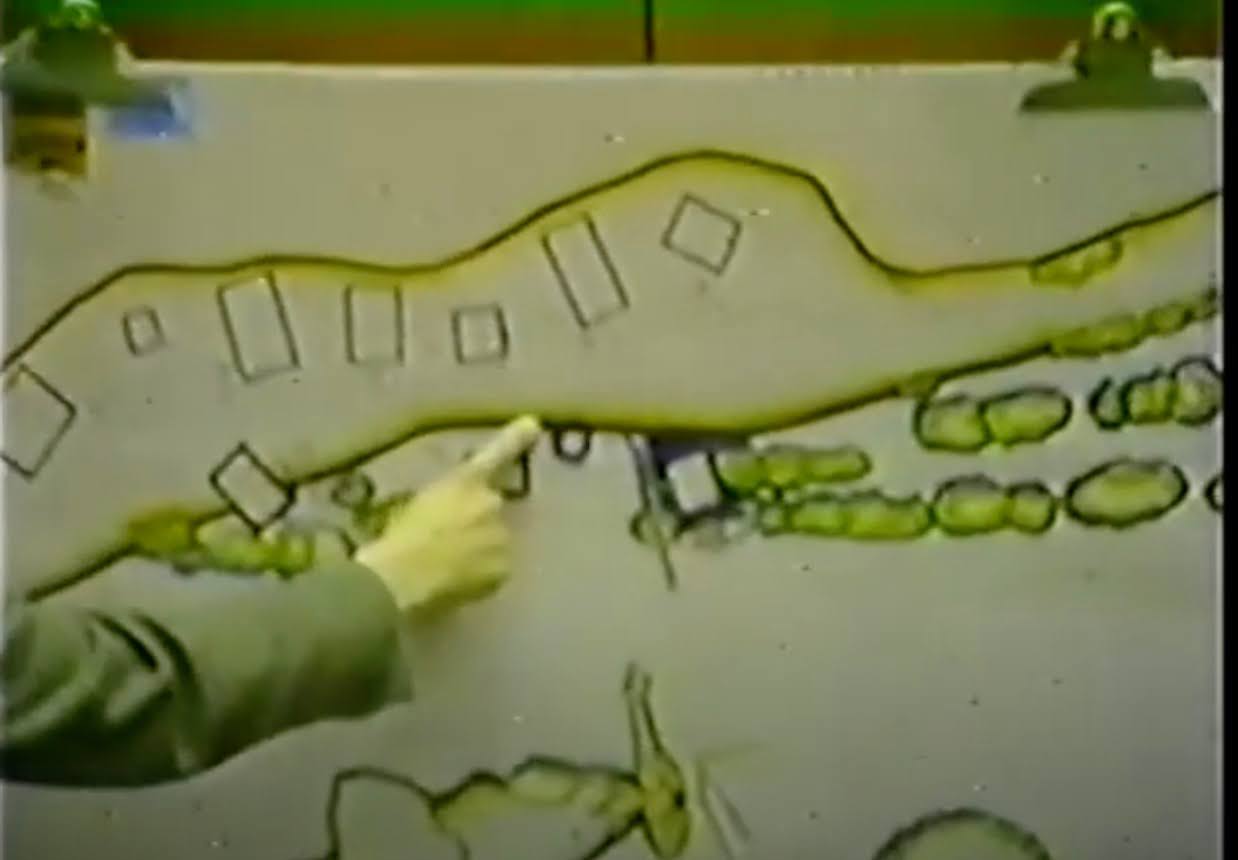
| # | Title | Description |
|---|---|---|
| 1 | The deal memo | Details of the contract between Warner Bros. and the filmmakers. |
| 2 | A Steven Spielberg Production? | Twilight Zone’s originally intended “Presentation credit.” |
| 3 | “8:00 or 8:30pm” | Suspicious nuance regarding Marshall’s alleged claim about waivers. |
| 4 | A semantic misunderstanding? | Possible miscommunication regarding the use of children? |
| 5 | The peculiar testimony of Edward Morey | Spotlight on Warner Bros.’ VP of Production Edward Morey. |
| 6 | 11:30pm–2:20am: Testimony and forensics | Under Construction; See Chain for disambiguation. |
| 7 | “Fly by Night” | Decal painted on the nose of the helicopter, washed off the morning of the crash. |
| 8 | Steve Williams | Snubbed. |
| 9 | Steve Starkey | Frank Marshall’s mentee’s contribution to Jurassic Park. |
| 10 | Citizen Steve | Spielberg’s 40th (41st) birthday celebration: ephemera. |
#01n. The deal memo
This agreement summarizes the principal terms negotiated between Warner Bros. and the production entities associated with Mr. Steven Spielberg and Mr. John Landis concerning the motion picture tentatively titled Twilight Zone: The Movie.
The parties initially proposed a “negative pickup” structure, wherein the production team would independently finance and produce the picture, delivering a finished negative to Warner Bros. in exchange for payment. This financing model—customarily involving the procurement of a bank loan secured against the studio’s distribution commitment—was rejected by Warner Bros., which requested a production framework with oversight, citing the historical reputations of the principals involved. In particular, Mr. Landis’s high-spending practices and Mr. Spielberg’s recent string of heavily supervised and commercially successful releases (Raiders of the Lost Ark, Poltergeist, and E.T.) were noted as material considerations.
The final terms of agreement, as executed, are as follows:
- Mr. John Landis, acting through Levitsky Productions, Inc., shall receive total compensation of one hundred fifty thousand dollars ($150,000 USD), allocated as follows:
- Thirty thousand dollars ($30,000 USD) for writing services;
- Thirty thousand dollars ($30,000 USD) for producing services;
- Ninety thousand dollars ($90,000 USD) for directing services.
- Mr. Spielberg and Mr. Landis shall be co-producers of the picture, with all rights and obligations associated thereto shared equally (50/50 split).
- Each co-producer shall receive five percent (5%) of the gross receipts of the picture. Said percentage shall escalate to twelve and one-half percent (12.5%) of gross receipts once cumulative gross surpasses fifteen million dollars ($15,000,000 USD), and shall further escalate to fifteen percent (15%) following the break-even threshold as defined in studio accounting terms.
- Despite the picture’s modest domestic box office performance (~$29,500,000 USD), gross participation entitlements are projected to yield approximately three and one-half million dollars ($3,500,000 USD) per co-producer, exclusive of international, home video, and ancillary revenues.
- Mr. Landis shall retain final cut rights for his segment of the film, contingent upon completion within schedule and budget (defined as within ten percent [10%] of approved cost) and the receipt of a Motion Picture Association of America rating no more restrictive than PG.
- Credit provisions shall read as follows: “John acknowledges that Steven may have a presentation credit.” Mr. Landis shall receive onscreen and advertising credits for writing, directing, and producing, with such credits to be equal in size and treatment to all similar credits, excluding only the presentation credit granted to Mr. Spielberg.
- Mr. Frank Marshall shall receive a flat fee of one hundred thousand dollars ($100,000 USD), one-half percent (0.5%) of gross revenues post-break-even, and three percent (3%) of net profits. Mr. Richard Matheson and Mr. George Miller shall receive a separate percentage of net profits commensurate with services rendered, in addition to agreed-upon fees.
Note: All production expenditures for Twilight Zone: The Movie were administered through Twilight Zone Productions, Inc. For any budgetary disbursement exceeding five hundred dollars ($500 USD), dual authorization was required. Cheques were co-signed by (i) DISC Management Services Group, Inc., the payroll company (typically Frank Marshall), and (ii) Warner Bros. payroll operations (typically Jim Henderling, studio payroll executive).
#02n. A Steven Spielberg Production?
Although several initial news reports stated that the tragedy occurred on “a Steven Spielberg production” (or similar), within days, Spielberg’s name was removed from the story. When the movie was finally released, it had no “Presentation credit.”
Twilight Zone: The Movie (1983) was most likely originally going to be “a Steven Spielberg Production.” This is only significant as part of the broader argument that Spielberg had every likelihood of being invested in the film’s production.
The deal memo stipulates that “Steven may have a presentation credit,” and the initial highly researched NTSB report stated that “The film, ‘Twilight Zone,’ is a STEVEN SPIELBERG PRODUCTION funded by Warner Bros. Inc., Burbank California” (2); the revised edition (following several petitions from the defence) does not include this specification; perhaps because Spielberg never claimed the credit.
By July 1982, Amblin was still in its fledgling stages, sorting out its branding and product lines for the rest of the decade.
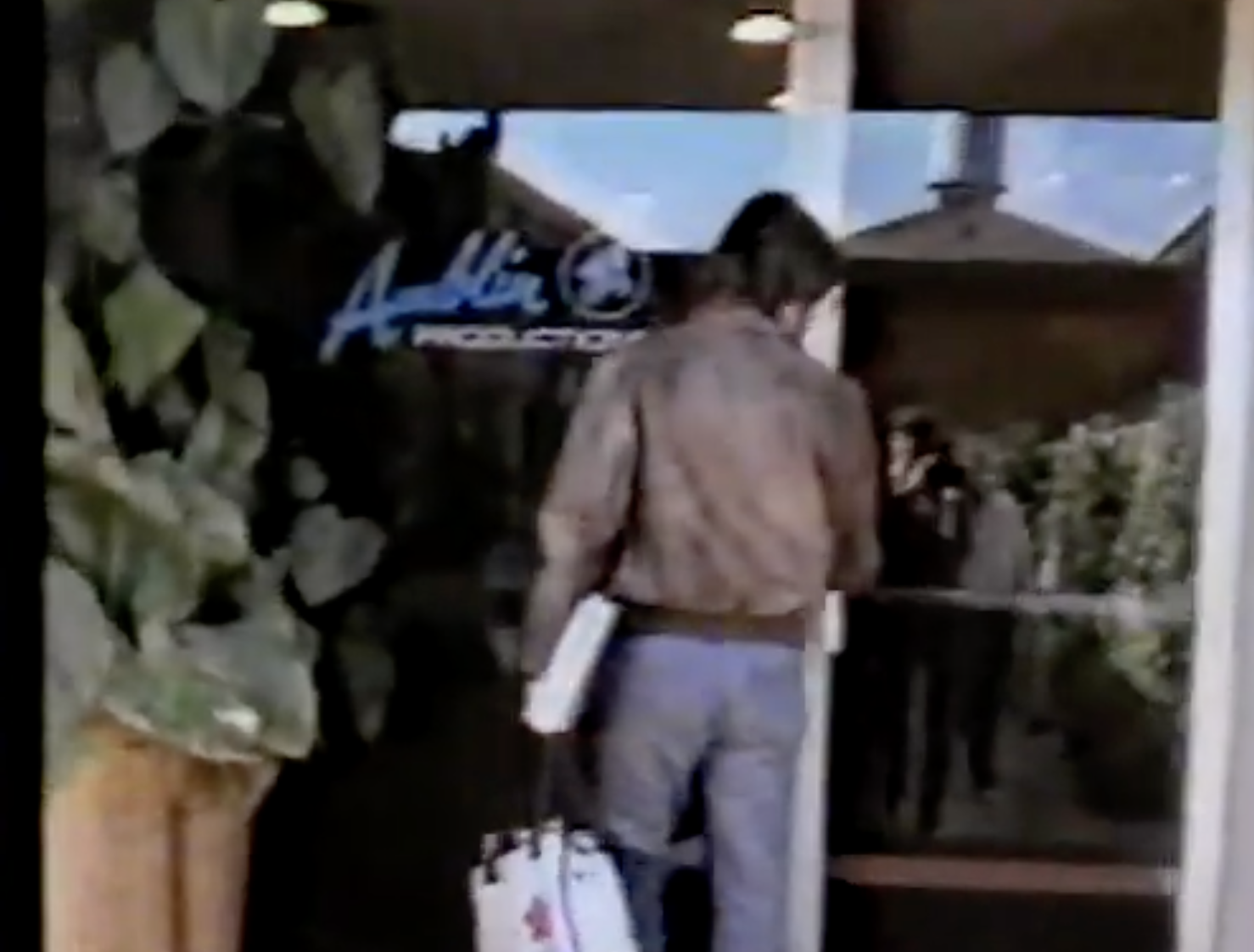
Spielberg’s first production entity was Amblin’ Productions, Inc. (incorporated December 17th, 1970; California entity no. 613679), named after the short film he’d just produced at the time. Spielberg would continue to use this as his personal loan-out company through 1980. During this time he produced the Gale and Zemeckis movie, I Wanna Hold Your Hand (1978), as “Steven Spielberg Presents.” (He also produced Zemeckis’s Used Cars (1980) but without a presentation credit.)
After the incorporation of Amblin’ Entertainment, Inc. on April 1st, 1980 (California entity no. 955752), Spielberg produced Continental Divide (1981) as “an AMBLIN Production,” but this was a one-off, with “Amblin Entertainment Presents” occurring only once or twice through to the ’90s.
Poltergeist (1982) is “A Steven Spielberg Production.” E.T. (1982) is “A Steven Spielberg Film,” and The Goonies (1985) is a “Steven Spielberg Presents.”
By the mid-eighties, Amblin had established a two-tier product line: “Steven Spielberg Presents,” (for works not directed by Spielberg) and “A Steven Spielberg Film” (for works directed by Spielberg).
As well, it’s possible Twilight Zone was initially conceived by Spielberg as a potential franchise.
Ted Ashley, who was Serling’s agent at the time that the writer created The Twilight Zone, had graduated to the position of chairman of the board at Warner Bros. Following the success of Star Wars, Close Encounters of the Third Kind, and Alien in the late seventies, Ashley decided the time was right to create a big-screen fantasy built around the concept of The Twilight Zone. Star Trek, another TV show that had a fanatical cult following, was being turned into a whole series of feature films. Ashley imagined the same future for Twilight Zone.
“Before the accident, everyone was talking about sequels, and that idea was forgotten.”
#03n. “8:00 or 8:30pm”
In Landis’s testimony (Feb. 1987), he reported that on or around Friday, July 9th, 1982, a second meeting took place at his offices on the Universal Studios lot. Present were Marshall, Landis himself, Folsey, and Allingham. He stated that the first meeting—approximately Tuesday, July 6th—had centered on Marshall’s question about whether it would be possible to obtain waivers for young children to work past 6:30pm, which Marshall acknowledged was the legal cut-off. The defendants say Marshall told them he would have his colleague, Kathleen Kennedy, call the Division of Labor Standards Enforcement (DLSE) to inquire.
At the second meeting, the defendants say Marshall informed them that waivers could only be obtained until “8:00 or 8:30 p.m.” (James Neal’s opening statement; Landis’s testimony).
However, Colleen Logan, Area Administrator for the DLSE, testified that the board’s policy at that time was—more or less uniformly—to grant extensions until exactly 10:00pm, when requested
If the defendants’ account of the “8:00 or 8:30 p.m.” restriction is accurate, then where did Marshall get that timeframe? Did he actually have Kennedy—or anyone—call the DLSE?
If not, why not?
Is it possible that Marshall, given his experience as a producer, already knew waivers were unlikely to be granted—not because of the late hour, but due to the children’s proximity to dangerous practical effects? If so, any call to the DLSE would have drawn unwanted attention to the production and been clearly ill-advised. But then, why would Marshall present the issue to the defendants as one of scheduling rather than safety?
The point is that if the defendants were genuinely naïve or deferential to Marshall’s expertise, he may have misrepresented the obstacle as a matter of timing rather than danger—thus downplaying to them the seriousness of the subsequent illegal hiring.
To what end? On whose suggestion?
#04n. A semantic misunderstanding?
Chain claims the existence of a series of interdepartmental Warner Bros. memos detailing interviews with key figures involved in the production on the Warner Bros. side in the days after the accident, including Lucy Fisher and Frank Marshall.
If the authenticity of these memos is accepted, it means that Lucy Fisher told Warner Bros. lawyers that she had specifically asked both Landis and Marshall whether the children newly added to the script would be “a problem,” and both men assured her that it would not. She let them know that, if asked, she would deny any knowledge of the matter.
Marshall, for his part, allegedly told Warner Bros. lawyers that he had no idea what Folsey Jr.’s “personal cash advance” cheque was for, having assumed it was going to be used for its stated purposes. In his recounting of an early July meeting at Landis’s Universal Studios compound (he remembered just one, not two), he had told Landis, Folsey, and Allingham that it would not be possible to use young children later than 8:30. Instead, he suggested, they should pursue waivers to hire 12-year-olds who look young, which he assumed they did for the shots in which Marshall saw the children prior to the 2:20am shot.
Marshall said that for that shot in particular, he was under the impression that dummies were going to be used. This was because at that same meeting, when he told Allingham to “forget about” the possibility of using children legally, Allingham said it wouldn’t be a problem because it would be a “long shot.” What Marshall could have understood by that was “we will be far away so we can use dummies without the spectator being aware,” but what Allingham meant was, “we can put Morrow and the kids further away from the explosions than it will appear on the screen so it will be safer than it looks on film.”
The devil is in the details, however, and the question remains: why did Marshall, with his experience, think it appropriate even for 12-year-olds to be in the conditions he witnessed Myca and Renee in?
Even if the memo were spurious, it at least provides a possible alternative explanation to the narrative of Landis et al.—that Marshall in particular, and the filmmakers more generally, successfully pursued a strategy of avoidance.
As well, Marshall implied the use of the children in the final shot, but not the 9:30pm shot, was the possible result of a semantic misunderstanding between him and Allingham during their second meeting in early July.
Could it explain the whole tragedy?
#05n. The peculiar testimony of Edward Morey
Morey on Spielberg
DA (GK): Who represented the John Landis production staff at those meetings?
EM: The executive producer Frank Marshall; the associate producer George Folsey Jr.; the production manager Dan Allingham; I think Bonnie Radford was there. Landis wasn’t at those meets. Never met him.
DA: Was it your understanding that Frank Marshall was simply lending his name to this production, but in essence the individuals who were running the show so to speak were John Landis and George Folsey?
EM: Yes, I think Frank Marshall was really representing Steven Spielberg.
#06n. 11:30pm–2:20am: Testimony and forensics
Given the voluminous technical details pertinent to the beleaguered investigators, “what exactly happened,” in terms of the intended flight path of the helicopter, various technical cues, and so on, remained improperly understood. The disambiguation was greatly advanced in 2021 by Chain.
The FBI and Sheriff’s Dept established fairly early on that the fourth blast fired that night was the one that destroyed the helicopter’s tail rotor. This was the one that came through the “fish-drying hut.” The question became: who cued that blast?
There were two main candidates, each operating wired firing boards at a distance: SFX man Jerry Williams, and SFX man James Camomile. Camomile had been granted immunity for his cooperation early in the investigation. Williams was standing beside Landis; Camomile was standing off somewhere else. This had not been properly disambiguated at the time; though retrospective forensics determined it was Williams
Braun had favoured the “delamination theory”: that not debris, but intense heat had destroyed the tail rotor, creating a lack of precedent. But Neal sensed accurately that the disorganization abounding in the case meant almost anything would do.
The defence maintained that the helicopter had been intending to cross to the opposite shore before explosives went off destroying the village. But the helicopter was a character in the story, not just a technical platform.
Camomile—who wasn’t facing charges—was compelled by the defence (including SFX chief Paul Stewart) to admit he was the one to have fired the lethal explosive, without having looked up at the helicopter placement first. This let Williams—and Landis—off the hook.
Had the helicopter intentionally been called “lower, lower, lower,” for artistic effect vis-à-vis the fish-drying hut? Recreating the effect from The Exterminator (1980)?
#07n. “Fly by Night”

Allingham presented himself to prospective helicopter pilot Clay Wright as working for “Fly by Night”
#08n. Steve Williams
Steve Williams resists the emphasis on Tippett’s “extinction” narrative. Williams had been Animation Supervisor on The Abyss and Terminator 2, and now, despite single-handedly redeeming the prospect of seamless CGI for Jurassic Park, that role was given to Tippett. “Kathleen Kennedy pats me on the back and goes, ‘You have a very bright future.’ And that was that. That was the first and only time I ever met her. I never saw her again.”
#09n. Steve Starkey
Steven Starkey had been an editor at ILM assigned to edit a promotional documentary for Frank Marshall: The Making of Raiders of the Lost Ark. He would go on to edit The Making of Poltergeist and The Making of Indiana Jones and the Temple of Doom, before moving into the Amblin bungalow on the Universal lot, where he was encouraged to pivot to Associate Producer by Frank Marshall, who became his “mentor.” Starkey was hired on to Jurassic Park in September 1990, when he was put in charge of preparing a budget and a production plan in coordination with Carter. They had previously worked together on Amazing Stories and Back to the Future Part II and III. Their first budget was too expensive for Spielberg, so they began to make script revisions. Eventually, Steve Starkey turned these into a 3-page document that allowed Spielberg to greenlight the budget. But once Hook started, Starkey was put onto other projects (he’d initially felt “jilted” when his contribution had been minimized, but was quickly offered the role of Producer on Death Becomes Her). Carter and Starkey’s work would eventually become Carter’s draft, following a parallel evolution from Crichton’s first draft; but then incorporating the changes Spielberg liked from Crichton’s second along with ideas brainstormed a few days later. Carter knew Crichton personally and had been in touch with him to keep apprised of story developments. He’d also submitted several story memos of his own. Although Tom Stoppard (Empire of the Sun, 1987) was being considered, Carter knew Marmo was also in the conversation but was concerned that she was going to (or did, eventually) take the story down “the wrong path.” The existence of Carter’s draft was only uncovered in 2020 by Derrick Davis. He turned it into an illustrated audio drama, imagining Carter’s version brought to life, in which he combined the script and story memos with his collection of rare and unreleased concept art and storyboards, including an entire binder that had belonged to Tippett.
#10n. Citizen Steve (December 1987)
“...First he worked on my dolls. He’d act out a Jack LaLanne scene, an exercise story, and then he’d rip their legs off, throw them against the wall, and beat them up until all the stuffing came out.” (Citizen Steve)
“We have a daughter, Janice, and he tore the head off her Barbie doll.” (Citizen Steve)
“I remember being totally scared of him,” says Janice Zusman, who lived in the house behind the Spielbergs. “One time Susie and I were playing Barbie dolls by the canal near our house, on Indian School Road. I would have been grounded for life if my parents knew I’d even gone near the canal. We were pretending it was the Grand Canyon. Steve was bugging us and teasing us: ‘If you don’t do whatever’—unfortunately, I don’t remember what it was he wanted us to do—‘then I’m going to throw your Barbie into the canal.’ He grabbed my Barbie doll and yanked the head off and threw it into the canal. The most important thing in my life was this Barbie doll! It was so traumatic I’ve been talking about it ever since. The worst thing was that I couldn’t tell my folks, so I had to go down and fish the head out of the canal.”
Did the Barbie doll symbol hold any personal significance to the filmmaker, any at all, or was it just another shared relic of a bygone era?
ACKNOWLEDGEMENTS
Gracious contributors, patient friends; my family; and Julia Phillips, who said it all first.